
BRIN cross-agency collaboration launches book on climate change
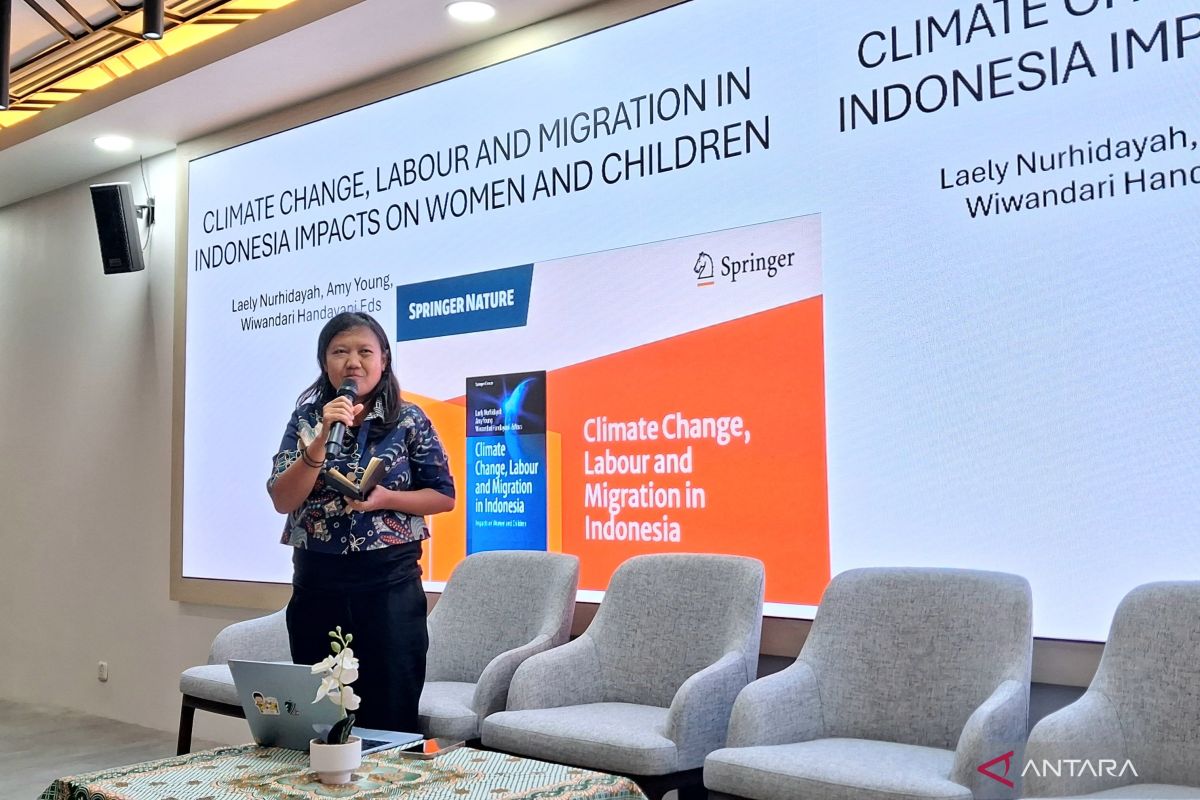
Jakarta, Indonesia — The National Research and Innovation Agency (BRIN), in collaboration with Griffith University, Australia, and Diponegoro University in Central Java, launched a book titled Climate Change, Labour and Migration in Indonesia. The volume gathers studies on women and children who are among the most vulnerable to climate change, particularly in the coastal areas of Java Island—the Special Capital Region of Jakarta, Semarang, Pekalongan, and Demak. ‘This book emphasises that climate change is a cross‑sector challenge encompassing political economy, socio‑economic dimensions, and migration, which can be addressed by strengthening the agricultural sector and community structures at the domestic level, especially for women and children who often bear a double burden in climate resilience,’ said Acting Head of BRIN’s Social Sciences and Humanities Research Organisation (OR IPSH), Muhammad Najib Azca, in Jakarta on Tuesday. The book also surveys major climate change challenges, including land subsidence, tidal flooding, rising temperatures, economic decline, inadequate sanitation, water supply and wastewater issues, disease, and migration and relocation, including during floods, which can trigger unfulfilled community rights. ‘We hope to enrich economic discussions and produce policy recommendations that are relevant, with research serving as a basis for decision making, while encouraging all parties to actively participate in strengthening sustainable collaboration,’ Najib added. The studies also found that 80 per cent of women reported significant income declines due to floods, sea‑level rise, and land subsidence. In addition, attention to fulfilling basic child rights such as access to education, health, nutrition, and protection becomes increasingly important to ensure better recovery capacity when disasters strike. ‘One recommendation we have formulated in this research is to revise Law No. 24/2007 on Disaster Management to classify systematic literature reviews and land subsidence as disasters and to include climate‑adaptive social protection,’ said Laely. Meanwhile, Franky Zamzani, Director of Climate Change Adaptation at the Deputy for Climate Change Control and Carbon Economy Governance in the Ministry of Environment and Forestry (KLH), reminded of the importance of strengthening climate adaptation actions in facing increasingly complex climate challenges and their broad socio‑economic impacts, particularly with rising vulnerability. ‘Mitigation and adaptation efforts must go hand in hand. Indonesia continues to strengthen its commitments through the National Adaptation Plan (RAN) to integrate climate resilience into development planning across sectors and levels of government. However, the adaptation process also needs to be supported by a robust understanding of the conditions of communities directly affected,’ he said. According to Franky, the book can deepen climate discussions beyond statistics and policy language, offering human experiences to help the public understand that climate change is not only an environmental issue but also a social, economic, and human rights issue.