
BRIN Chief: CNG Gas Cylinders to Be Trialled with Fried-Snack Vendors in Early 2027
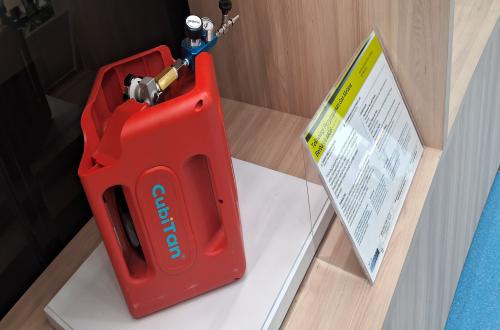
JAKARTA — National Research and Innovation Agency (BRIN) chief Prof Arif Satria said research into methane gas in three-kilogram cylinders was 80 per cent complete. The gas is intended to replace the subsidised three-kilogram LPG cylinders currently in circulation. Switching from LPG to methane, or natural gas, could reduce energy subsidy spending in the state budget.
“The research is 80 per cent complete, and it could be launched early next year,” Arif told Republika on Tuesday (10 November 2026). He added that the planned launch would not be for mass consumption, but for a limited public trial.
“It is planned to be trialled with fried-snack vendors,” Arif said. He claimed the methane gas would be more economical than LPG. Asked how much could be saved, he said: “If one LPG cylinder lasts 10 days, this gas could last 20 to 25 days.”
The 2026 state budget allocates Rp103.5 trillion for subsidies for three-kilogram LPG cylinders, down from the proposed Rp143 trillion. LPG has to be imported, while natural gas, or methane, is widely available domestically and is generally supplied through piped-gas networks.
In a video released by BRIN on Monday (9 November 2026), Joddy Arya Laksomono, a researcher at BRIN’s Polymer Technology Research Centre, showed the red methane-gas cylinder. The gas is compressed natural gas (CNG). Joddy said the cylinder-development research focused on creating a storage system that is safe, efficient, durable and suited to users’ needs.
One challenge in developing CNG, Joddy said, is the pressure inside the cylinder. Unlike low-pressure LPG, CNG is stored at a very high pressure of 200 bar, which poses safety concerns for everyday use. BRIN researchers are therefore working to lower the pressure to match LPG’s 30 bar.
Joddy added that BRIN is collaborating with Japanese companies Atomis and Iachio, under the supervision of Nobel laureate Susumu Kitagawa of Kyoto University. Kitagawa is developing a carbon-fibre-based polymer composite intended to make the gas cylinder lighter.
“Another issue is how to create the conditions inside the cylinder, which will be filled with MOF (metal-organic framework), a neutral material that does not react,” Joddy said. MOF is a sponge-like material with pores whose combined surface area is equivalent to several sports fields. It will be used to store methane and reduce its pressure.
Source: jawawa.id (https://jawawa.id/newsitem/brin-chief-cng-gas-cylinders-to-be-trialled-with-fried-snack-vendors-in-early-2027-1794322241)
Originally published by Republika (https://ekonomi.republika.co.id/berita/toagp5475/kepala-brin-tabung-gas-cng-siap-diujicoba-awal-2027-ke-tukang-gorengan), translated from Indonesian