
BRIN and UIN Ar-Raniry Develop Conservation Model for Manuscripts Affected by Disasters
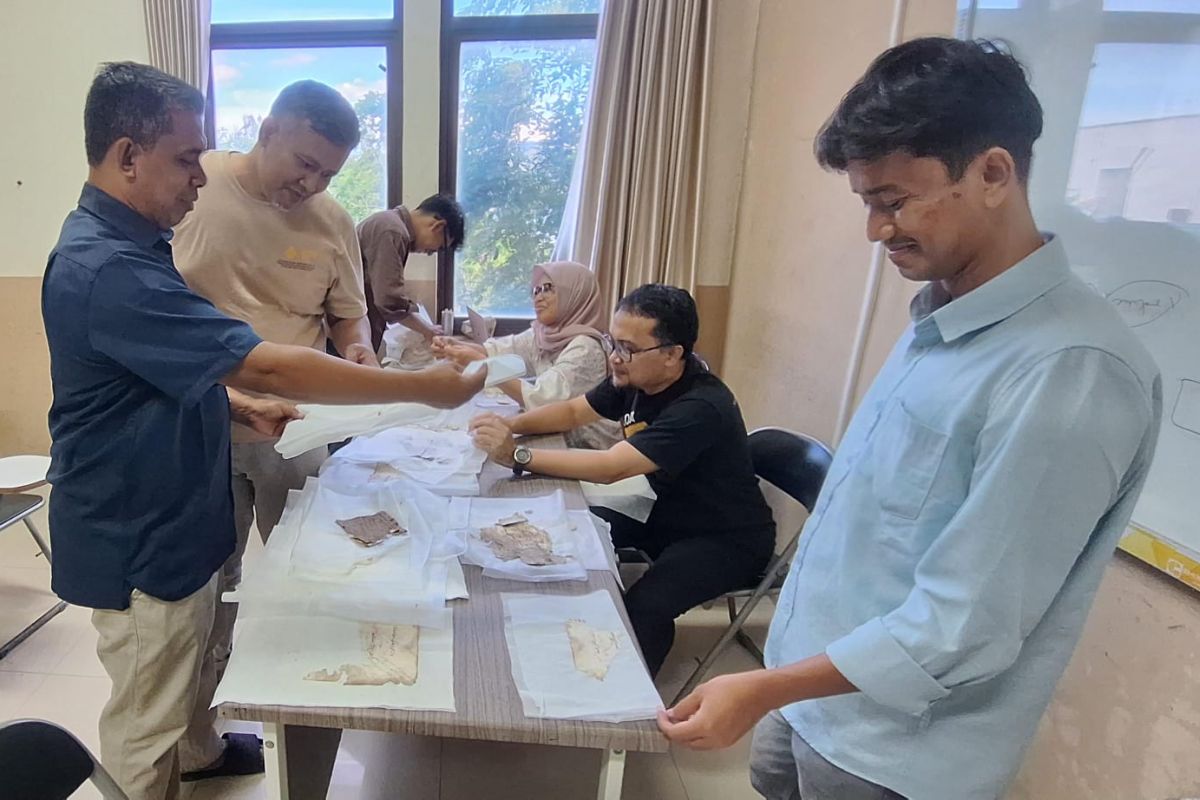
The National Research and Innovation Agency (BRIN), in collaboration with UIN Ar-Raniry Banda Aceh, is developing a conservation model for manuscripts affected by floods and landslides in several regions of Aceh, targeted for implementation by the end of 2025.
“The model is designed to be portable, modular, low-cost, and can be applied in situ in areas prone to hydrological disasters,” said Husnul Fahimah Ilyas, Head of the Research Team at BRIN’s Centre for Research on Manuscripts, Literature, and Oral Traditions, in Banda Aceh on Sunday.
She explained that the development of this conservation model is being conducted through collaborative research involving BRIN, the Nusantara Manuscript Society (Manassa), the National Library of Indonesia (Perpusnas), and the Faculty of Adab and Humanities (FAH) at UIN Ar-Raniry.
She noted that the research focuses not only on the physical rescue of manuscripts but also on developing disaster risk management to protect documentary heritage from hydrometeorological threats.
The research aims to develop a conservation model for manuscripts affected by flooding using a manual knockdown drying method.
Agus Iswanto, a BRIN research team member and General Chairperson of Manassa Pusat, stated that the research is also directed towards producing a model or protocol for hydrological disaster risk management specifically for documentary heritage in the form of manuscripts.
Meanwhile, Aris Riyadi, a Conservator at the National Library, stated that the team is developing a portable drying chamber as a tactical solution to accelerate the rescue process for manuscripts affected by floods.
According to him, the portable chamber can be used directly at the disaster site, making it faster, more efficient, and easier to mobilise compared to the freeze-drying machines currently used in the handling of wet library materials.
Hermansyah, Head of the Manassa Aceh Commission and Vice Dean III for Student Affairs and Cooperation at the Faculty of Adab and Humanities, UIN Ar-Rany, mentioned that based on data collection, at least 520 manuscripts across nine regencies/cities in Aceh were found to be affected by disasters.
“It is hoped that the results of this BRIN research can be utilised in handling manuscripts affected by similar disasters in other locations,” he said.
He added that UIN Ar-Raniry, specifically the Faculty of Adab and Humanities, will be directed to become a Laboratory for Manuscripts or Ancient Scripts as part of strengthening its academic function and the preservation of Acehnese manuscripts.
AS Rakhmad Idris, a researcher from BRIN’s Deputy for Development Policy, stated that the research results need to be reinforced with policy documents so that the developed conservation model can be implemented more widely.
“Policy documents are necessary to provide essential analysis and recommendations to policymakers regarding how the conservation of manuscripts affected by hydrological disasters should be conducted,” he said.