
Brilliant! UMY Students Turn Golden Apple Snail Pest into Fertiliser
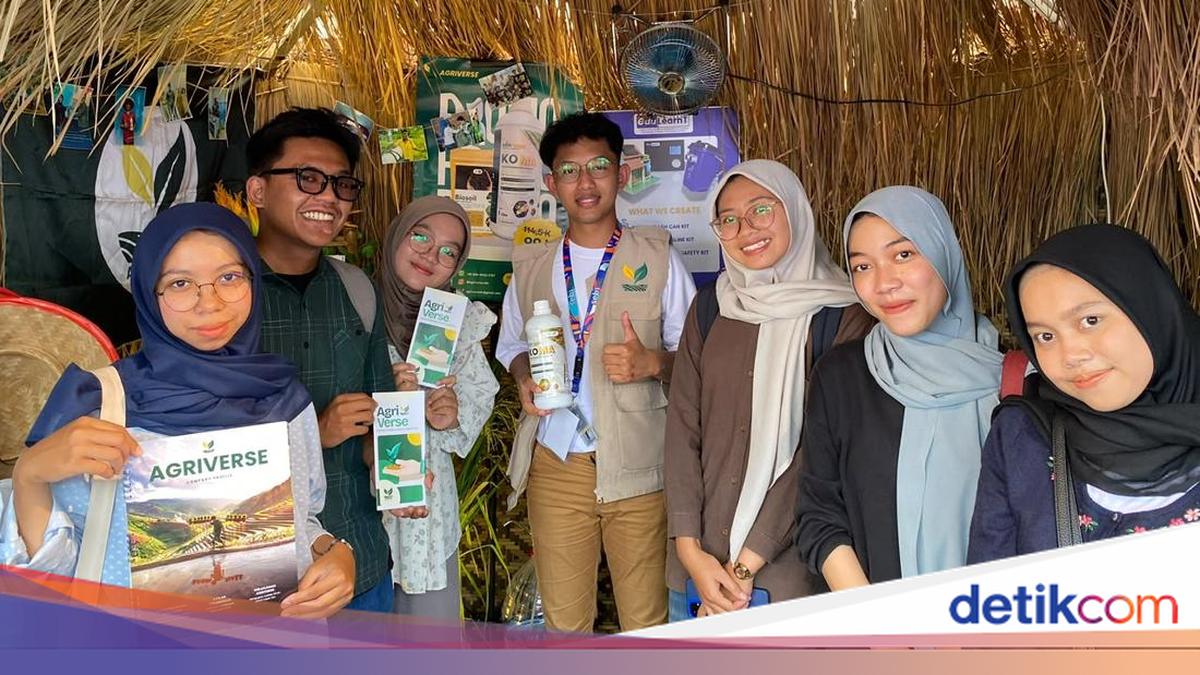
Students at Universitas Muhammadiyah Yogyakarta (UMY) have developed a liquid organic fertiliser made from golden apple snails. The product originated from farmers’ frustrations with the golden apple snail pest.
The fertiliser innovation is called Agriverse. The golden apple snail, usually the enemy of farmers, is processed into a biofertiliser containing microorganisms that can significantly boost land productivity.
“So the idea emerged from the problems faced by rice farmers, particularly the golden apple snail pest. We previously took part in UMY’s Vessel SEBI programme. Our team already had this idea and developed it further through that programme,” said Agriverse founder and CEO Arif Reksa Pambudi, when contacted by detikJogja on Tuesday (15/9/2026).
Arif explained that the frustration stemmed from the problems faced by rice farmers in his area. One of the most problematic pests is the golden apple snail.
“Rice farmers in particular. The most feared pest for rice in our area is the golden apple snail. So that’s where we started,” he revealed.
Through the Vessel SEBI UMY programme, Arif said his team received funding as well as mentoring, ranging from idea brainstorming, building a cross-disciplinary team, drawing up a roadmap and drafting standard operating procedures.
“There we were funded and given mentoring, starting with brainstorming ideas, then there was team recruitment from various multidisciplinary fields. For example, our CFO is from accounting, the COO is from agriculture, then there’s someone from Information Systems, and so on. Then there was roadmap creation, SOP drafting and so on. All of that was facilitated by SEBI,” he explained.
Arif said the team also conducted field trials. The trials were carried out in two villages, while the developed product has also been distributed to farmers through the Yogyakarta Millennial Farmers Communication Forum.
“For the trial villages, we were in two villages. But for what we’ve distributed, it has spread everywhere — quite a lot, because we distributed it through the Yogyakarta Millennial Farmers Communication Forum,” he said.
Furthermore, the use of Agriverse expanded after trials were conducted on farmland in Sleman and Magelang regencies. The product was also developed together with a fertiliser formulator in Sleman.
“After the fertiliser trials were done, we collaborated with a fertiliser formulator, one of the fertiliser formulators in Sleman,” Arif said.
The International Law student said he has empowered more than 200 farmers through the development of Agriverse. This impact has made their innovation begin to attract attention from various parties, including local governments.
“Because I personally have empowered more than 200 farmers, it started to boom, grow and become well-known everywhere. Local government agencies have also taken notice,” he said.
Agriverse itself comes in two types of fertiliser: vegetative and regenerative. The vegetative fertiliser is used from planting through to the middle growth phase, while the regenerative fertiliser is used until the plant bears fruit.
“We have a regenerative fertiliser and a vegetative fertiliser. The vegetative one is from planting until the middle, roughly the middle of the growth phase. The regenerative one is until fruiting. That’s what sets them apart,” he explained.
The development of Agriverse has also led the team to enter various competitions. One of them was the International Lean Canvas Competition ISCOMBUS, which they won.
“Yes, that’s right (we won the International Lean Canvas Competition ISCOMBUS), because our impact has been significant, and we’ve also received support from local governments and community figures,” he said.
Arif revealed the challenges of taking part in the international competition, such as the pitching process and question-and-answer sessions that had to be conducted in English.
“The struggle was tough because we had to pitch, prepare the pitch, then create the pitch deck in English. The question-and-answer session was also in English,” he revealed.
“Participants came from several countries. But those who made it to the final were from Indonesia and Malaysia,” he added.
Going forward, Arif hopes that support for student entrepreneurs can continue to be strengthened. He hopes funding and mentoring for students can be sustained so that more young entrepreneurs emerge from universities.
“The hope is that it can keep growing, that funding can continue to be distributed to students, and that the beneficiaries can grow even bigger with greater support for the development of young entrepreneurs at UMY,” he concluded.