
Bridging Data and Financing: A New Strategy for Upgrading MSMEs in Southeast Sulawesi
Southeast Sulawesi’s economic growth has posted an impressive green report card. In the first quarter of 2026, the province’s economy grew by 6.23 percent year-on-year, surpassing the national economic growth rate.
At the same time, the flow of digitalisation continues to surge. Reports note that QRIS merchants in Southeast Sulawesi have exceeded 200,000 and grown by more than 36 percent.
On paper, these macro figures are a source of pride. However, if we go down to the field, a critical question awaits an answer: does the high rate of digital payment adoption automatically make it easier for micro, small, and medium enterprise (MSME) players to obtain business capital?
The reality is that there is a real gap between being ‘digitalised’ and being ‘funded’. Having an active digital payment channel does not necessarily guarantee that an MSME can access productive credit.
This irony is even more visible in our Islamic finance sector, where financial literacy has reached more than 43 percent, yet the inclusion rate has only touched 13 percent.
Digitalisation programmes so far have generally focused more on chasing quantity indicators, such as the number of users or transaction volume. This is indeed important as a first step, but now is the time to shift the focus from mere digital adoption towards economic impact.
We must ensure that the digital activity footprint of MSMEs does not merely settle into a pile of transaction data, but can be ‘translated’ into business feasibility information that leads to the disbursement of financing.
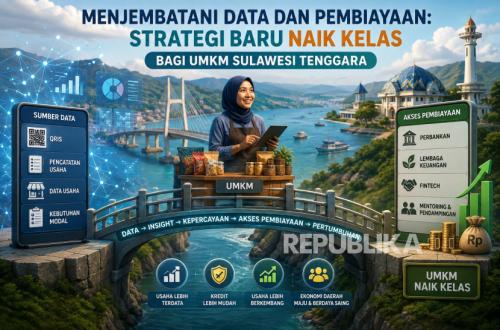
To answer this challenge, Southeast Sulawesi needs an ecosystem orchestration that we can call the ‘MSME Data–Financing Bridge’.
This concept differs from a mere automated credit scoring application. The Data–Financing Bridge is an integrated mechanism that strings together seven crucial stages: from business identity verification, valid turnover recording, MSME consent for data use, to ‘business matching’ with the most appropriate financing institutions and products—whether conventional or sharia.
More than just sharing data, this model emphasises protection and mentoring. MSMEs are not simply thrown at financial institutions, but are accompanied so that they understand the contracts, risks, and their rights.
Thus, the decision to take financing is an educated decision, not a decision that ends in over-indebtedness.
To measure its success, we can begin to abandon conventional metrics and switch to using the Digital-to-Financing Conversion Ratio (RKP).
RKP will concretely measure how many MSMEs that previously only used digital transactions have now truly succeeded in obtaining capital injections for business expansion.
Of course, an idea of this scale cannot be executed instantly. As a first step, the regional government, Bank Indonesia, the Financial Services Authority (OJK), and payment service providers can synergise to launch a 12-month pilot project in three pilot zones: urban areas, production centres, and island regions in Southeast Sulawesi.
In the end, digitalisation is not merely about how sophisticated the technology we use is. Digitalisation is a tool to realise a Southeast Sulawesi economic ecosystem that is inclusive, independent, and globally competitive.
Our ultimate goal is not to create more data flows, but to ensure that more Southeast Sulawesi MSMEs get the opportunity to grow in an empowered and sustainable manner.