
BRICS Expands Indonesia's Economic Horizons
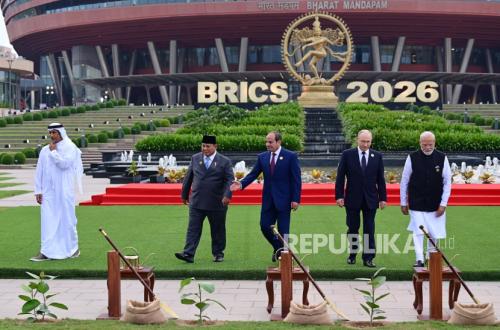
An economist from Mulawarman University, Aji Sofyan Efendi, believes that Indonesia’s membership in the BRICS group of nations can strengthen the national economy, both in terms of market expansion, alternative sources of financing, and enhancing Indonesia’s bargaining position on the global stage.
“This membership opens access to much broader new markets. So far, Indonesian exports have relied on the United States, Europe, Japan, and the ASEAN region,” said Aji Sofyan Efendi in Samarinda, East Kalimantan, on Monday.
According to him, with Indonesia’s joining, trade opportunities are now opening to Brazil, Russia, India, China, South Africa, and other BRICS member states.
These opportunities become increasingly relevant as Indonesia begins to involve itself fully in the BRICS economic and financial agenda. Bank Indonesia reported on Friday, 11 September 2026, that Indonesia attended the Meeting of BRICS Finance Ministers and Central Bank Governors in Mumbai, India, on 9–10 September 2026, which discussed strengthening the use of local currencies, cross-border payment connectivity, digital transformation, artificial intelligence, and the reform of the global financial architecture.
In that meeting, Indonesia was represented by the Governor of Bank Indonesia, Destry Damayanti, and the Deputy Finance Minister, Juda Agung. Bank Indonesia stated that BRICS nations agreed to strengthen economic and financial cooperation to increase resilience against global uncertainty and economic fragmentation.
Data from the Central Bureau of Statistics shows that trade relations are beginning to strengthen. Indonesian exports to Africa reached 2.4 per cent in 2024, illustrating that relations with the region have developed even before Indonesia officially joined BRICS. Meanwhile, imports from Brazil rose by 17.95 per cent, and exports to Brazil increased by 7.71 per cent in 2025.
“Indonesian MSME products, palm oil, nickel, and furniture now have a more diverse market showcase,” said Aji Sofyan.
Brazil’s potential serves as a prime example of the vast trade space that remains to be tapped. During the state visit of Brazilian President Luiz Inácio Lula da Silva to Indonesia in October 20cap 2025, the Brazilian government noted that trade between the two nations had more than tripled over two decades to approximately 6.5 billion USD, yet the value is still considered disproportionate to the size of both economies.
BRICS is an economic and geopolitical cooperation that currently consists of 10 full member states: Brazil, Russia, India, China, South Africa, Egypt, Ethiopia, Iran, the United Arab Emirates, and Indonesia. Indonesia was officially announced as a full member of BRICS on 6 January 2025 and has since begun participating in various strategic agendas of the group.
Indonesia’s entry also expands BRICS’ position as a representative of developing nations, or the Global South. For Jakarta, the forum is not only related to trade but also opens space to influence discussions on the reform of international financial institutions, sustainable development, and global economic governance.
This was evident in the meeting in Mumbai in September 2026. BRICS nations agreed on the importance of reforming the governance of the International Monetary Fund (IMF) so that the voice and representation of developing nations become stronger, an agenda that aligns with Indonesia’s interests as one of the largest emerging economies.
Beyond markets, the presence of the New Development Bank (NDB) provides an option for development financing outside the multilateral financial institutions that have traditionally been dominant. On 25 March 2025, President Prabowo Subianto announced Indonesia’s decision to join the NDB after the government evaluated the invitation and the requirements offered by the development bank.
The NDB itself identifies infrastructure, digital connectivity, energy transition, renewable energy, urban modernisation, clean water, sanitation, education, health, and poverty reduction as potential areas of cooperation with Indonesia. NDB President Dilma Rousseff, in her meeting with Prabovi on 25 March 2025, stated that these priorities align closely with Indonesia’s 2025–2045 development agenda.
This funding has the potential to be utilised to accelerate infrastructure and energy development, including various national strategic projects. In the context of East Kalimantan, development financing opportunities are also relevant to the infrastructure needs and regional development related to the Nusantara Capital City.
However, funding opportunities must still be calculated based on project feasibility, financing burdens, and long-term economic benefits. Membership in international forums or access to new financing institutions does not, in itself, guarantee that investment will flow without project readiness and regulatory certainty within the country.
Source: jawawa.id (https://jawawa.id/newsitem/brics-expands-indonesias-economic-horizons-1789365385)
Originally published by Republika (https://news.republika.co.id/berita/tlc4wr451/brics-perluas-ruang-gerak-ekonomi-indonesia), translated from Indonesian