
BRICS Cooperation Opens Opportunities for Accelerating Agricultural Modernisation and Strengthening National Food Security
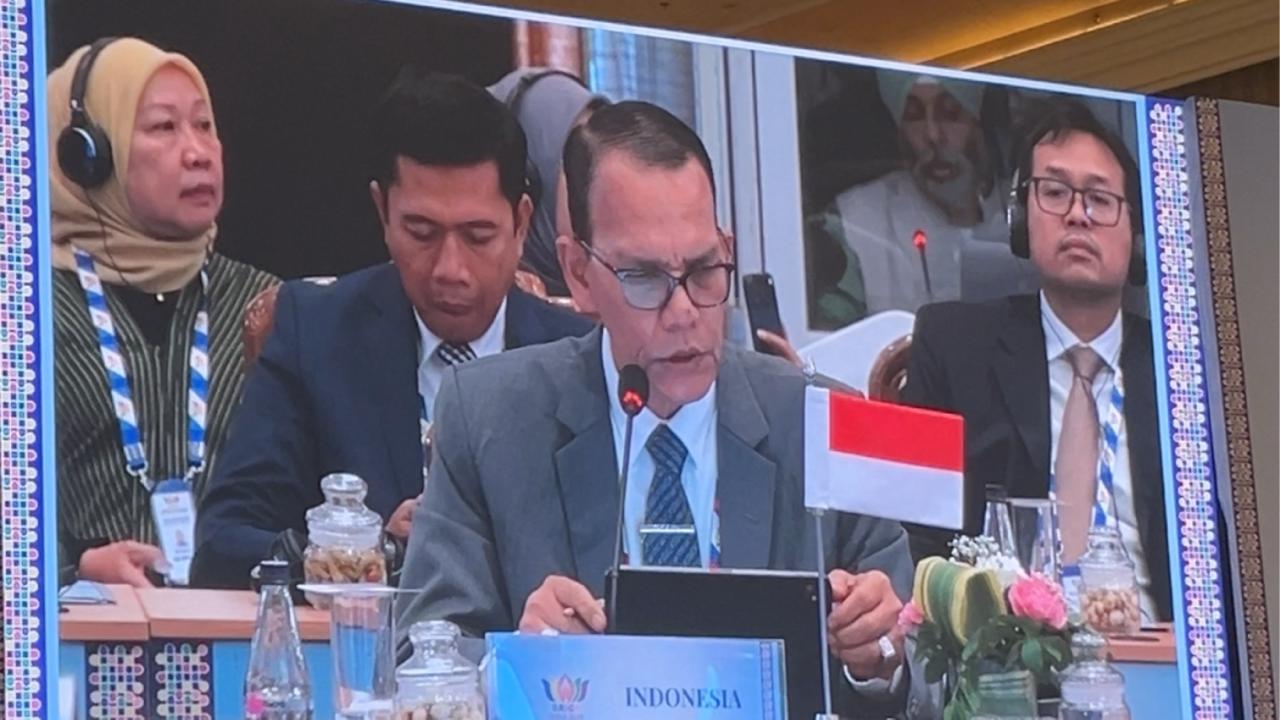
Cooperation among BRICS nations opens strategic opportunities for Indonesia to strengthen national food security through the acceleration of agricultural modernisation, increased productivity, and the development of sustainable farming systems. This commitment emerged during the BRICS Agriculture Ministers’ Meeting under India’s 2026 Presidency, held in Indore, India, on 12–13 June 2026.
The meeting, themed ‘Building for Resilience, Innovation, Cooperation, and Sustainability’, produced a Joint Declaration affirming the commitment of BRICS countries to strengthen global food security, improve the welfare of smallholder farmers, women, and the younger generation, and expand cooperation in innovation, technology, trade, and sustainable agricultural development.
The Indonesian delegation was led by the Acting Director General of Plantations, Ali Jamil, representing the Minister of Agriculture of the Republic of Indonesia. At the forum, Indonesia expressed its support for strengthening cooperation in seed systems, agricultural production inputs, plant genetic resources, and digital agriculture.
‘Indonesia greatly appreciates this BRICS Agriculture Ministers’ Meeting as an important platform to strengthen cooperation towards resilient, inclusive, and sustainable agricultural and food systems,’ said Ali Jamil.
According to him, Indonesia also encourages stronger cooperation in seed systems, agricultural production inputs, plant genetic resources, and digital agriculture to support the transformation of the agricultural sector into one that is more modern and sustainable. Additionally, Indonesia stressed the importance of farmers’ roles in preserving agricultural biodiversity and the sustainability of food systems.
For Indonesia, the outcomes of this meeting open various strategic opportunities, including the expansion of research, innovation, and technology transfer cooperation through the BRICS Agricultural Research Platform (BARP), as well as strengthened collaboration in seeds, genetic resources, fertilisers, and agricultural production inputs via BRICS AGRIN to support increased national productivity and food security.
The BRICS Declaration also opens opportunities for enhanced cooperation in digital agriculture, artificial intelligence (AI), satellite-based agricultural monitoring, and digital extension services to support agricultural modernisation. Furthermore, there are opportunities for cooperation in developing livestock technology, feed, animal health, fisheries and aquaculture, as well as improving post-harvest capacity, storage, cold chain systems, and reducing food loss to increase added value and farmers’ incomes.
BRICS countries also encourage strengthened cooperation in food safety, sanitary and phytosanitary (SPS) standards and measures, and digital certification. This cooperation has the potential to support improved market access and the competitiveness of Indonesian agricultural products in international markets.
In addition, BRICS agreed to strengthen cooperation in climate-resilient agriculture, agroecology, and regenerative farming. The declaration also opens up the potential utilisation of various development financing schemes, including through the New Development Bank (NDB), to support sustainable agricultural investment in member countries.
On the sidelines of the meeting, the Indonesian delegation also held bilateral meetings with delegations from South Africa and India. Indonesia and South Africa agreed to strengthen technical cooperation to improve quality and food safety standards and facilitate market access for the two countries’ leading agricultural commodities. Both parties also encouraged the acceleration of the finalisation of a Memorandum of Understanding (MoU) on Agricultural Cooperation to be signed by the Agriculture Ministers of both countries.
Meanwhile, Indonesia and India discussed potential cooperation in the supply of wheat and garlic seeds from India, as well as capacity building programmes to support increased domestic production and the development of strategic national commodities. The two countries also explored collaboration in digital agriculture and the development of downstream gambier processing through capacity building for gambier farmers in Indonesia.
The outcomes of the 2026 BRICS Agriculture Ministers’ Meeting align with the policy direction of the Ministry of Agriculture, which is currently focused on accelerating food self-sufficiency through increased productivity, agricultural modernisation, strengthening production inputs, and the utilisation of innovation and technology. The various cooperation opportunities generated are expected to support the transformation of Indonesia’s agricultural sector into one that is more advanced, efficient, competitive, and sustainable.
On various occasions, Minister of Agriculture Andi Amran Sulaiman has emphasised that agricultural modernisation through technology, mechanisation, and strengthening farmer capacity is key to maintaining national food security amidst the challenges of climate change and global food dynamics.
‘Agricultural modernisation is key to maintaining national food security. We encourage innovation and technology-based agriculture. With technology, productivity increases, the cropping index rises, production costs fall, and farmers’ welfare is boosted,’ stated Minister Amran.
Through BRICS cooperation, Indonesia has the opportunity to expand access to innovation, technology, investment, and markets that can support the acceleration of national agricultural modernisation. This collaboration is expected to make a tangible contribution to achieving food self-sufficiency, improving farmers’ welfare, and strengthening Indonesia’s position as a major agricultural power in the region and the world.