
BRICS, BoP, and the Economic Price of Prabowo's Diplomacy
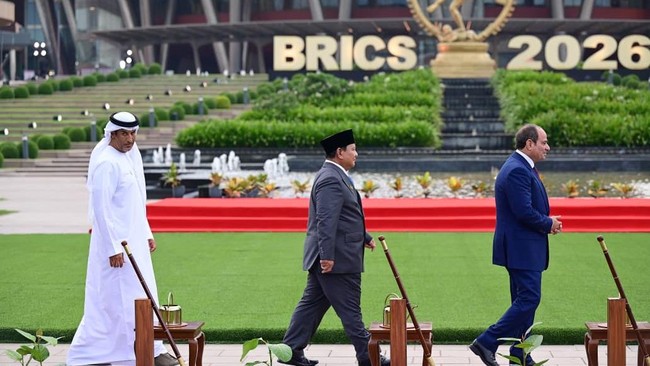
President Prabowo Subianto brought one powerful sentence to the BRICS Summit in New Delhi on 12 September: Indonesia does not like being dictated to by one or two particular powers. That statement sounds very close to the free-active instinct. Indonesia wants to determine its own course, strengthen food and energy resilience, and use BRICS to expand its economic room for manoeuvre.
Yet speeches about sovereignty are always easier to deliver than to measure. Only a few months earlier, Indonesia signed the Board of Peace (BoP) charter led by US President Donald Trump, then declared its full commitment to the plan.
At the same time, Indonesia continues to pursue OECD accession, signed a trade agreement with the United States, deepened economic ties with China, and remains active in BRICS. None of this is automatically contradictory.
The Board of Peace is not a Western alliance, BRICS is not an anti-Western pact, and the OECD is not a geopolitical bloc. Indeed, a country as large as Indonesia genuinely needs to talk and cooperate with many centres of power.
The problem arises when the public is offered only the language of ‘independence’, ‘friendship’ or ‘national interest’ without sufficiently clear measures to assess what Indonesia actually gains from each of these commitments.
Free and Active Is Not Free to Collect Partners
In investing, one is not said to have a strategy simply because one holds many assets. A portfolio only becomes a strategy when the objective, risk, return and exposure limits of each asset are known. Foreign policy ought to be tested with the same discipline.
Indonesia is indeed building a very broad portfolio of relationships. The OECD accession process begun in 2024 requires a deep assessment of Indonesia’s regulations and practices against the organisation’s standards.
In BRICS, Indonesia is pushing the use of local currencies, cross-border payment connectivity, and strengthened energy resilience. With the United States, the government has just reaffirmed the implementation of the reciprocal trade agreement.
Conceptually, this pattern can be read as partial multialignment: Indonesia chooses to work more closely with different powers on different issues, without surrendering its entire strategic orientation to one camp.
Such a strategy makes sense for a middle power seeking to enlarge its options. But having many options is not proof that those options are well managed.
Diversification does not necessarily produce autonomy. If each relationship adds commitments, dependencies and adjustment costs without a clear hierarchy of interests, Indonesia could end up with many doors but increasingly little room to move.
BRICS Must Produce Returns That Can Be Counted
Therefore, Indonesia’s success in BRICS should not be measured by how loudly Jakarta speaks about the Global South. The measure must be more grounded: whether market access increases, transaction costs fall, development financing improves, energy security strengthens, technology transfers, and Indonesian businesses gain new opportunities.
There are concrete openings. At last week’s meeting of BRICS finance ministers and central bank governors, Indonesia pushed local currency transactions, payment connectivity, and an acceleration of Local Currency Transactions with India. This is more meaningful than the family photo of leaders, because its benefits can be tested.
If rupiah-rupee trade genuinely reduces conversion costs and foreign exchange risk for exporters, BRICS is producing value. If payment connectivity stops at the communiqué, its value is far smaller.
The need for such measures matters because Indonesia’s economic structure is already deeply tied to many partners. From January to November 2025, China absorbed around 23.8% of Indonesia’s non-oil exports, the United States 11.5%, and India 6.7%.
Throughout 2025, China was also Indonesia’s largest source of imports, accounting for around 36.2% of all imports. On the investment side, realised foreign direct investment in 2025 reached Rp900.9 trillion; China contributed US$7.5 billion, while Hong Kong contributed US$10.6 billion and Singapore US$17.4 billion.
These figures show why the slogan ‘East or West’ is not much help. Indonesia’s economic interests are already connected to both, but in different forms of dependency.
China is vital for trade, capital goods, downstream processing and supply chains. The United States remains one of the largest export markets, especially for labour-intensive manufactured goods. India is an important market for several commodities as well as a BRICS partner. One relationship cannot replace another merely by political decision.
BoP and the Question of Commitment Limits
The Board of Peace presents a different problem. Indonesia joined for understandable reasons: the government wants to remain relevant in efforts towards Palestinian peace and to have influence over the stabilisation and reconstruction of Gaza.
At the inaugural BoP meeting last February, Prabowo even stated his readiness to send up to 8,000 personnel or more for the International Stabilization Force if required. What needs questioning is not whether Indonesia may cooperate with Trump.
The question is how the national interest, limits of involvement, costs, risks and exit conditions of such a commitment are established. Foreign policy is not sufficiently legitimised by a president’s good intentions alone. The greater the consequences for the budget, reputation, personnel or relations with other countries, the stronger the need for institutional explanation and public evaluation.
Sovereignty Must Also Be Visible at the Negotiating Table
The same logic applies to economic relations with Washington. Under the trade agreement finalised in February 2026, Indonesia committed to removing tariff barriers on more than 99% of US products, while the United States maintains a 19% reciprocal tariff on most Indonesian goods, although a number of products received exemptions.
The US government also cited various Indonesian commitments on non-tariff barriers, including treatment of local content requirements for certain goods. The agreement may offer other benefits, including certainty of market access and exemptions for some products.
But precisely because the trade-offs are complex, the public needs a more complete balance sheet. How much export value is protected? Which domestic industries face additional competition? Does the relaxation of local content rules weaken certain downstreaming instruments?
What investment or technological benefits offset it? The rhetoric of ‘refusing to be dictated to’ only carries economic weight if Indonesia’s bargaining power can also be demonstrated in negotiation outcomes.
So Who Is Meant by Indonesia?
The sentence ‘Indonesia refuses to be dictated to’ sounds as though Indonesia were one person with one preference. In reality, the national interest is a far more complicated aggregate.
Indonesia is exporters dependent on overseas markets, workers who need quality investment, industries that need machinery and technology, consumers who need affordable energy, micro and small businesses seeking market access, state-owned enterprises pursuing financing, and a government that must safeguard the rupiah and state revenue.
Therefore, the question ‘who is Indonesia?’ is not a semantic game. Every international commitment distributes benefits and costs differently. An agreement that benefits exporters does not necessarily benefit producers facing new imports.
Large investment does not necessarily strengthen national capability if technology, suppliers and skilled labour remain dependent on outsiders. Diversified financing does not necessarily mean independence if it merely replaces one dependency with another.
The president does indeed speak on behalf of the state. But Indonesia’s interests are not identical to the president’s preferences. They must be translatable into benefits and risks that the public can test.
We Need a Balance Sheet of Economic Diplomacy
The government should therefore treat major international commitments like a portfolio evaluated periodically. At least five measures could be used: genuinely open market access; realised investment rather than mere commitments; job creation and local value added; technology transfer or improvement of national capability; and any new dependencies that emerge.
For BRICS, that scorecard could measure intra-BRICS trade, local currency usage, financing, energy, and projects involving Indonesian companies. For relations with the United States and the OECD, the same measures could test market access, reforms delivering domestic benefits, technology, and regulatory costs. For China, evaluation should include investment and downstream processing alongside import concentration, local supplier capability, and technological dependency.
This balance sheet need not be a complicated diplomatic document. The government could publish it periodically in an easily readable format: targets, achievements, economic value, risks and follow-up.
That way, the public need not judge diplomacy by the frequency of presidential trips or the number of memoranda signed. What is seen is what genuinely changes for Indonesia’s economy.
This approach would also make free-active policy more substantive. Free-active is not a licence to switch stages and produce different messages for different audiences. It is the ability to preserve freedom of decision whilst actively maximising the national interest.
That freedom is only real if Indonesia knows when a relationship adds options and when it instead narrows them. Indonesia does not need to distance itself from the West to prove its sovereignty.
Nor is Indonesia automatically more independent by sitting with BRICS. Far more important is the government’s ability to explain what Indonesia gains, what it sacrifices, and at what point Indonesia is prepared to say no.
Because what must not be dictated is not a president’s preference. What must be safeguarded are the economic interests of more than 280 million Indonesians.
Note: This article reflects the author’s personal opinion and does not represent the views of the CNBC Indonesia editorial team.