
BRICS Alliance Unites Strength in India: Is it Time for the West to Tremble?
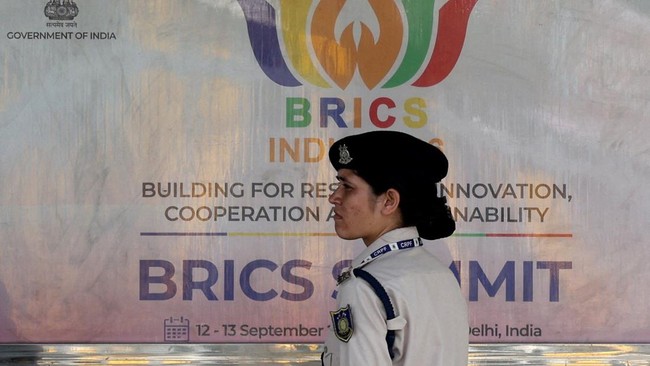
India has officially become the host of the BRICS Summit, held on 12-13 September. This crucial moment takes place as the giant Global South bloc seeks to strengthen its position on the global stage, despite the threat of fragmentation caused by its members being drawn into the vortex of the United States’ conflict with Iran.
According to Al Jazeera, Russian President Vladimir Putin arrived in New Delhi on Friday morning. The summit follows the massive attacks by the US and Israel on Iran, which had only recently joined BRICS in 2024 alongside the United Arab Emirates (UAE), Saudi Arabia, Egypt, Ethiopia, and Indonesia.
Although BRICS was created to challenge the Western-led world order, analysts agree that the bloc, established following the 2008 financial crisis, still struggles to build a coherent institutional alternative. The most visible structural weakness is the trade dependence of most BRICS members, which remains deeply rooted in the US dollar.
Economic Ambition & the Reality of Dollar Dependency
Researchers from the BRICS Studies Group at the University of Sao Paulo, Octavio Oliveira and Enzo Godinho, highlighted that the existence of this bloc remains an important platform for the Global South to have a voice and cooperate outside of Western influence. The New Development Bank (NDB) they established has successfully become the first financial institution free from Western state intervention, although it has yet to rival the power of the IMF.
“We tend to underestimate BRICS-led initiatives because it is not the revolution we might expect,” they noted.
Professor of International Studies at Carleton University, Sean Burges, assessed that BRCS has no intention of taking over the global governance responsibilities of the G7. The group’s primary focus is to offer alternative pathways for trade and investment that are free from the strict conditions typical of Western aid.
“The unifying priority for BRICS nations is largely the desire to generate significant wealth through international trade and to end the ‘Western’ preaching regarding failures in human rights and democracy,” he explained.
In economic terms, the strength of BRICS is indeed massive. Geostrategic analyst Imran Khalid detailed that this 11-nation bloc represents nearly half of the world’s population, 40% of total global output, 44% of global oil production, and approximately one-quarter of world trade. Its growth projection even reaches 3.7% this year, far surpassing the G7, which is held at the 1% level.
Nevertheless, Khalid noted that BRICS’ leverage is actually weaker than its paper size suggests. The NDB was recorded as having approved only about US$ 39 billion in funding by the end of 2024, a very small figure compared to the commitments of the World Bank, and most of which is still raised in US dollars. Geopolitical analyst Guy Burton agreed that although China and Saudi Arabia are pushing for alternative currencies, US dollar hegemony will not face a serious challenge for at least another decade.
“The bloc as a whole is not moving away from the dollar; each member is reducing their own exposure, one relationship at a time,” he asserted.
Cracks Due to Geopolitical Conflict
In the geopolitical arena, the expansion of membership has actually triggered confusion and eroded internal cohesion. Burton assessed that the bloc lacks a collective defence commitment. This fracture was evident during the BRICS foreign ministers’ meeting last May, which ended without a joint statement. The failure was triggered by a deadlock between Iran, which demanded explicit condemnation of US and Israeli actions, and the UAE, which firmly rejected the proposal.
“There is no ‘one for all, all for one’ logic in BRICS. Members deliberately maintain their freedom to act independently, which is the opposite of a coordinated bloc,” he said.
Despite being filled with dynamics and differing interests, the entry of giant oil producers has significantly multiplied the bloc’s influence in the global energy market. China’s aggressive investment initiatives in member countries also provide breathing room for developing nations to manoeuvre between the hegemony of Washington and Beijing.
Khalid concluded that BRICS currently functions more as a platform for autonomy rather than a destroyer of Western dominance.
“(BRICS emerges as) a challenger to how cheaply the West can exert pressure on each individual nation,” he concluded.
Source: jawawa.id (https://jawawa.id/newsitem/brics-alliance-unites-strength-in-india-is-it-time-for-the-west-to-tremble-1789142252)
Originally published by CNBC Indonesia (https://www.cnbcindonesia.com/news/20260911170534-4-767325/aliansi-brics-satukan-kekuatan-di-india-saatnya-barat-gemetar), translated from Indonesian