
BRI Reveals 3 Keys for Indonesian MSMEs to Enter Global Markets
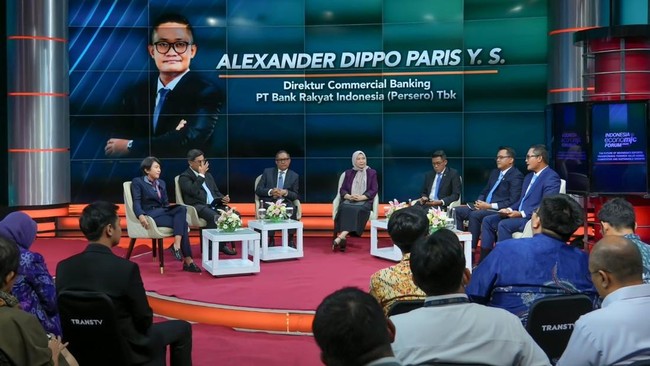
PT Bank Rakyat Indonesia (Persero) Tbk, known as BRI, is strengthening its role in driving Indonesian Micro, Small, and Medium Enterprises (MSMEs) to upgrade their operations and penetrate global markets. This comprehensive effort involves not only providing financing but also enhancing production capacity, improving financial literacy, and opening access to international business and markets.
This was stated by BRI’s Director of Commercial Banking, Alexander Dippo Paris Y. S., during the Indonesia Economic Forum 202<0xC2>6, themed “The Future of Indonesia’s Exports: Transforming Towards Value-Added, Competitive and Sustainable Growth”. The forum discussed strategies to strengthen Indonesia’s export competitiveness and promote sustainable economic growth. The event was attended by the Chairman of Commission XI of the Indonesian House of Representatives, Misbakhun, the President Director of DSI, Luke Thomas Mahony, and the Director General of National Export Development (PEN) of the Ministry of Trade, Fajarini Puntodewi.
Dippo revealed that there are three main challenges that must be addressed to enable more Indonesian MSMEs to enter export markets: business capacity and production quality, financial literacy, and business access.
“Based on these three elements, we provide financing to assist capacity, we provide mentoring programmes to assist literacy, and we open as much access as possible to assist the business access of MSMEs,” Dippo stated in a written release on Wednesday (30/9/2026).
According to Dippo, financing serves as the initial foundation for MSMEs to increase both production capacity and product quality. With capital support, entrepreneurs can scale up their businesses, increase production capacity, and meet the standards required by broader markets.
This commitment is reflected in BRI’s credit portfolio. By the end of the second quarter of 2026, credit to the MSME segment reached Rp1,235.4 trillion, growing 8.6% year-on-year. With this achievement, approximately 75.1% of BRI Group’s total credit and financing portfolio is allocated to the MSME segment.
Beyond access to finance, Dippo emphasised that entrepreneurs must also possess financial literacy and good business governance, given that export markets have more complex demands, including financial transparency and the ability to meet potential buyers’ standards.
“Exporting is not just about selling goods. Overseas buyers also demand financial transparency. The ability of producers to explain how they produce, their financial status, and their sources of funding is also crucial for buyers to consider,” Dippo explained.
To encourage these aspects, BRI is developing an MSME empowerment ecosystem that operates alongside financing. As of June 2026, the Desa BRILiaN programme has reached over 5,700 assisted villages, while the Klasterku Hidupku programme has reached over 44,000 business clusters. Digitally, LinkUMKM has reached approximately 17.3 million MSME players, while mentoring through Rumah BUMN has involved around 596,000 MSME players.
“The most difficult part is how we gradually increase their scale and literacy until they can be accessed internationally. This order must not be reversed. If we provide access today but literacy has not been achieved, then that access will be wasted,” Dippo remarked.
Once business capacity and readiness are strengthened, the next challenge is connecting MSMEs with markets. In this regard, Dippo continued, BRI utilises its customer ecosystem across various segments through the ‘One BRI Solution’ approach. This approach allows MSMEs to connect with corporate and commercial clients, opening opportunities for integration into larger value chains.
Efforts to open market access are also realised through the BRI UMKM EXPO(RT). During the 2025 event, more than 1,000 MSMEs participated and successfully realised commitment deals through business matching totalling USD 90.6 million, or approximately Rp1.5 trillion. The event also brought MSMEs together with 506 registered buyers from 34 countries.
Dippo cited the potential for MSME development in the fisheries and timber industries in East Java as an example. He noted that BRI does not work alone in opening international market access but instead utilises its corporate and commercial customer ecosystem, which already maintains business relationships with buyers in various countries.
“When they succeed in selling their products, they are not alone. BRI does not provide that access in isolation. We use our corporate and commercial customers who happen to have buyers in those countries. This collaboration is a prime example,” Dippo added.