
BRI Maintains Asset Quality through Selective Growth and Prudent Principles
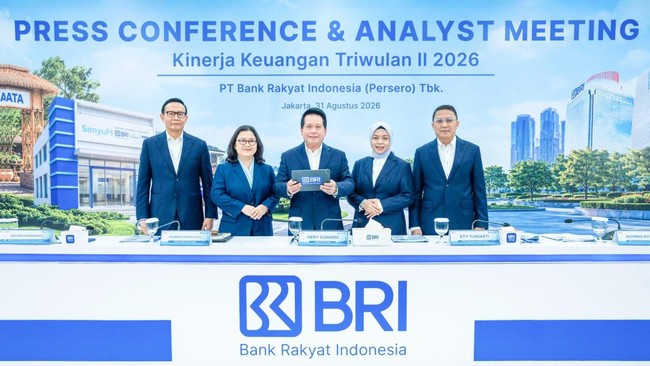
PT Bank Rakyat Indonesia (Persero) Tbk, known as BRI, continues to maintain a balance between business growth and asset quality through the application of prudent principles and disciplined risk management. As of the end of the second quarter of 2026, BRI’s credit and financing distribution has grown above the banking industry average, accompanied by improvements in several asset quality indicators.
BRI’s Risk Management Director, Ety Yuniarti, revealed that this growth is part of BRI’s strategy to drive healthy and high-quality expansion. In executing its growth strategy, BRI does not merely pursue credit volume, but ensures that every expansion remains within the corridors of risk appetite and prudent principles.
“BRI’s credit and financing growth in the second quarter of 2026 is above the banking industry and is accompanied by continuous improvement in asset quality. This reflects that the expansion we are undertaking remains healthy, prioritising prudent principles. We continue to maintain the balance between business growth and credit quality so that BRI’s growth can be sustainable in the long term,” Ety stated in an official statement on Friday (4/9/2026).
The quality of this growth is reflected in the improvement of the Non-Performing Loan (NPL) ratio, which decreased from 3.0% in the second quarter of 2025 to 2.9% at the end of the second quarter of 2026. The NPL improvement is one of the indicators of the effectiveness of the risk management strategy implemented by BRI amidst the acceleration of credit distribution.
According to Ety, BRI consistently applies a selective growth strategy by directing expansion towards segments, sectors, and customers with measurable risk profiles. This strategy is accompanied by the strengthening of early warning systems and the optimisation of collection and recovery functions to maintain overall portfolio quality.
“We want to ensure that every growth has good quality from the start. Therefore, risk management is conducted end-to-end, starting from the acquisition pipeline and debtor selection process, monitoring credit quality, to collection and recovery,” Ety explained.
BRI’s credit quality improvement is also reflected in more forward-looking indicators, namely Loan at Risk (LaR). As of the end of the second quarter of 2026, BRI’s LaR ratio improved to 9.1% from 9.6% at the end of 2025. This decrease indicates an improved risk profile of the portfolio and reflects the improved quality of new credit distribution.
In line with the improvement in NPL and LaR, BRI’s Cost of Credit (CoC) also fell from 3.4% in Q2 2025 to 3.1% at the end of the second quarter of 2026. The improvement in CoC shows that the increase in asset quality has also had a positive impact on the company’s risk costs.
On the other hand, BRI possesses an advantage in the form of a widespread network and a diversified customer base. These characteristics allow BRI to build a credit portfolio that is geographically and sectorally diversified, thereby strengthening the company’s resilience in facing economic dynamics.
Managing credit quality is also vital given that MSMEs (Micro, Small, and Medium Enterprises) are BRI’s core business. For BRI, the large exposure to MSMEs is not only an instrument to expand financial inclusion and drive the people’s economy, but also a business portfolio that must be managed healthily with strong risk monitoring discipline.
“The MSME-based business model has a significant social and economic impact because it directly touches the productive activities of the community. At the same time, we continue to prove that this portfolio can be managed with an adequate level of risk. With disciplined risk management, MSMEs can continue to be an important foundation for BRI’s growth while strengthening the company’s contribution to the people’s economy,” concluded Ety.
The improvement in asset quality has also supported BRI’s solid performance. As of the second quarter of 2026, BRI Group’s total assets reached Rp2,352 trillion, growing 11.7% YoY, while credit distribution grew 16.2% YoY to Rp1,646 trillion. During the same period, the company’s consolidated net profit was recorded at Rp31.2 trillion, an increase of 17.5% YoY.