
BRI disburses Rp103.8 trillion in KUR loans to two million debtors as of June
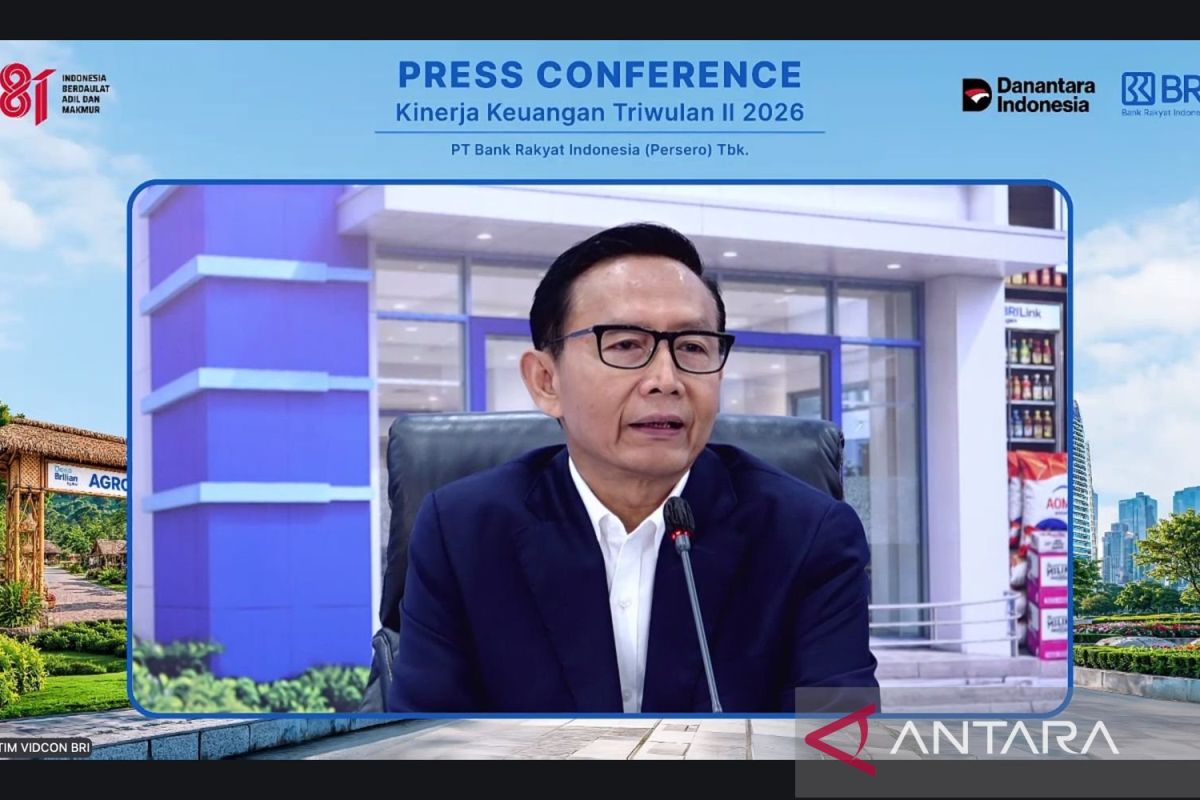
PT Bank Rakyat Indonesia (Persero) Tbk (BRI) disbursed Rp103.8 trillion in people’s business credit (KUR) to more than 2 million debtors from January to June 2026.
KUR disbursement was dominated by productive sectors that play a strategic role in the national economy, with the agricultural sector being the largest recipient, equivalent to 42.68 percent of total disbursement.
“If we look further back over the period from 2015 to the second quarter of 2026, BRI has disbursed KUR amounting to Rp1,539 trillion to 48.4 million customers,” said BRI Director of Network and Retail Funding Aquarius Rudianto at a press conference in Jakarta on Monday.
Aquarius said that for BRI, KUR is not merely a credit disbursement programme, but also a strategic instrument to expand access to financing for business actors who are feasible yet have limited access to commercial credit, encourage the emergence of new debtors, and create pathways for business actors to grow and move up a class.
The company, he added, ensures that KUR truly flows to activities that have a multiplier effect on the economy, with the majority of BRI’s KUR disbursement going to the production sector and expanding the customer base to business actors.
Amid fairly expansive disbursement, the company maintains credit quality with KUR non-performing loans (NPL) held at a level of 2 percent.
“With the network and empowerment ecosystem that we have, we want to continue ensuring that KUR does not stop as access to capital, but also becomes a bridge for MSMEs to grow productively, resiliently, and sustainably,” said Aquarius.
Amid the transformation being undertaken by the company, he explained that one consistent element is BRI’s commitment to MSMEs and the people’s economy. Therefore, BRI’s approach to MSMEs continues to be built end-to-end, from the village level, business communities, to individual entrepreneurs.
Through Desa BRILiaN, the company has empowered more than 5,700 villages with a focus on optimising local economic potential while strengthening village capacity and institutions.
At the business community level, the company has developed Klasterku Hidupku, which has now reached more than 44,000 business clusters. This empowerment has also been expanded through the Link UMKM digital platform, which has reached around 17.3 million MSME actors.
In addition, the company also continues to strengthen direct mentoring through Rumah BUMN, with around 596,000 MSME actors having joined as of June 2026.
“So the role we are building is not merely as a financial intermediary, but as an enabler for grassroots economic growth,” said Aquarius.
He added that the company wants to continue creating a sustainable cycle that empowers MSMEs so that their businesses develop, their capacity increases, they move up a class, and become increasingly integrated into the larger economic ecosystem, thereby increasing income and welfare.
BRI Deputy President Director Viviana Dyah Ayu RK added that KUR disbursement is one of the company’s steps as a government partner in driving development and sustainable economic inclusion.
Besides KUR, BRI is also consistently strengthening the housing provision ecosystem through the disbursement of housing programme credit (KPP) or housing KUR.
As of June 2026, BRI’s KPP realisation was recorded at Rp10.7 trillion, or nearly 90 percent of BRI’s total KPP disbursement target of Rp12 trillion.
This disbursement includes financing for business actors on the housing supply side as well as financing for the public on the demand side.
The company also disburses mortgages under the housing finance liquidity facility (FLPP) scheme. According to Viviana, BRI is currently one of the largest credit disbursing banks, with the majority of subsidised mortgage (KPRS) financing coming from the FLPP programme. As of June 2026, BRI’s KPRS disbursement reached Rp18.4 trillion to more than 134,000 debtors.
“In addition, BRI also actively participates in other government programmes such as the Free Nutritious Meals programme (MBG), the Red and White Village/Sub-district Cooperatives (KDKMP), and the distribution of social assistance,” said Viviana.
As of the end of the second quarter of 2026, total lending grew by 16.2 percent year-on-year (yoy) to Rp1,645.5 trillion. Meanwhile, third-party funds (DPK) reached Rp1,580.7 trillion, representing growth of 6.7 percent (yoy). BRI posted a net profit of Rp31.2 trillion as of the end of the second quarter of 2026, growing by 17.5 percent (yoy).
Source: jawawa.id (https://jawawa.id/newsitem/bri-disburses-rp103-8-trillion-in-kur-loans-to-two-million-debtors-as-of-june-1788166517)
Originally published by Antara (Indonesian) (https://www.antaranews.com/berita/5718616/bri-penyaluran-kur-rp1038-triliun-untuk-dua-juta-debitur-per-juni), translated from Indonesian