
BRI: Digital banking push lifts low-cost funds ratio to 67.6 percent
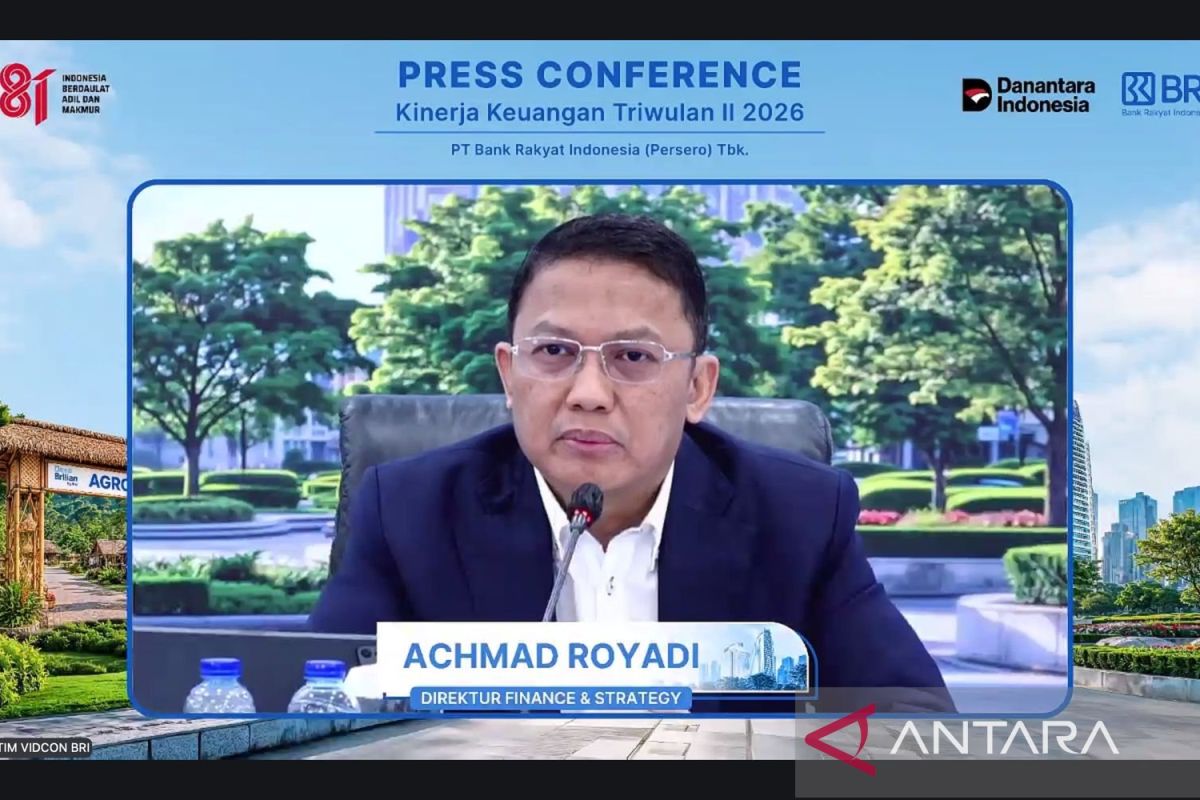
PT Bank Rakyat Indonesia Persero Tbk (BRI) said the strengthening of transaction banking and its digital banking ecosystem has had a positive impact on customer deposits, particularly low-cost funds (CASA), with the ratio reaching 67.6 percent as of the end of the second quarter of 2026.
At the end of the second quarter of 2025, BRI’s low-cost funds ratio was recorded at 65.5 percent. Total third-party funds (DPK) as of June 2026 reached Rp1,580.7 trillion.
BRI Director of Finance & Strategy Achmad Royadi said at a press conference in Jakarta on Monday that the increase in low-cost funds was also driven by the large customer base, which provides a strong natural funding franchise.
He added that savings growth of 11.3 percent year-on-year (yoy) at the end of the second quarter of 2026 shows that BRI’s funding does not come solely from institutional deposits, but also from BRI’s broad customer base.
From a liquidity perspective, Achmad said BRI’s condition is very good and well maintained, as reflected in the loan-to-deposit ratio (LDR) at 90.8 percent. According to the company, this level is ideal for carrying out the intermediation function in banking.
Meanwhile, from a capital perspective, BRI’s capital adequacy ratio (CAR) in the second quarter of 2026 was recorded at 21.5 percent, well above regulatory requirements.
“With well-managed liquidity and strong capital, BRI has an adequate foundation to continue healthy and sustainable growth while prioritising the precautionary principle and maintaining a balance between growth, asset quality, liquidity, capital and, of course, profitability,” Achmad said.
Meanwhile, BRI Director of Network and Retail Funding Aquarius Rudianto said active users of the BRImo super app reached 22.4 million by the end of the second quarter of 2026, recording 3.3 billion financial transactions with a volume of Rp4,166 trillion.
Compared with the same period the previous year, the number of active users grew 15.6 percent year-on-year, while the number of transactions increased 30.6 percent yoy and transaction volume grew 28.9 percent yoy.
“Our strategy to enlarge CASA is by strengthening transactions and making BRI increasingly relevant in customers’ daily financial activities, one of which is through BRImo, which continues to show growth,” he said.
Aquarius added that on the merchant side, the company is also continuing to strengthen BRI’s payment ecosystem. Through BRI Merchant, the company is simplifying the onboarding process, integrating acceptance and settlement, while providing business analytics for merchants.
As a result, sales volume per merchant grew 17.8 percent yoy, transaction frequency increased 20.5 percent yoy, and the number of productive merchants grew 20.1 percent yoy.
“So our focus is not only on adding merchants, but ensuring that these merchants are actively transacting and increasingly connected to the BRI ecosystem,” Aquarius said.
He said a stronger indicator can be seen in QRIS transactions, where sales volume per store increased 53.8 percent yoy from around Rp8.7 million to Rp13.4 million per month. Meanwhile, transactions also grew 86 percent yoy to 583.4 billion transactions.
“This growth shows that BRI’s position is strengthening in managing the daily transactions of the public and also business actors, including MSMEs,” Aquarius said.
He added that the increase in digital activity is being converted into funding and revenue. Through BRILink agents, for example, low-cost funds (CASA) increased 28.6 percent to Rp30.7 trillion, while fee-based income grew 16.3 percent to around Rp915.7 billion.
“This shows that BRI’s physical and digital networks complement each other in building a transaction ecosystem,” he said.
Aquarius said digitalisation is not only about the number of users or the number of transactions, but the combination of transactions and relationships into CASA, and CASA into a more sustainable source of growth for the company.
This, he added, is what the company means by the transformation of the funding franchise. The more customer economic activity that takes place within the BRI ecosystem, the stronger the company’s ability to build low-cost funds organically.
“Going forward, we will continue to integrate BRImo, Merchant, QRIS, BRILink agents, payroll and transaction banking so that BRI increasingly becomes the primary transaction bank for all customer segments,” Aquarius said.