
Breaking: Stocks Continue to Be Bought Up as JCI Soars 1%
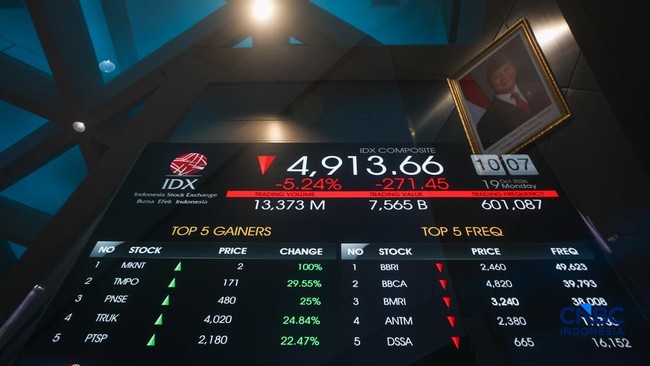
Jakarta, CNBC Indonesia — The Jakarta Composite Index (JCI) extended its gains in the first session today. At 10.24am Western Indonesia Time, the index stood at 5,449.09, up 61.18 points or 1.14%.
The JCI had risen from the opening level of 5,397.34, gaining 0.18%. After opening, it came under pressure and touched the day’s low of 5,366.29, down 0.40%. It then reversed course and continued climbing, reaching a high of 5,451.54, up 1.18%.
Trading volume by 10.23am reached 161.48 million lots, with transaction value totalling Rp5.08 trillion.
On Friday, the market will continue to monitor several domestic developments, particularly government policy, conditions in the banking industry and economic liquidity. Wall Street’s slump is also in focus as a global market sentiment.
Domestically, attention is on President Prabowo Subianto’s comments on natural resource management and plans to streamline state-owned enterprises (SOEs).
Investors are also watching bank credit growth, which has reached its highest level in a decade; expectations of an increase in new lending towards the end of the year; and a government programme to widen access to bank accounts.
Market participants are also awaiting Bank Indonesia’s (BI) September 2026 broad money data, following a slowdown in growth for two consecutive months.
The Indonesia Stock Exchange (IDX)’s changes to the JCI calculation rules have also drawn investors’ attention. From 2 November 2026, stocks classified as having High Shareholding Concentration (HSC) will no longer be included in the JCI calculation.
According to an IDX disclosure, the policy is intended to make the index better reflect market dynamics. Previously, only stocks on the Acceleration Board were excluded from the JCI calculation.
Global sentiment also includes the release of Japan’s September inflation data, scheduled for Friday morning.
Japan’s annual inflation rose to 2.1% in September 2026, from 1.9% in each of the previous two months. This was the highest rate since December 2025 and marked a return of core inflation to above the Bank of Japan’s (BOJ) target.
According to the Statistics Bureau of Japan, core inflation—which excludes fresh food prices but includes energy—reached 2.1% year on year. That was up from 1.7% in August and the highest in nine months. The result was also in line with market expectations.