
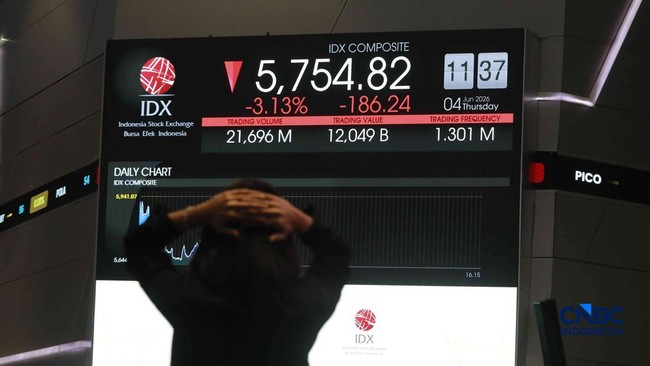
Breaking News! Jakarta Composite Index Opens Down 3.5%
Breaking News! Jakarta Composite Index Opens Down 3.5%
Jakarta, CNBC Indonesia — The Jakarta Composite Index (IHSG) plunged deeper, hitting the 5,395.07 level, or dropping 199.70 points, a 3.57% decline at the opening of trading today, Monday (8/6/2026).
The weakening reflects persistent selling pressure across almost all market sectors. A total of 497 stocks were recorded as declining, while only 73 stocks gained, and 389 stocks remained stagnant.
The morning’s transaction value reached Rp885.8 billion, with trading volume touching 1.05 billion shares and transaction frequency reaching 101,000 times.
Indonesia’s financial markets continue to face dynamics ranging from warfare to investors closely monitoring domestic fiscal resilience. Iran reportedly launched missiles towards Israel on Sunday (7/6/2026), marking the first time since the ceasefire between Tehran and Washington came into effect last April.
The Speaker of the Iranian Parliament, Mohammed Baqer Ghalibaf, accused the US maritime blockade and Israeli attacks in Lebanon of violating the agreement. He stated that US bases and Israeli assets in the region are now legitimate targets.
US President Donald Trump, having received reports on the attack, stated that Iran’s actions would not assist the negotiation process. Trump is also said to be contacting Israeli Prime Minister Benjamin Netanyahu to urge him not to retaliress against the Iranian attack.
The Islamic Revolutionary Guard Corps (IRGC) emphasised that the ceasefire holds on the condition that conflict also ceases on all fronts, including Lebanon. Iran warned that a broader response would follow if attacks recur.
These tensions threaten fragile peace efforts. Iran demands an end to the war in Lebanon and the lifting of the US blockade, while Washington requests Tehran surrender nuclear materials and cease nuclear weapons ambitions.
Domestically, Finance Minister Purbaya Yudhi Sadewa presented the realisation of the State Budget (APBN) up to the end of May 2026 during the APBN KiTA Press Conference held on Friday (5/6/2026).
Amid global uncertainty and geopolitical tensions in the Middle East, the Finance Minister asserted that Indonesia’s economic foundation remains solid, with APBN realisation showing a very positive trend.
The APBN deficit position remains well-maintained, measured, and in accordance with the 2026 APBN design. Budget financing is also managed prudently, efficiently, and flexibly in response to financial market dynamics.
The budget deficit increased slightly to Rp180.4 trillion, or 0.70% of GDP. This figure is slightly higher than the Rp164.4 trillion, or 0.64% of GDP, recorded at the end of April 2026.
“The realisation of the APBN up to May 2026 continues to show positive trends,” said Purbaya during the press conference, as quoted on Monday (8/6/2026).
Fiscal deficits remain a sharp focus for investors, particularly amidst war volatility which drives up energy prices and derivatives, expected to increase costs.
Meanwhile, the US Dollar Index rose back to the 100.069 level, its highest since late March 2026. The strengthening dollar index signifies that investors are returning to US dollars, which could trigger outflows from emerging markets, such as Indonesia. Consequently, the Rupiah remains under threat.
In the past week, the Rupiah plummeted to the level of Rp18,000/US$1.
Deputy Governor of Bank Indonesia, Destry Damayanti, noted that the exchange rate weakness is still influenced by the escalating geopolitical tensions in the Middle East, which hampers peace prospects, keeps oil prices high, and increases the risk of global inflation and capital outflows from developing nations.
“Furthermore, domestic demand for dollars remains quite high, following patterns of dividend repatriation and external debt payments,” said Destry in a short message to CNBC Indonesia, quoted on Monday (8/6/2026).