
Breaking News! IHSG Falls 1% in Early Trade, Here's Why
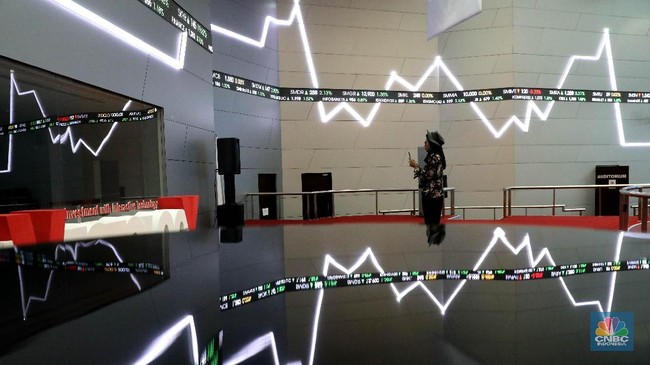
Jakarta, CNBC Indonesia — The Jakarta Composite Index (IHSG) continued its weakness in Tuesday’s trading (15/9/2026). The index was corrected by more than 1% at the start of trade amid pressure from both domestic and global sentiment.
Based on data from the Indonesia Stock Exchange, at 09.09 WIB the IHSG stood at 6,463.97, down 70.72 points or 1.08% from the previous close of 6,534.69.
The IHSG opened at 6,544.77 and touched an intraday high of 6,549.60. However, selling pressure sent the index down to a low of 6,462.85.
The decline came amid pressure on the majority of stocks. A total of 297 shares fell, 203 rose, and 463 were unchanged.
In terms of trading activity, transaction volume reached 2.89 billion shares with a transaction value of Rp1.63 trillion. The frequency of transactions was recorded at 182,500 times.
The correction in the IHSG came alongside the slide in large-capitalisation shares. Bayan Resources (BYAN) continued its fall, dropping 6.8% this morning.
The same was true of jumbo bank issuers, with Bank Rakyat Indonesia (BBRI) down 2.35%, Bank Mandiri (BMRI) down 2.03%, and Bank Central Asia (BBCA) down 1.92%.
The IHSG’s movement in today’s trading was shadowed by a number of sentiments from home and abroad.
On the domestic front, investors’ attention was focused on the change of finance minister from Purbaya Yudhi Sadewa to Suahasil Nazara. Globally, war tensions in the Middle East, the direction of The Federal Reserve’s interest rate policy, and the release of Chinese economic data were factors with the potential to influence market movement.
Domestically, market players will scrutinise the direction of fiscal policy under Suahasil’s leadership. After being sworn in on Monday (14/9/2026), Suahasil affirmed his commitment to safeguarding the health and credibility of the State Budget (APBN), including ensuring the deficit remains below 3% of Gross Domestic Product (GDP). Certainty over the direction of fiscal policy is important for investors amid pressure on the rupiah exchange rate and global uncertainty.
Externally, the escalation of the Middle East conflict has again raised concerns over global energy supplies. The Iran-backed Houthi group launched attacks on Saudi Arabia on Monday (14/9/2026), after the Saudi East-West oil pipeline was disrupted by previous attacks. Meanwhile, the Strait of Hormuz remains closed, and diplomatic efforts to reopen it face obstacles.
The situation has pushed world crude oil prices higher. In Monday’s trading, West Texas Intermediate (WTI) crude futures rose 1.24% to US$102.65 per barrel, whilst Brent gained 1.18% to US$106.93 per barrel.
The rise in oil prices has the potential to add inflationary pressure and increase energy costs, making it a concern for stock markets, particularly in oil-importing countries.
External pressure also came from the outlook for US monetary policy. Bank Indonesia (BI) cautioned that the higher-for-longer interest rate era poses a challenge for developing countries. The strengthening of the US dollar and rising US government bond yields could push capital flows towards developed-market assets, thereby pressuring the rupiah and domestic financial markets.
Investors will also be watching the Federal Open Market Committee (FOMC) meeting taking place on 15-16 September US time. The market expects The Fed to raise interest rates by 25 basis points, with the probability of an increase towards the 3.75%-4.00% range at 92.4% according to CME FedWatch.
Source: jawawa.id (https://jawawa.id/newsitem/breaking-news-ihsg-falls-1-in-early-trade-heres-why-1789440753)
Originally published by CNBC Indonesia (https://www.cnbcindonesia.com/market/20260915090921-17-767936/breaking-news-ihsg-pagi-pagi-sudah-anjlok-1-ini-penyebabnya), translated from Indonesian