
Breaking! JCI Surges 2% as Conglomerate Stocks Rally
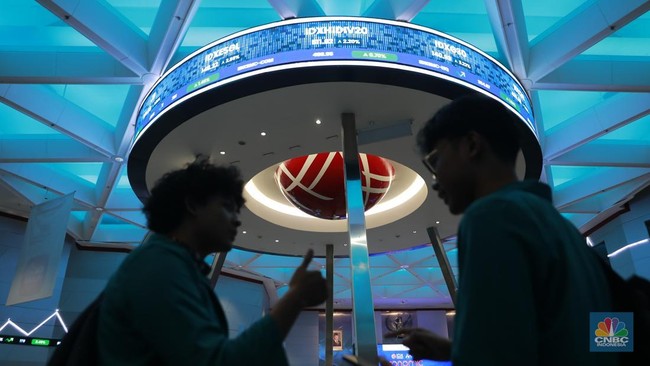
The Jakarta Composite Index (JCI) began its first trading session of June on a strong note on Tuesday (2/6/2026), reversing the downward pressure experienced since last month. At the start of trading, the JCI surged by 82.62 points or 1.35% to the 6,210 level, fluctuating between 6,119.97 and 6lar6,153.71. Shortly thereafter, the index jumped by 2%, rising 122 points to reach 6,249.98.
Transaction value at the start of trading was recorded at Rp 4.2 trillion, with a volume of 5.91 billion shares and a frequency of 374,000 transactions. A total of 340 stocks were recorded as gaining, 237 declined, and 156 remained stagnant. Conglomerate issuers, particularly those belonging to the Barito Group, were the most heavily traded this morning, acting as the primary drivers of the JCI’s performance.
As the first week of June 2026 begins, market participants are closely monitoring several key macroeconomic data releases from both domestic and international sources. Additionally, attention is focused on the implementation of strategic domestic policies and global geopolitical dynamics, particularly concerning State-Owned Enterprises (SOEs) involved in exports.
Starting 1 June 2026, the government has implemented a series of new policies targeting the management of export foreign exchange and the stability of the foreign exchange market. A notable development is the formation of PT Danantara Sumber Daya Indonesia (DSI) to serve as a single-window export mechanism for three strategic commodities: coal, palm oil, and ferroalloy. These three commodities contributed US$66.13 billion in exports in 2025, accounting for approximately 23.4% of total national exports.
Coordinating Minister for Economic Affairs, Airlangga Hartarto, stated that this policy is part of an effort to improve natural resource governance and strengthen the supervision of export transactions, ensuring that recorded export values reflect actual transactions. The government will conduct evaluations every three months during the transition period before full implementation on 1 January 2027.
Simultaneously, the government has introduced new regulations regarding Natural Resource Export Proceeds (DHE SDA) through Government Regulation (PP) Number 21 of 2026. Non-oil and gas exporters are now required to deposit 100% of their export proceeds into specific domestic accounts for a minimum of 12 months. For the oil and gas sector, the mandatory placement is set at 30% for at least three months. The government also limits the conversion of foreign exchange to Rupiah to a maximum of 50% and is preparing tax incentives, such as lower Income Tax rates, for compliant exporters. This policy is expected to strengthen domestic foreign exchange reserves and increase the benefits of exports to the national financial system.
Meanwhile, Asia-Pacific stock markets opened lower on Tuesday (2/6/2026) amid rising uncertainty regarding peace negotiations between the United States and Iran. According to CNBC, this sentiment has led investors toward a cautious approach, despite major Wall Street indices hitting record highs in previous trading. In Japan, the Nikkei 225 opened down 0.52%, while the Topix corrected further by 0.98%. Pressure was also felt in South Korea, with the Kospi index falling 0.32% and the Kosdaq small-cap index plunging 2.5%. The Australian market also moved into the red, with the S&P/ASX 200 weakening by 0.67%, while Hang Seng futures in Hong Kong stood at 25,207, lower than the previous close of 25,398.18. Market participants are closely watching developments in US-Iran relations after US President Donald Trump downplayed the possibility of failure in peace talks with Tehran.