
Breaking: Israeli Exit Polls Leave Netanyahu’s Fate Uncertain
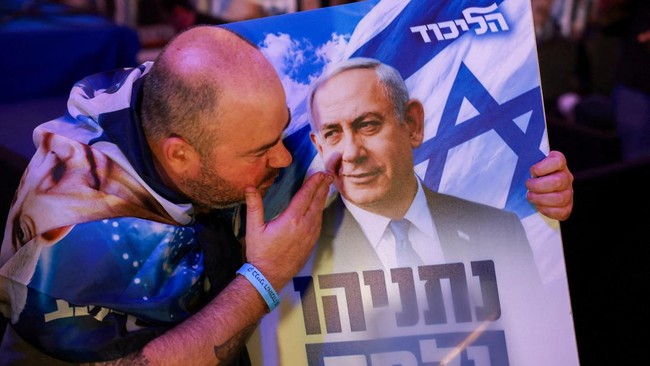
Israel’s election, held amid wartime conditions, ended without a clear winner, according to exit polls released on Tuesday (27 October 2026), local time. The preliminary results are a potential setback for Prime Minister Benjamin Netanyahu, who is seeking to retain power after years of dominating Israeli politics.
Although the opposition bloc led by Gadi Eisenkot is projected to win more seats than Netanyahu’s camp, neither side has a clear path to forming a government. The narrow lead could at least give Eisenkot the first opportunity to assemble a coalition.
The political deadlock, however, could work in Netanyahu’s favour. He may remain in office as caretaker prime minister while political parties negotiate to form a new coalition.
Israel’s Central Elections Committee recorded voter turnout of 77.7%. That is the highest level in more than two decades and about seven percentage points above turnout in the previous election, in 2022.
Three major Israeli television networks updated their exit-poll projections, putting Eisenkot’s bloc two seats ahead of the camp led by Netanyahu’s Likud party, with 52 and 50 seats respectively.
A further 18 seats are projected to go to Arab parties unaffiliated with either bloc. However, Eisenkot, leader of the Yashar party, has almost entirely ruled out forming a government with them.
That stance makes it more difficult for him to secure a majority, despite his bloc’s lead in the seat projections.
Other Israeli media outlets, including Channel 14, which is known to support Netanyahu, reported different projections. They estimated that Netanyahu and his allies could secure a total of 60 seats.
The official election results are expected to take several days to announce. Israel’s fragmented political system also means smaller parties could play a decisive role in forming a government.
No single party has ever won 61 seats outright in the 120-member Knesset, making coalition governments the norm.
Yohanan Plesner, president of the Israel Democracy Institute, described the exit-poll results as a major defeat for Netanyahu’s coalition. The bloc, which previously held 68 Knesset seats, is projected to win only about 50 in this election.
Nevertheless, Plesner said Eisenkot could not yet be called a clear winner. He warned that the final result could still change as votes are counted.
If the official results match the exit-poll projections, Eisenkot could try to form a minority government to end Netanyahu’s time in power, although it might last only until the next election.
Opposition gains ground, putting Netanyahu under threat
Although the exit polls have not produced a definitive winner, they point to strong support for those seeking to end Netanyahu’s government.
Opposition leader Yair Lapid said in a statement that the results amounted to a crushing defeat for the prime minister’s camp.
“Let no one confuse you: the Netanyahu bloc has suffered a crushing defeat. This is a total collapse, and the people have told them to go home,” Lapid said, Reuters reported.
Eisenkot, 66, has emerged as Netanyahu’s strongest challenger. The former military chief, known for his hard-line security views, lost a son and two nephews in the Gaza war.
In this campaign, he drew on his security credentials while presenting himself as a centrist on domestic affairs.
Eisenkot entered politics only about four years ago. After Hamas’s 2023 attack, he joined Netanyahu’s war cabinet but resigned eight months later, criticising the prime minister’s leadership.
He has offered a change from Netanyahu’s leadership and the influence of his far-right allies. On security, however, Eisenkot has not proposed a major departure from the hard-line approach that has taken root since Hamas’s 2023 attack.
He opposes the creation of a Palestinian state and says Hamas’s military wing must be destroyed or disarmed.
Eisenkot nevertheless considers Israel’s response to the Hamas attack a failure. Israel’s war has killed more than 74,000 Palestinians, according to Gaza health authorities, but Hamas remains in power in the territory.
Yair Golan, leader of the Democrats party and another political opponent of Netanyahu, addressed supporters after the polls closed.
“Dear Democrats, the decision has been made. The nation has given us a sacred task: to turn the trust it has placed in us into action, strengthen democracy, save Israel and provide real protection for the country,” Golan said.
Meanwhile, celebrations broke out at the headquarters of Joint List, an alliance of several Arab parties. Supporters cheered and applauded as the exit-poll results were announced after voting ended. Turnout among Palestinian citizens of Israel also marked a significant moment in this election.
“We reject occupation and racism, and we will remain here,” said Faten Gattas, a Joint List candidate, in a speech at the alliance’s headquarters in Nazareth.
Candidates hoped that high turnout among Arab voters would give them a decisive position from which to prevent Netanyahu’s coalition, considered the most right-wing government in Israel’s history, from returning to power.
Voter turnout reaches a record
Voters’ enthusiasm was evident in long queues outside polling stations. The election took place as Israelis continued to grapple with the trauma of Hamas’s 7 October 2023 attack, which killed 1,200 people and led to 251 being taken hostage.
The attack was followed by the war in Gaza, conflict with Hezbollah in Lebanon and war against Iran.
Netanyahu has faced fierce criticism over the security failures that allowed the Hamas attack to take place. He has argued, however, that his military actions—including the killing of several senior Hamas, Hezbollah and Iranian leaders—have made Israel and the world safer.
The policies of Netanyahu’s right-wing coalition have fuelled divisions at home and deepened Israel’s international isolation. Amid the criticism, Netanyahu continues to portray himself as a leader capable of confronting Israel’s enemies.
Netanyahu, 77, has served as prime minister for almost 19 years over the past three decades. He has repeatedly managed to survive political crises.
Since 2009, his opponents have removed him from the premiership only once. That followed four inconclusive elections held within two years. Just 18 months later, however, Netanyahu returned to power.
In this election, he also faced legal troubles in the form of long-standing corruption charges, which he denies. He has additionally been criticised over intelligence failures that allowed Hamas-led militants to launch their October 2023 attack.
Netanyahu campaigned with the support of US President Donald Trump, his ally in the war against Iran.