
Breaking Disciplinary Boundaries: Asian Lexicographic Innovation Through Collaboration
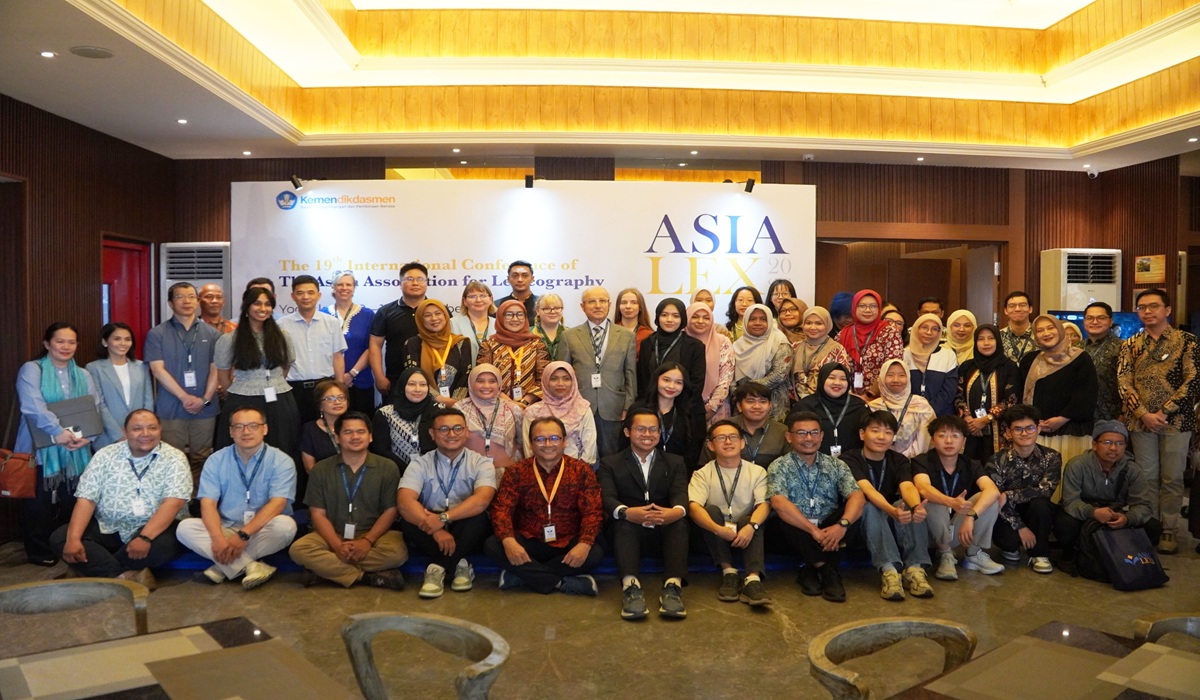
Indonesia is hosting the 19th International Conference of the Asian Association for Lexicography (AsiaLex 2026), to be held on 9–11 September 2026 in Yogyakarta. This international conference is organised by the Language Development and Cultivation Agency (Badan Bahasa) of the Ministry of Primary and Secondary Education of the Republic of Indonesia, in cooperation with the Asian Association for Lexicography (ASIALEX).
This appointment marks the second time for Badan Bahasa, having previously been selected to host the AsiaLex Conference in 2020. However, due to the pandemic, the conference originally planned for Yogyakarta was postponed and converted into an online conference held on 12–14 June 2021.
AsiaLex was founded at the conference Dictionaries in Asia: Research and Pedagogical Implications at the Hong Kong University of Science and Technology on 27–29 March 1997. The organisation aims to foster scholarly and professional activities in the field of lexicography through the exchange of information and ideas via meetings, publications and other means. After being held biennially until 2015, AsiaLex has been held annually since 2016, with the conference process transforming from print to electronic formats.
For the 2026 edition, AsiaLex carries the theme ‘Lexicography: Multidisciplinary Approaches and Collaboration’. The theme was chosen to demonstrate that modern-day dictionary compilation no longer stands alone, but intersects with technology, computer science, artificial intelligence, psychology and sociology, whilst also showcasing the important role of lexicography beyond the field of linguistics.
In her report, the Coordinator of the AsiaLex 2026 Conference, who also serves as Executive Editor-in-Chief of the Great Dictionary of the Indonesian Language (KBBI), Dewi Puspita, stated: ‘We chose this theme because in the modern era, dictionary-making no longer stands alone; it aims to demonstrate the influence and importance of lexicography for other scholarly fields, not only for linguistics.’
Over three days, 64 papers will be presented in parallel sessions spread across four rooms, both offline and online. Dewi expressed hope that through the discussions, all participants would gain new findings that challenge existing theories and methods, as well as build sustainable professional collaborations.
A number of leading lexicography experts are scheduled to appear as keynote speakers, including the Editor-in-Chief of the KBBI, Dr Dora Amalia; Prof. Kilim Nam of Yonsei University (South Korea); and Prof. Pedro A. Fuertes-Olivera of the University of Valladolid (Spain).
In addition to the keynote speakers, the event is attended by 90 participants, with 64 papers presented across 17 parallel sessions. The papers cover topics including the development, compilation and use of specialised dictionaries; the intersection of lexicography with other fields of study; dictionary compilation assisted by artificial intelligence; natural language processing; digital lexicography; as well as dictionaries in bilingual or multilingual contexts, translation studies, and cross-linguistic resources.
The AsiaLex Conference was originally planned to take place entirely offline, but the eruption of Mount Anak Krakatau caused participants’ flights to Indonesia to be delayed or cancelled, prompting organisers to swiftly adapt the event into a hybrid format to accommodate those unable to attend in person in Yogyakarta.
In her opening remarks, the President of AsiaLex, Ai Inoue of the University of Tokyo, expressed hope that the conference would provide ample opportunities for stimulating discussions, fruitful exchanges of ideas, and the forging of new connections.
‘I also hope that, whether joining offline or online, we can all share ideas and engage in discussions with mutual respect for one another,’ said Ai Inoue.
The future of Indonesian lexicography lies in the willingness to collaborate and innovate. ASIALEX 2026 demonstrates that Badan Bahasa is ready to go further, harnessing technology to record, preserve and bring to life every trace of words for future generations.