
Brace for a Fiery Global Skies: US to Buy 850 F-35 Fighter Jets
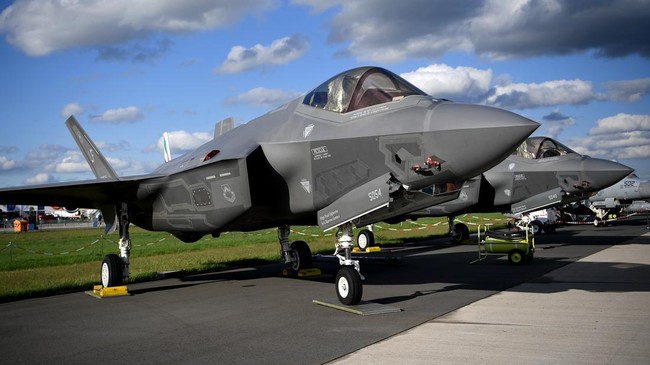
Jakarta, CNBC Indonesia – Geopolitical conflicts, including the war involving Iran, have drawn greater attention to US arms manufacturer Lockheed Martin. The Pentagon’s need to replenish its weapons stocks could create opportunities for the company.
Reuters reported on 23 July 2026 that conflicts from Iran to Ukraine had depleted weapons stocks that need to be replenished. Against this backdrop, how have Lockheed Martin’s revenue, net profit and equity performed?
A comparison of the first halves (H1) of 2022–2026 shows steadily rising sales. Profit, however, has also been affected by programme-loss provisions and other expenses.
H1 2026 revenue highest in five periods
Lockheed Martin recorded revenue of US$38.08 billion in H1 2026, up 5.44% from H1 2025.
This was the highest figure in the five periods compared. Revenue was up 25.24% from H1 2022.
The trend reflects sales growth over several years. The increase in H1 2026 should therefore be considered alongside production growth and the execution of contracts already under way.
Profit surges, but remains below H1 2023
Net profit in H1 2026 reached US$3.32 billion, up 61.83% from US$2.05 billion in H1 2025.
Despite the strong growth, profit remained 1.36% below H1 2023. H1 2026 therefore marked a strong recovery from the previous year, while the period’s highest profit was still recorded in 2023.
The comparison base is important. In the second quarter of 2025, the company recorded pre-tax programme losses of about US$1.62 billion, including a classified Aeronautics programme and helicopter programmes in Canada and Turkey.
Those expenses weighed on H1 2025 profit. The recovery in 2026 also reflects the absence of a similar large loss.
The 2022 figures were also affected by a one-off non-cash pension settlement charge. Consequently, profit fluctuations over these five periods cannot be attributed entirely to the intensity of warfare.
Equity recovers to US$8.77 billion
Shareholders’ equity reached US$8.77 billion at the end of H1 2026, up 64.38% from the end of H1 2025.
Despite the recovery, it remained below the levels at the end of H1 2022 and H1 2023.
Changes in equity should be considered alongside profit, dividend distributions, share buy-backs and other comprehensive income. A lower equity base can also increase the return-on-equity (ROE) ratio.
H1 follows the company’s fiscal period, which ends around late June; the number of weeks in each period may vary. Revenue and net profit are cumulative figures for the half-year, while equity is measured at the end of the period.
Comparing H1 2026 and H1 2025
Lockheed Martin’s cash flow also increased compared with the first half of the previous year.
In its Form 10-Q, the company said the rise in H1 2026 operating cash flow was primarily due to the timing of customer receipts and lower tax payments. The increase in cash also had drivers beyond sales growth.
Demand impact visible in missile business
The performance of the missile business offers a more specific indication of rising demand for weapons.
Missiles and Fire Control revenue in H1 2026 reached US$7.75 billion, up 13.87% from H1 2025. Its operating profit rose 15.89% to US$1.09 billion.
The company attributed the increase in half-year sales mainly to higher production of PAC-3, THAAD and Precision Strike Missile systems.
The figures show growth in weapons production. However, the report does not separate out how much additional revenue or profit came specifically from the war involving Iran. The conflict’s contribution to consolidated results cannot be calculated from these figures alone.
Assets, ROE and DER at the end of H1 2026
Total assets as at 28 June 2026 stood at US$62.45 billion, with liabilities of US$53.68 billion and equity of US$8.77 billion.
First-half ROE was 42.92%, calculated by dividing H1 net profit by average equity at the end of 2025 and at the end of H1 2026. On a simple annualised basis, the figure is 85.84%; this is an extrapolation.
The debt-to-equity ratio (DER), based on total liabilities, was 6.12 times, while interest-bearing debt stood at 2.34 times equity.
Pentagon agreement adds to outlook after H1
After the first half ended, Lockheed Martin and the Pentagon announced a 10-year F-35 framework agreement on 22 October 2026.
The framework covers 850 aircraft for the United States, initial spare parts, and modifications and maintenance. Including international customers, production is planned to remain at 156 aircraft a year.
Implementation still requires congressional authorisation and funding before prices, schedules and contract terms are finalised.
The October agreement is a future business prospect and did not drive H1 2026 performance. Its benefits to shareholders will depend on contract execution, production margins and the timing of customer payments.
Source: jawawa.id (https://jawawa.id/newsitem/brace-for-a-fiery-global-skies-us-to-buy-850-f-35-fighter-jets-1792900229)
Originally published by CNBC Indonesia (https://www.cnbcindonesia.com/research/20261023163331-128-778984/siap-siap-langit-dunia-membara-as-borong-850-jet-tempur-f-35), translated from Indonesian