
BPS: Indonesia's Financial Literacy Rises to 69.57 Percent
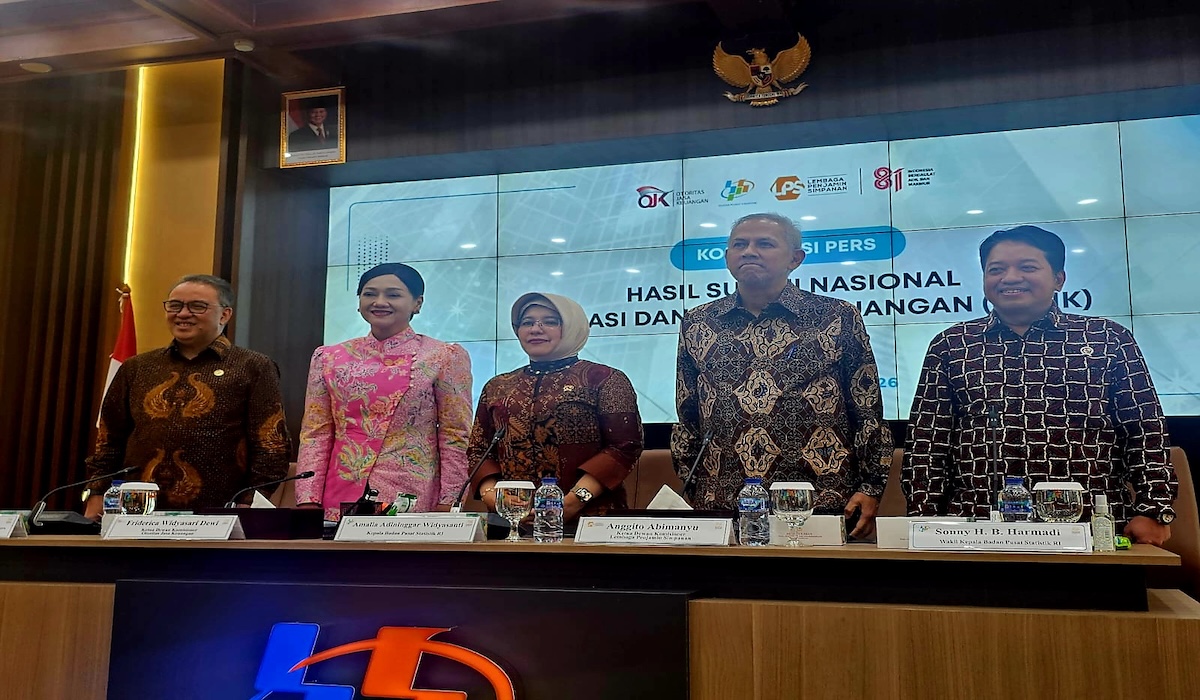
The National Survey of Financial Literacy and Inclusion (SNLIK) 2026 recorded an increase in public understanding and access to financial products and services. The national financial literacy index rose from 66.64% in 2025 to 69.57% in 2026.
Head of Statistics Indonesia (BPS) Amalia Adininggar Widyasanti stated that the increase demonstrates growing public comprehension of financial products and services, in line with intensified financial literacy programmes. She made the remarks during a press conference on the SNLIK 2026 results at the BPS office in Central Jakarta on Monday (10/8).
Financial literacy measurement covers five main aspects: knowledge, skills, confidence, attitude, and behaviour in managing finances. Individuals who meet all five criteria are categorised as well literate. With the 2026 national financial literacy index achievement, approximately 70 out of every 100 Indonesians aged 15-79 years meet the well-literate criteria. The index rose by 2.93 percentage points compared to the previous year.
By service type, conventional financial literacy was recorded at 69.57%, while Sharia financial literacy reached 43.07%. Improvements were also seen across regions. The financial literacy index in urban areas increased by 1.54 percentage points, while rural areas saw a more significant rise of 4.55 percentage points. Amalia noted that this development indicates a more even distribution of financial literacy improvement, including between men and women.
By province, DKI Jakarta recorded the highest literacy rate at 80.01%, followed by South Kalimantan at 79.69% and Bali at 78.77%. Meanwhile, several provinces in eastern Indonesia remain below the national average. Amalia said this situation provides room to strengthen literacy programmes tailored to the characteristics and needs of communities in each region. For Sharia financial literacy, Aceh recorded the highest achievement, followed by the Riau Islands and DKI Jakarta.
In terms of education, financial literacy increased across almost all education groups. The highest increase was recorded among those who completed elementary school or equivalent, rising by 5.06 percentage points. By age group, the productive age group of 26-35 years had the highest financial literacy level compared to other age groups.
Beyond literacy, public access to financial products and services also continued to grow. The national financial inclusion index rose from 92.74% in 2025 to 93.61% in 2026, an increase of 0.87 percentage points. This increase mainly came from conventional financial inclusion, which rose from 92.61% to 93.53%. Both urban and rural areas recorded increases of 0.99 and 0.36 percentage points respectively.
By province, DKI Jakarta recorded the highest financial inclusion, followed by the Special Region of Yogyakarta and the Riau Islands. Conversely, Papua Pegunungan, Central Papua, and North Maluku still recorded relatively low inclusion rates, requiring strengthened financial access. For Sharia financial inclusion, Aceh recorded the highest achievement, followed by the Riau Islands and Riau, while the lowest achievements were recorded in Bali, East Nusa Tenggara, West Papua, and Papua Pegunungan.
By age group, the 26-35 age group again recorded the highest achievement with a financial inclusion rate of 96.27%. Meanwhile, the 15-17 and 51-79 age groups remained below the national average.
The SNLIK 2026 also measured public knowledge regarding deposit insurance by the Indonesia Deposit Insurance Corporation (LPS). The survey results showed that 62.51% of residents aged 15-79 years with savings accounts knew their deposits were insured. Knowledge of deposit insurance tended to increase with education level. The group with tertiary education had the highest level of knowledge, reaching 85.26%. By deposit value, account holders with balances of IDR 100 million to IDR 500 million had the highest level of knowledge about deposit insurance, at around 92.6%.
Regionally, Papua recorded the highest level of knowledge about deposit insurance at 77.14%, followed by DKI Jakarta at 76.39% and East Kalimantan at 74.73%. Conversely, Papua Pegunungan, Gorontalo, and South Sulawesi still had relatively low levels of knowledge.
Overall, the SNLIK 2026 results show progress in public understanding and access to financial services. However, disparities between regions and community groups remain a challenge that needs to be addressed through more targeted financial literacy and inclusion programmes.
Source: jawawa.id (https://jawawa.id/newsitem/bps-indonesias-financial-literacy-rises-to-69-57-percent-1786362669)
Originally published by Media Indonesia (https://mediaindonesia.com/ekonomi/920189/bps-literasi-keuangan-indonesia-meningkat-jadi-6957-persen), translated from Indonesian