
BPS: Financial literacy and inclusion indices rise in 2026
The increase was driven primarily by conventional finance, which rose from 92.61 percent to 93.53 percent.
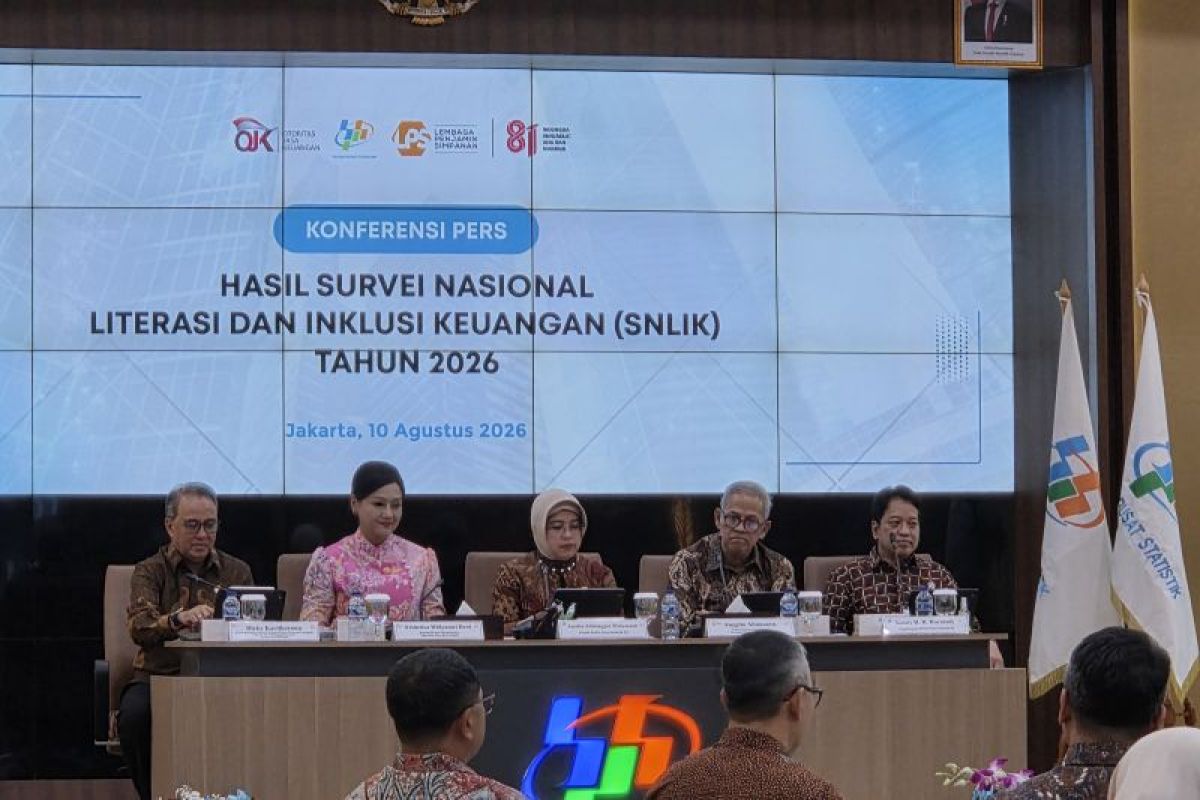
Jakarta (ANTARA) - Statistics Indonesia (BPS) has released the results of the 2026 National Survey on Financial Literacy and Inclusion (SNLIK), showing that the public’s financial literacy and inclusion indices have increased compared to the previous year.
BPS recorded the public’s financial literacy index in 2026 at 69.57 percent, up 2.93 basis points from 66.64 percent in 2025.
“Based on the 2026 SNLIK results, the 2026 Financial Literacy Index stands at 69.57 percent, meaning that around 70 out of 100 Indonesians aged 15 to 79 have met the well literate criteria,” said BPS Head Amalia Adininggar Widyasanti during a press conference on the 2026 SNLIK results in Jakarta on Monday.
Financial literacy refers to the knowledge and skills that influence attitudes and behaviour to improve the quality of financial decision-making and management.
Amalia detailed that by region, the financial literacy index in urban areas was higher at 72.54 percent, compared to 64.42 percent in rural areas.
Meanwhile, by type of finance, the conventional financial literacy index stood at 69.57 percent, while sharia finance was at 43.07 percent.
“In 2026, conventional financial literacy was 69.57 percent, while sharia was 43.07 percent. Compared to 2025, the conventional financial literacy index increased by approximately 2.93 basis points,” she explained.
Furthermore, the financial inclusion index was recorded at 93.61 percent in 2026, an increase of 0.87 percentage points from 92.74 percent the previous year.
“This increase was driven primarily by conventional finance, which rose from 92.61 percent to 93.53 percent,” said Amalia.
Financial inclusion refers to the availability of access to and utilisation of affordable, quality and sustainable financial sector products or services that meet the needs and capabilities of the public.
By region, the financial inclusion index in rural areas was recorded at 90.39 percent, while urban areas reached 95.47 percent.
“The 2026 financial inclusion index in both urban and rural areas increased compared to last year, with urban areas up 0.99 basis points and rural areas up 0.36 basis points,” Amalia explained.
The 2026 SNLIK used a survey methodology with samples spread across 38 provinces and 514 regencies/cities.
Interviews were conducted using the Computer Assisted Personal Interviewing (CAPI) method through the FASIH Mobile application.
Field data collection took place from 26 January to 18 February 2026, with a total of 75,000 respondents.
The 2026 SNLIK survey was a collaboration between BPS, the Financial Services Authority (OJK) and the Indonesia Deposit Insurance Corporation (LPS).