
BPS Explains Latest Prices of Rice, Cooking Oil, and Garlic
Jakarta, CNBC Indonesia - Statistics Indonesia (BPS) has revealed that the prices of several food commodities remain above the government’s reference levels in the first week of August 2026. Commodities requiring attention include rice and cooking oil, while garlic prices have begun to show a decline despite still being above the reference selling price (HAP).
Head of BPS Amalia Adininggar Widyasanti stated that based on food price monitoring up to the first week of August 2026, the prices of rice and cooking oil are already at relatively high levels, even though their Consumer Price Index (IPH) changes are relatively low.
“If we look at rice and cooking oil, their price levels are already relatively high, above the HAP,” Amalia said during the Ministry of Home Affairs’ Regional Inflation Coordination Meeting on Monday (10/8/2026).
According to BPS data, the national average price of all rice qualities in the first week of August 2026 reached Rp15,545 per kilogramme, a slight increase of 0.16% compared to July 2026. BPS also noted that 106 districts/cities still experienced an increase in the rice IPH up to the first week of August 2026. The highest rice price was recorded at Rp50,000 per kg, with regions such as Pegunungan Bintang Regency, Intan Jaya Regency, and Nabire Regency listed among the areas with the highest prices. This situation is one reason why rice still requires government attention, even though the national price increase is relatively limited. BPS categorises rice as a commodity with a high price level but low IPH change.
For cooking oil, BPS recorded the average price in traditional markets during the first week of August 2026 at around Rp20,229 per litre, a slight decrease of 0.04% compared to July 2026. Despite the monthly decline, the price level remains high and above the reference selling price. BPS noted that 82 districts/cities experienced an increase in the cooking oil IPH up to the first week of August 2026, with the highest recorded price reaching approximately Rp60,000 per litre in Intan Jaya Regency. Thus, the slight national decline does not mean the cooking oil price issue is resolved, especially as some regions still face very high prices.
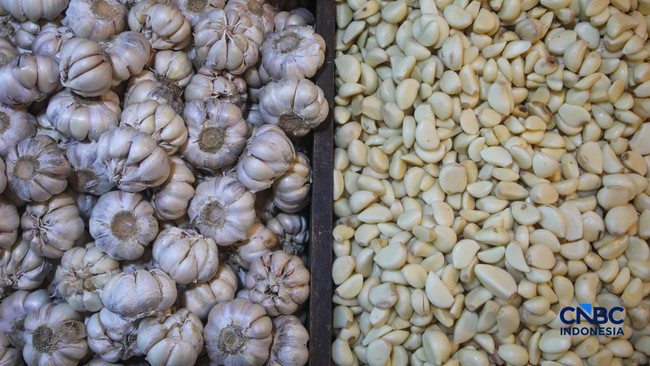
In contrast to rice and cooking oil, garlic price developments show improvement. BPS recorded the national average garlic price in the first week of August 2026 at Rp39,924 per kg, a decrease of 4.95% compared to July 2026. The number of regions experiencing a garlic IPH increase also fell sharply, from 248 districts/cities previously to just 50 districts/cities. Amalia stated that the garlic situation is now far more under control compared to before. “So the remaining issues are much better, much smaller, as we can also see from the garlic import figures,” she noted. However, the national garlic price is still above the HAP of Rp38,000 per kg. BPS recorded that some areas still have quite high prices, such as South Manokwari Regency at Rp63,750 per kg, Paniai Regency at Rp68,750 per kg, and Kaimana Regency at Rp53,000 per kg. Amalia said the national garlic supply should be adequate because imports during the first half of 2026 were relatively large. “This has been continuously declining, and cumulatively it is already quite a lot. Garlic imports during the first semester of 2026 reached 229,000 tonnes. So, almost 230,000 tonnes, and this should mean the supply is adequate,” she explained.
BPS data shows that garlic imports from January to June 2026 reached 229,760 tonnes. This figure increased compared to the same period the previous year, which was recorded at 178,890 tonnes. The majority of these imports originated from China. In the first semester of 2026, garlic imports from China reached 225,570 tonnes, or 98.18% of the total imports. India was the second-largest source, with a volume of around 4,180 tonnes, or 1.82%. “As usual, 98% of our imports come from China, followed by India,” Amalia said. She added that the number of regions experiencing garlic price increases is now far fewer than before. Therefore, garlic is considered relatively more under control, although several areas still require attention. Based on these developments, BPS observes that food price pressures in early August 2026 are not uniform. Rice and cooking oil still need to be monitored due to their relatively high price levels, while garlic has begun to show a downward trend with narrowing price increase pressures in the regions.