
BPOM Uncovers Illegal Cosmetics Factory with Annual Turnover of Rp9 Billion
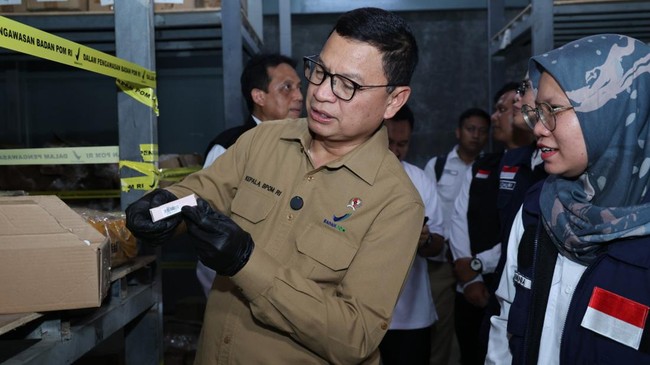
Indonesia’s Food and Drug Monitoring Agency (BPOM) has uncovered suspected illegal cosmetics production involving potentially harmful ingredients in Mojokerto, East Java. During a raid on a production facility, officers found various cosmetics without distribution permits, with an estimated economic value of more than Rp16 billion.
The operation was carried out by officers from the Surabaya Centre for Drug and Food Control on Thursday (8 October) at a production site on Jalan PB Sudirman, Mojokerto.
Officers found a range of production equipment, including mixing, filling and coding machines. They also discovered raw materials, semi-finished products and packaging used to make cosmetics. The facility was found to have no business licences for cosmetics production. Products including creams, lotions and toners were also found in plain containers without labels or distribution permits.
BPOM head Taruna Ikrar said the facility was suspected of having operated since 2021, producing cosmetics illegally for financial gain.
The suspicion that hazardous ingredients were being used was reinforced by the discovery of several pharmaceutical substances at the site. These included dexamethasone, clindamycin phosphate, triamcinolone acetonide, metronidazole, betamethasone dipropionate and mometasone furoate.
“Compounded creams containing medicinal ingredients must be used under a doctor’s supervision, as each person’s needs differ. The public’s continued desire in Indonesia for instant results is one factor behind the widespread circulation of cosmetics containing prohibited or dangerous substances,” Taruna said in a press release received by CNBC Indonesia on Friday (6 November 2026).
Illegal cosmetics marketed to beauty clinics
BPOM’s investigation found that the illegal cosmetics had been distributed to various parts of Indonesia. The sales targets included a number of beauty clinics.
Sales were estimated to generate turnover of Rp750 million a month, or around Rp9 billion a year.
Taruna stressed that producing cosmetics without a business licence and adding prohibited substances constituted a serious offence, as the resulting products offered no guarantee of safety or quality for the public.
“The business operators deliberately produced cosmetics at a facility without the required business licences for cosmetics and added substances prohibited in cosmetics, meaning there was no assurance of the safety and quality of the products being distributed,” he said.
To establish the products’ contents, BPOM collected samples of both finished and semi-finished cosmetics. Laboratory tests confirmed that several samples contained substances prohibited in cosmetics: retinoic acid, dexamethasone, hydroquinone and mometasone furoate.
Health risks
Using cosmetics containing medicinal substances without medical supervision can have a range of adverse health effects.
BPOM said retinoic acid can cause dry skin and a burning sensation. It may also harm a foetus if used during pregnancy because it is teratogenic.
Dexamethasone can trigger contact dermatitis, acne and skin redness, as well as reduce hormone production.
Hydroquinone can cause darkening of the skin and discolouration of the cornea and nails. Mometasone furoate may also lead to skin thinning, or atrophy, and disrupt the body’s hormone-release system.
BPOM is continuing to investigate the case to identify those involved and determine how the violations were carried out.
All items found at the site have been seized to stop production and prevent the illegal cosmetics from spreading further. BPOM said the business operators could face administrative sanctions, including the destruction of the products.
Those responsible for producing and distributing illegal cosmetics in breach of the rules may also be prosecuted under Article 435 in conjunction with Article 138(2) of Law No. 17 of 2023 on Health. The offence carries a maximum sentence of 12 years in prison or a fine of up to Rp5 billion.
BPOM urges the public not to be tempted by instant results
Amid the proliferation of beauty products, BPOM urged the public to take greater care when choosing cosmetics. Claims of achieving whiter, brighter or smoother skin in a short time should not be accepted without first checking that the product is safe.
Consumers were also urged to buy cosmetics from trusted retailers and ensure that products have an official distribution permit.
One recommended measure is to follow the Cek KLIK principle: check the packaging, label, distribution permit and expiry date before buying or using cosmetics.
BPOM also called on the public to report any suspected illegal production, storage or distribution of cosmetics.
Through continued monitoring and public education, BPOM hopes consumers will become more discerning when choosing beauty products and will not put their health at risk for the sake of instant results.
Source: jawawa.id (https://jawawa.id/newsitem/bpom-uncovers-illegal-cosmetics-factory-with-annual-turnover-of-rp9-billion-1793955058)
Originally published by CNBC Indonesia (https://www.cnbcindonesia.com/lifestyle/20261106142552-33-783000/bpom-bongkar-pabrik-kosmetik-ilegal-omzet-rp9-miliar-setahun), translated from Indonesian