
BPOM Regulation No. 5/2026 Issued to Strengthen National Drug Supervision and Protect the Public
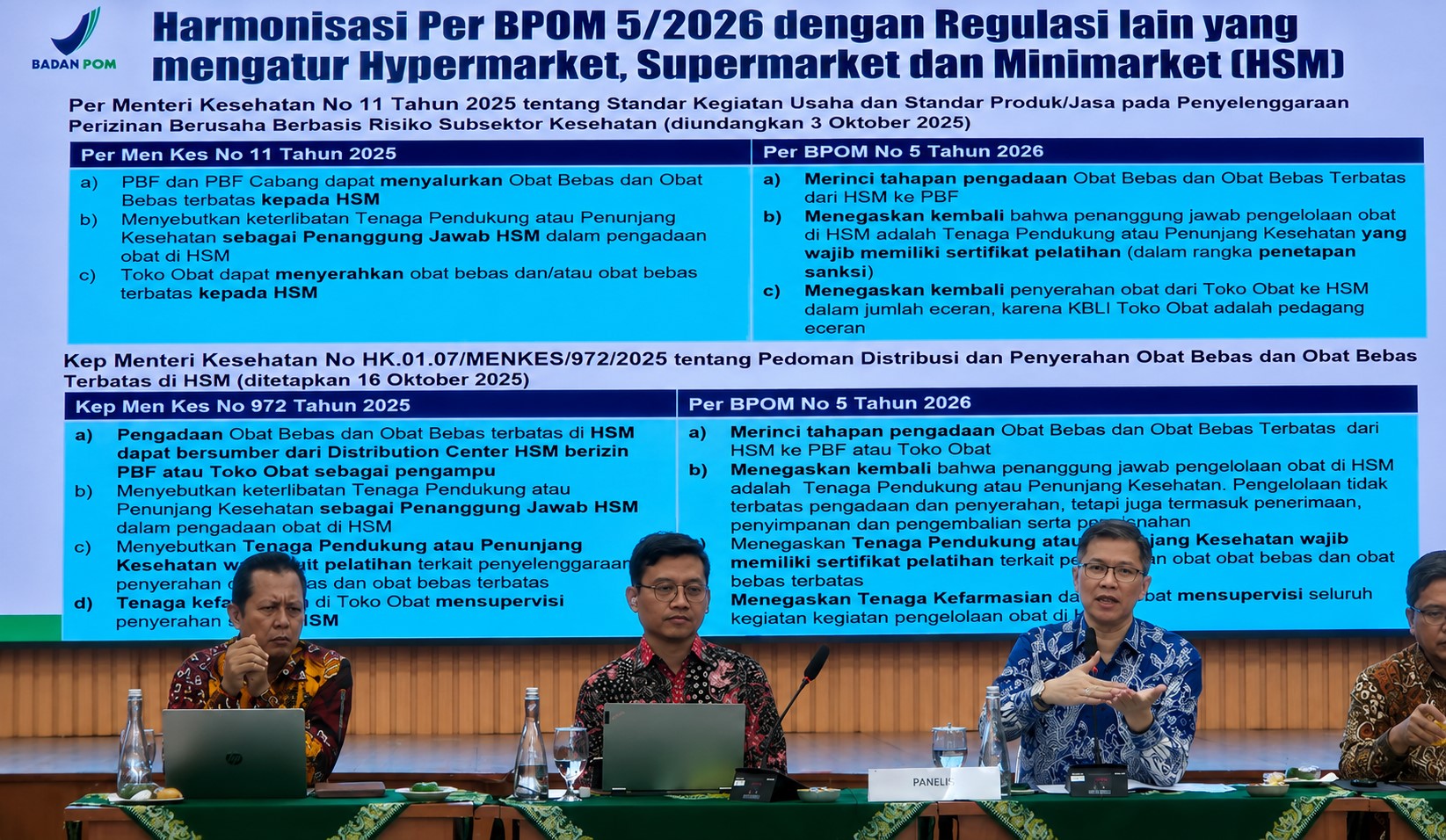
The Indonesian Food and Drug Authority (BPOM) has emphasised that BPOM Regulation Number 5 of 2026, concerning the ‘Supervision of Drug and Drug Ingredient Management in Pharmaceutical Service Facilities and Other Facilities’, was issued to strengthen the national drug supervision system while simultaneously increasing public protection. This clarification was made during a Focus Group Discussion (FGD) held at Universitas Gadjah Mada (UGM) in Yogyakarta.
William Adi Teja, Deputy for the Supervision of Drugs, Narcotics, Psychotropics, Precursors, and Addictive Substances at BPOM RI, explained that the regulation does not mandate the placement of a pharmacist in every minimarket or supermarket. Instead, it ensures that the entire drug management process is conducted according to standards and remains under the supervision of pharmaceutical professionals.
According to William, following the directives of the Head of BPOM, Taruna Ikrar, the presence of over-the-counter (OTC) and limited OTC drugs in various hypermarkets, supermarkets, and minimarkets is a long-standing phenomenon aimed at meeting public needs. However, prior to the issuance of PerBPOM 5/2026, BPOM faced limitations in imposing administrative sanctions on non-pharmaceutical facilities that committed violations. With this new regulation, BPOM can implement guidance and administrative law enforcement more effectively without always relying on criminal approaches.
During the forum, William also clarified several pieces of information circulating in the public. He emphasised that not all hypermarkets, supermarkets, and minimarkets are permitted to sell OTC or limited OTC drugs. Only retail networks that have met the requirements for pharmaceutical professional supervision are allowed to manage and sell drugs in accordance with applicable provisions.
For large-scale modern retail networks, drug procurement must be under the supervision of a pharmacist stationed at the distribution centre. Meanwhile, standalone minimarkets or supermarkets must receive oversight from pharmaceutical technical personnel through drugstores that meet regulatory requirements.
William stressed that every drug procurement must go through a pharmaceutical supervision mechanism. Without valid approval and documentation from the responsible pharmaceutical professional, procurement cannot take place, and pharmaceutical companies or official distributors will not provide service. This provision is part of an effort to maintain the security of the drug distribution chain until it reaches the public.
PerBPOM 5/2026 is also considered to provide legal certainty for local governments, retail business actors, pharmaceutical professionals, and the public as consumers. The regulation introduces a more proportional supervisory instrument through guidance, administrative oversight, and the strengthening of responsible drug distribution governance.
Through this policy, BPOM reaffirms its commitment to ensuring that all drugs circulating in Indonesia continue to meet the aspects of quality, safety, and efficacy. At the same time, BPOM strives to create a balance between ease of public access to over-the-counter medicines and the protection of public health through stronger and more measurable supervision.
Source: jawawa.id (https://jawawa.id/newsitem/bpom-regulation-no-5-2026-issued-to-strengthen-national-drug-supervision-and-protect-the-public-1780849250)
Originally published by Media Indonesia (https://mediaindonesia.com/humaniora/896491/peraturan-badan-pom-no52026-untuk-kuatkan-pengawasan-obat-nasional-dan-lindungi-masyarakat), translated from Indonesian