
BPOM and URI discuss BPOM Vocational School to strengthen national resilience
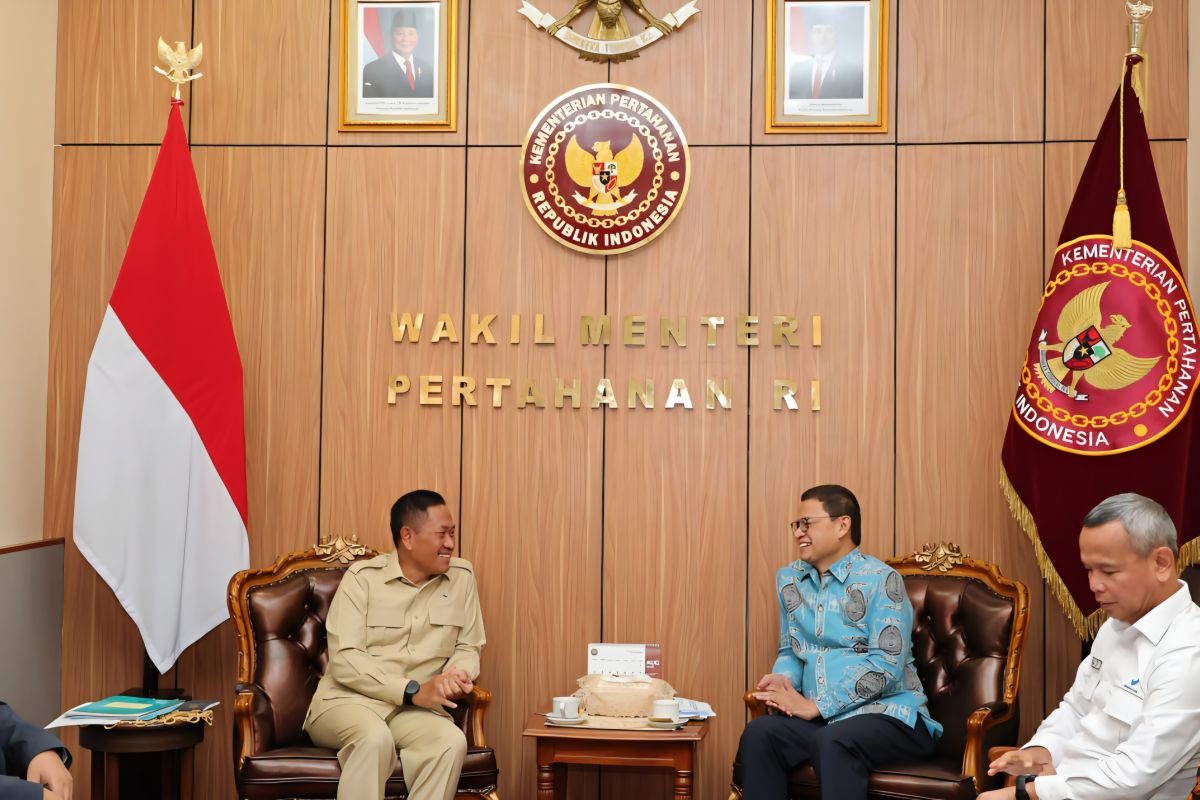
Jakarta (ANTARA) - Head of BPOM Taruna Ikrar held an audience with the Governor of the University of the Republic of Indonesia (URI), Marshal (Ret.) Donny Ermawan Taufanto, to discuss strengthening national human resources through the use of artificial intelligence (AI) and the development of the BPOM Vocational School.
One of the topics discussed in the meeting was the importance of utilising AI in developing education for Indonesia’s future leaders, which needs to be balanced with increasing human resource capacity so that its use can support strategic decision-making while still paying attention to ethical aspects and technology governance.
“Collaboration between academia, business, and government, or Academia-Business-Government (ABG), is one of the approaches encouraged to build a human-centred AI leadership ecosystem. Through this collaboration, technology development is expected to continue to place humans and leadership quality as the main aspects,” said Head of BPOM Taruna in Jakarta on Thursday.
He said BPOM also supports the integration of AI into the national leadership curriculum across disciplines, particularly in strengthening data literacy and technology ethics.
In addition, he continued, the development of AI-based simulated decision labs is also considered to be a means for prospective leaders to test policy formulations in various scenarios and real risks.
“This need is increasingly important given the complexity of supervisory challenges that continue to evolve along with advances in pharmaceutical science, technology, and the threat of crime in the drug and food sector,” said Taruna Ikrar.
Based on data as of August 2026, BPOM has 6,432 civil servants (ASN), or around 60.06 percent of the human resource (HR) requirement of 10,710 people. This condition shows the need for an HR development strategy that is able to answer the specific needs of drug and food supervision.
BPOM’s human resources, he said, are required to have competencies that combine technical aspects, digital technology, regulation, regulatory science, testing, evaluation, supervision, and enforcement in the field.
The agency considers that national resilience is not only determined by military defence aspects, but also by the state’s ability to guarantee health, food security, drug availability, technological mastery, and the quality of human resources.
Therefore, the development of the BPOM Vocational School is seen as part of the national health resilience infrastructure because the vocational education is also directed to become a strategic instrument in preparing human resources who are ready to carry out the state’s supervisory function in the drug and food sector.
Collaboration with the Indonesian Defence University is one of the strategic opportunities to optimise existing education programmes while strengthening synergy between the drug and food supervision sector and national resilience.
In addition to developing vocational education, BPOM is also opening up opportunities for cooperation with URI in developing AI-based HR training, research on AI-based drug and food supervision governance, and the establishment of a study centre focusing on ethics, regulation, impact, and audit of AI technology.
Source: jawawa.id (https://jawawa.id/newsitem/bpom-and-uri-discuss-bpom-vocational-school-to-strengthen-national-resilience-1787223315)
Originally published by Antara (Indonesian) (https://www.antaranews.com/berita/5703483/bpom-uri-bahas-sekolah-vokasi-bpom-perkuat-ketahanan-nasional), translated from Indonesian