
BPKH: Individual Account Scheme a Solution to Eliminate Invalid Hajj Queue Data
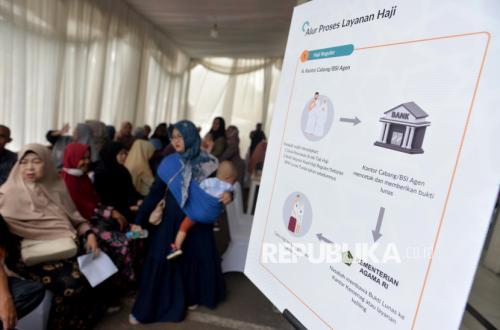
The Hajj Financial Management Agency (BPKH) believes that strengthening hajj fund management towards an individual account scheme, or segregated fund by name by address, can serve as a solution to eliminate the risk of invalid hajj pilgrim data. Previously, the Ministry of Hajj and Umrah (Kemenhaj) found around 400,000 queue data records at risk of being invalid, with potential initial deposit funds reaching approximately Rp 10 trillion.
BPKH member Indra Gunawan stated that the current general fund management of hajj funds has been operating safely, growing positively, and has received an unqualified opinion (WTP) for eight consecutive years from the Audit Board of Indonesia (BPK). However, for maximum protection and to eliminate data outliers in the future, strengthening towards individual accounts or segregated funds by name by address is indeed ideal.
“With this scheme, each pilgrim’s deposits, instalments, and benefit values are recorded individually, more transparently, and better protected, thereby eliminating invalid or outlier data of 400,000 queue records at risk of being invalid,” Indra told Republika.
Indra also highlighted facts that reinforce the move towards individual accounts. Among them, Law Number 34 of 2014 already requires BPKH to provide information and pay benefit values periodically to the virtual account of each prospective hajj pilgrim (by name-individual). BPKH currently operates a Virtual Account (NMVA).
With full individual accounts, the risk of invalid data such as the finding of 400,000 queue records at risk of being invalid with potential initial deposit funds of around Rp 10 trillion can be eliminated. This is because every rupiah is directly tied to the pilgrim’s identity in real-time and can be verified automatically. This is in line with the spirit of Law Number 34 of 2014 and the Fatwa of the Ijtima Ulama of the Indonesian Ulema Council (MUI), which emphasises the principles of justice and sustainability of hajj funds, particularly protecting the interests of 5.7 million pilgrims on the waiting list alongside those departing.
“BPKH is committed to keeping hajj funds safe, fair, and sustainable. This data validation is precisely a momentum for improving governance so that the trust of the ummah becomes even stronger,” Indra said.
Regarding the Kemenhaj finding of 400,000 queue data records at risk of being invalid with potential initial deposit funds of around Rp 10 trillion, BPKH stated that its main database resides in the Integrated Hajj Computerisation System (Siskohat) owned by Kemenhaj.