
BPKH Cuts 2026 Operational Budget by IDR 100.31 Billion to Safeguard Hajj Funds
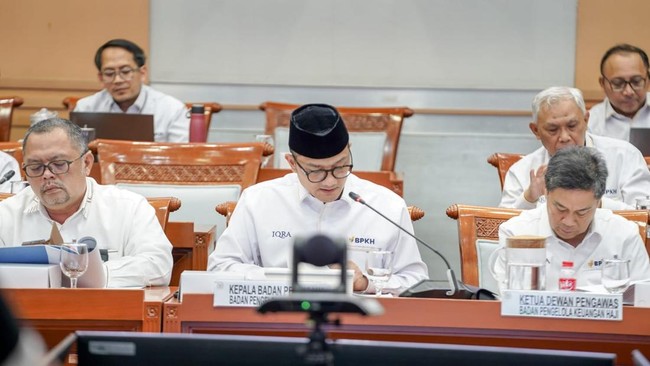
The Hajj Financial Management Agency (BPKH) has officially implemented an efficiency drive for its 2026 operational budget, cutting the operational cost ceiling by Rp100.31 billion, or 18.59%. This decision was agreed upon during a Hearing Session with Commission VIII of the Indonesian House of Representatives (DPR RI) during the discussion of BPKH’s 2026 Revised Annual Work and Budget Plan (RKAT-P).
Through this adjustment, the BPKH operational cost ceiling, which was originally Rp539.63 billion, has been set at Rp439.32 billion. This step represents BPKH’s commitment to strengthening institutional governance through more effective, efficient, transparent, and accountable budget management, without reducing the quality of service to pilgrims or the performance of Hajj fund management.
The Head of the BPKH Executive Body, Fadlul Imansyah, emphasised that the budget efficiency was carried out in a measurable manner while maintaining all the organisation’s strategic functions.
“Even though the operational budget has decreased by more than Rp100 billion, BPKH is optimistic that the quality of service to pilgrims, institutional governance, and the performance of Hajj financial investment development throughout 2026 will remain optimal, trustworthy, and professional. This efficiency is actually a momentum to strengthen a work culture that is increasingly effective, adaptive, and results-oriented,” said Fadlul, as quoted from a written statement on Tuesday.
Fadlul explained that the policy also aligns BPKH with the government’s direction in encouraging expenditure efficiency across all ministries and agencies.
“BPKH views that the spirit of efficiency, which is a policy of President Prabowo Subiante, needs to be realised by every institution according to their respective characteristics and authorities. As the manager of Hajj financial funds, we are obliged to ensure that every rupiah of operational costs is used precisely, provides added value to the organisation, and supports increasingly healthy and sustainable Hajj fund management,” he added.
According to Fadlul, the efficiency implemented by BPKH is not solely aimed at reducing operational spending, but is part of a strategy to strengthen institutional resilience in managing the entrusted funds of millions of prospective Indonesian Hajj pilgrims.
“The ultimate goal of all the efficiency steps we take is to maintain the sustainability of the Hajj funds. Hajj funds are entrusted funds belonging to pilgrims that must be managed carefully, efficiently, productively, and responsibly so that the benefits continue to be preserved, both for current pilgrims and for future generations of pilgrims,” he asserted.
In line with this, a member of the BPKH Executive Body for Planning and Direct Investment, M. Arief Mufraini, stated that the operational budget adjustment was conducted through a thorough evaluation of all work programmes to ensure no disruption to strategic programmes or investment development.
“Budget efficiency does not mean reducing organisational capacity, but optimising resource allocation to programmes that deliver the greatest impact. We ensure that the planning function continues to run optimally so that direct investment strategies can be implemented prudently, productively, and with an orientation towards increasing the value of Hajj fund benefits,” he revealed.
He added that the quality of planning is a crucial factor in ensuring every investment is selective, measurable, adheres to Sharia principles, and applies the principle of prudence.
Meanwhile, a member of the BPKH Executive Body for Accounting and Finance, Amri Yusuf, assessed that budget efficiency is part of strengthening the discipline of the institution’s financial management and implementing good governance.
“Efficiency is not merely about cutting spending, but ensuring every expenditure provides optimal benefits for the organisation and the welfare of pilgrims. Through the strengthening of accounting systems, internal controls, and accountable and transparent financial governance, BPKH ensures that efficiency goes hand-in-hand with the improvement of Hajj financial management quality,” said Amri.
According to him, strengthening efficiency will also increase BPKH’s flexibility in facing economic and financial market dynamics, without compromising the principle of prudence in managing the community’s funds.
At the same opportunity, the Vice Chairman of Commission VIII of the DPR RI, H. Ansory Siregar, stated that Commission VIII has approved the BPKH 2026 Revised Annual Work and Budget Plan (RKAT-P), including the adjustment of the operational cost ceiling to Rp439.32 billion.
“Commission VIII of the DPR RI approves the BPKH 2026 RKAT-P, including the adjustment of the operational cost ceiling to Rp439.32 billion. We hope this efficiency step further strengthens BPKH’s institutional governance without reducing the quality of service to Hajj pilgrims,” he said.
This approval serves as parliamentary support for BPKH’s steps in making measurable budget adjustments while ensuring the sustainability of healthy, efficient, and community-oriented Hajj financial management. Through this efficiency policy, BPKH reaffirms its commitment to prioritising good governance, strengthening accountability and transparency, and optimising every resource available.
Consequently, Hajj fund management is expected to become more resilient, providing optimal benefits, and remaining sustainable to protect the trust of millions of Indonesian Hajj pilgrims, both for the present and the future.