
BPKH and Lemhannas RI Strengthen Collaboration to Develop Character-Driven Human Resources
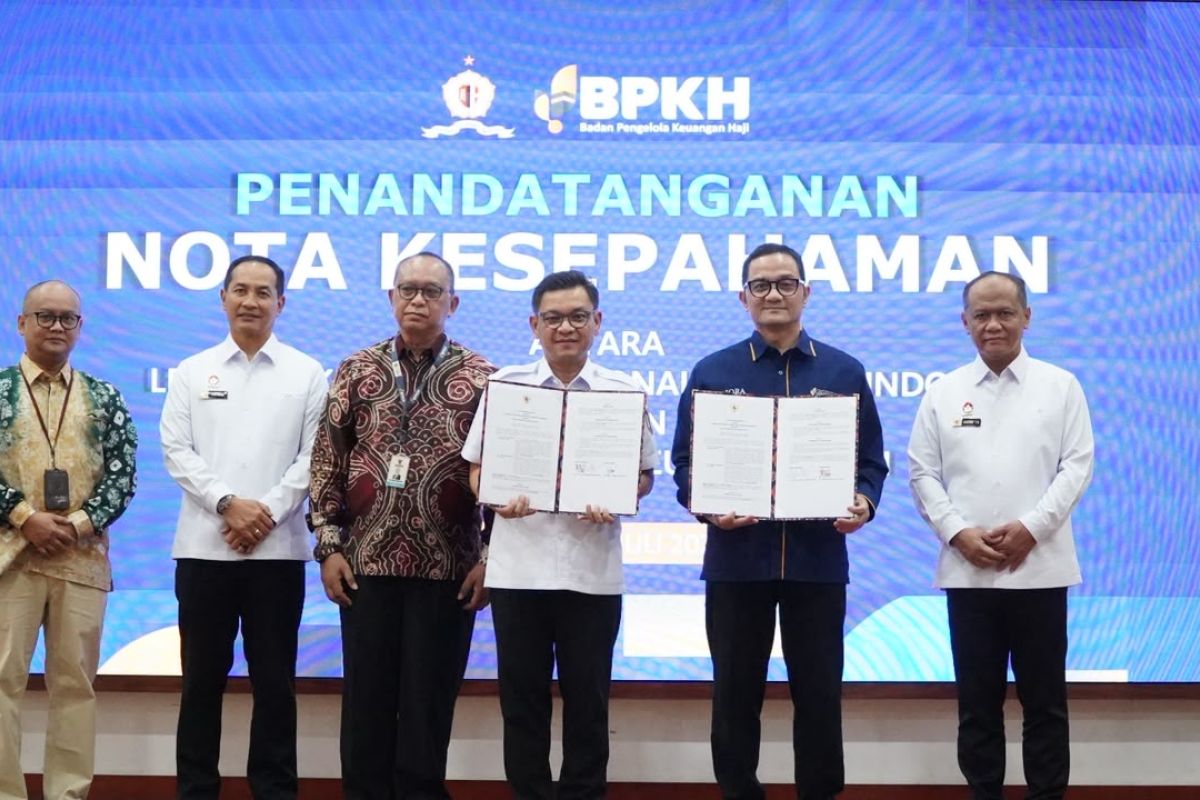
Jakarta (ANTARA) - The Hajj Financial Management Agency (BPKH) and the National Resilience Institute (Lemhannas) have signed a Memorandum of Understanding (MoU) to strengthen human resource quality, institutional governance, and the development of strategic studies to support the trustworthy, professional, and sustainable management of Hajj finances.
According to a statement received in Jakarta on Saturday, the MoU was signed by the Head of the BPKH Executive Body, Fadlul Imansyah, and the Governor of Lemhannas RI, Tubagus Ace Hasan Syadzily, at the Tri Gatra Building, Jakarta, on Thursday (30/7). The ceremony was witnessed by BPKH Executive Body Member Acep Riana Jayapriumira and Vice Governor of Lemhannas RI, Admiral Erwin S. Aldedharma.
Fadlul Imansyah stated that this cooperation is part of BPKH’s commitment to continuously strengthening institutional capacity amidst increasingly complex global challenges. “Therefore, BPKH’s responsibility is not only to keep the value of the funds secure, but also to manage them productively, transparently, and accountably to provide optimal benefits for pilgrims,” he said.
He explained that BPKH holds three primary mandates in managing Hajj funds: ensuring fund security, optimising benefits, and ensuring transparency in every policy and fund management decision. These mandates require BPKH to continuously improve the quality of its human resources to meet the challenges of geopolitical changes, technological developments, and social dynamics that affect Hajj investment and financial management.
“In the future, BPKH requires human resources that are not only excellent in professional and financial competence but also possess strong integrity, robust national insight, and strategic thinking capabilities,” he added. Consequently, he views the collaboration with Lemhannas RI as a long-term investment in building leadership capable of upholding the trust of the community and the interests of the nation.
Through this MoU, both institutions will collaborate in two main areas: improving human resource quality through various education and training programmes, and the exchange of information and the organisation of scientific activities. BPKH will involve its officials and employees in various strategic Lemhannas RI programmes, including the Short Course Programme for the Armed Forces (PPSA), the National Value Strengthening Programme, and internal training for all staff.
Fadlul emphasised that strengthening competence, integrity, and national insight is a vital foundation for the sustainability of Hajj fund management. BPKH is optimistic that the synergy with Lemhannas RI will produce leaders capable of maintaining public trust while strengthening Hajj financial governance in accordance with the principles of Sharia, prudence, transparency, and accountability.
This collaboration is also part of BPKH’s efforts to provide Hajj fund management that delivers maximum benefits to pilgrims and contributes to national development through professional, high-integrity, and sustainable governance. Furthermore, both institutions will develop discussion forums, seminars, research, and the exchange of experts to enrich perspectives on various strategic issues, including Hajj fund management and the development of the Sharia economy. This synergy is expected to strengthen the contribution of Hajj fund management to national economic resilience.
Meanwhile, the Governor of Lemhannas RI, Tubagus Ace Hasan Syadzily, welcomed the strategic cooperation between Lemhannas RI and BPKH. According to him, this collaboration serves as an important momentum to strengthen institutional capacity in facing increasingly dynamic national challenges. “We hope this cooperation does not stop at the signing of a document alone, but is immediately followed up through concrete, measurable implementation that provides real benefits for both institutions. The agreed programmes need to be realised promptly so that the goals of strengthening human resources, developing strategic studies, and improving governance can be achieved as soon as possible,” said Ace.