
BPKH: 2027 Hajj Costs Must Balance Pilgrim Fairness and Financial Sustainability
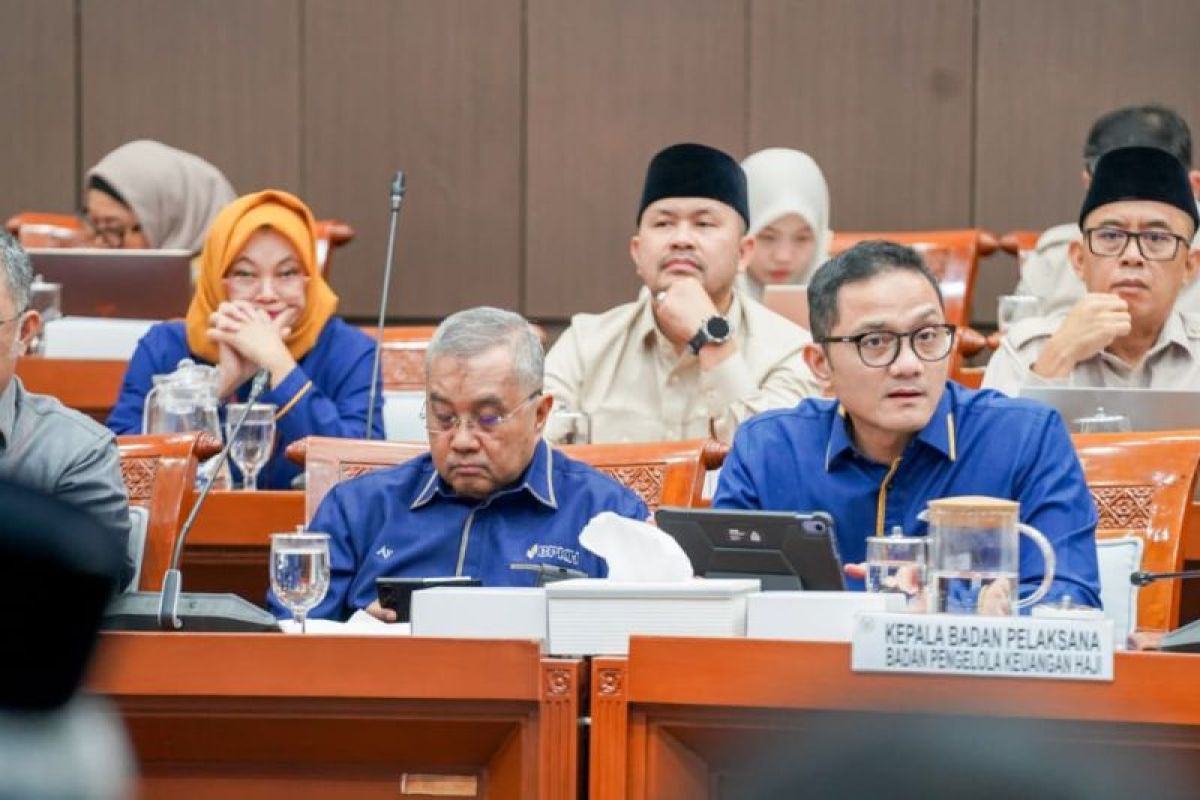
Jakarta (ANTARA) - The Hajj Financial Management Agency (BPKH) has stressed that the setting of the 2027 Hajj Pilgrimage Cost (BPIH) for 1448 Hijriah must carefully balance affordability for departing pilgrims, fairness for those still in the waiting period, compliance with sharia principles, and the long-term financial sustainability of the Hajj fund. This was conveyed by BPKH during a Hearing Meeting (RDP) with Commission VIII of the Indonesian House of Representatives (DPR RI) in Jakarta on Wednesday. BPKH presented the current state of Hajj finances and simulations of the impact of using benefit value based on the proposed 2027 BPIH.
Head of the BPKH Executive Board, Fadlul Imansyah, said the condition of managed Hajj funds continues to show positive growth. However, this growth must be accompanied by prudent and sustainability-oriented policies in utilising the benefit value. “The growth of Hajj funds shows positive performance. However, what is no less important is ensuring that these funds remain managed prudently and sustainably. Every BPIH policy needs to consider the long-term financial capacity of the Hajj fund, including the rights and interests of pilgrims who are still in the waiting period,” said Fadlul.
As of July 2026, the balance of Hajj funds was recorded at Rp182.34 trillion, growing 5.41 percent year-on-year compared to Rp172.99 trillion in July 2025. This position has reached approximately 96.19 percent of the year-end target of Rp189.62 trillion. Meanwhile, the benefit value up to July 2026 was recorded at Rp7.01 trillion, or 56.96 percent of the year-end target of Rp12.31 trillion.
In a longer perspective, managed Hajj funds increased from Rp112.35 trillion in December 2018 to Rp182.34 trillion in July 2026, or grew by approximately 62.30 percent with an average annual growth rate (CAGR) of 6.24 percent. According to Fadlul, this achievement must be maintained because the discussion of BPIH is not merely about the amount of costs to be borne by pilgrims in the current year.
“What we need to maintain is the balance between Bipih, benefit value, and the financial capacity of the Hajj fund. We want the current year’s Hajj implementation to run well, but at the same time the rights of pilgrims who are still waiting must also remain protected,” he said.
Based on the proposal under discussion, the BPIH for 1448 H/2027 M is Rp107.34 million per person, an increase of approximately Rp19.93 million or 22.8 percent compared to the BPIH for 1447 H/2026 M of Rp87.41 million per person. In a financing composition scenario of 40 percent Bipih (costs paid by pilgrims) and 60 percent benefit value, the Bipih per person becomes approximately Rp42.94 million, while the benefit value portion reaches approximately Rp64.40 million per person. For comparison, in the 2026 BPIH, the Bipih per person was approximately Rp54.19 million and the benefit value was approximately Rp33.22 million, with a composition of 62 percent Bipih and 38 percent benefit value.
With a quota of 203,320 prospective pilgrims, the 2027 BPIH scenario requires a benefit value of approximately Rp12.98 trillion. This figure is an increase of approximately Rp6.29 trillion compared to the benefit value requirement for the 2026 BPIH of approximately Rp6.70 trillion. On the other hand, based on BPKH projections, the total benefit value for 2027 is estimated at Rp12.375 trillion. This benefit value is not entirely available to finance the BPIH because there are other needs and allocations.
After accounting for the benefit value of the Ummah Endowment Fund of Rp260 billion, BPKH operational assumptions of Rp500 billion, and the distribution of virtual account benefit value for pilgrims of Rp5.5 trillion, the projected benefit value available for the 2027 BPIH is approximately Rp6.115 trillion. Thus, if the BPIH of Rp107.34 million per person uses a Bipih and benefit value composition of 40:60, BPKH simulations show a potential negative difference or pressure on Hajj finances of approximately Rp6.87 trillion.
Member of the BPKH Executive Board, Amri Yusuf, said the simulation shows the importance of comprehensive calculations before the 2027 BPIH financing formula is determined. “What needs attention is not only whether the benefit value is available for one year of Hajj implementation. We must also look at how its use affects the structure and health of Hajj finances in subsequent years. If the benefit value requirement exceeds the available benefit value space, policy adjustments are certainly needed,” said Amri.
According to Amri, the space for using benefit value for BPIH must be calculated realistically so that financing the Hajj implementation in one year does not place excessive pressure on the sustainability of Hajj funds. “In principle, the decisions we take today not only determine the financing of the 2027 Hajj, but also help determine the financial capacity of the Hajj fund to serve pilgrims in subsequent years,” he said.
BPKH is of the view that the BPIH formula needs to be placed in the perspective of intergenerational fairness among pilgrims. Efforts to maintain cost affordability for departing pilgrims must go hand in hand with protecting the rights and interests of pilgrims who are still in the waiting period. Fadlul said this principle is an important part of encouraging that the increase and formula of the 2027 BPIH be calculated carefully based on realistic Hajj implementation needs and the long-term financial capacity of the Hajj fund.
“We understand the importance of maintaining cost affordability for pilgrims who will depart. However, affordability must be placed within a framework of fairness. We need to ensure that policies for today’s pilgrims do not reduce the sustainability and rights of pilgrims who are still waiting,” said Fadlul. BPKH also noted that the growth of managed funds after the COVID-19 pandemic is in the range of Rp3-4 trillion per year in line with the resumption of the Hajj pilgrimage.
Source: jawawa.id (https://jawawa.id/newsitem/bpkh-2027-hajj-costs-must-balance-pilgrim-fairness-and-financial-sustainability-1787190769)
Originally published by Antara (Indonesian) (https://www.antaranews.com/berita/5702720/bpkh-biaya-haji-2027-perlu-jaga-keadilan-jamaah-dan-keberlanjutan), translated from Indonesian