
BPK Urges Supreme Court to Implement Government 5.0
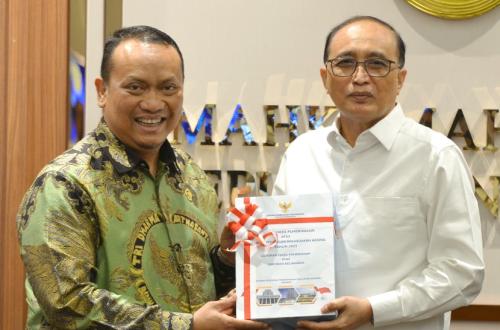
The Audit Board of Indonesia (BPK) is encouraging the Supreme Court (MA) to strengthen governance through the use of technology, artificial intelligence, and data analytics. This step is considered crucial to ensure that improvements in governance quality do not stop at administrative compliance but are able to meet the demands of an increasingly digital and sustainable government.
BPK Member I Nyoman Adhi Suryadnyana stated that governance transformation must go hand in hand with Environmental, Social, and Governance (ESG) principles and the Government 5.0 concept. He noted that the use of technology and cross-sector collaboration can improve the quality of policymaking while supporting the achievement of the Golden Indonesia 2045 vision.
“Audits do not only produce opinions but also contribute to the achievement of Golden Indonesia 2045 through strengthening governance and promoting sustainable development,” Nyoman said in a statement on Wednesday (12/8/2026).
As of the second semester of 2025, the Supreme Court had followed up on 1,948 BPK recommendations, achieving a 96.65 per cent follow-up rate, far above the national average of 76 per cent. The Supreme Court has also maintained an Unqualified Opinion for 14 consecutive years.
According to Nyoman, this achievement must be followed by system improvements and more optimal use of technology. Challenges faced include uneven digital transformation maturity, fragmented government data, limited AI talent, governance integrity, human resource capacity, cybersecurity, and inter-agency collaboration.
Therefore, Government 5.0 requires a whole-of-government approach so that digital transformation does not occur in isolation within each institution.
“The key to achieving the Golden Indonesia 2045 vision is how to combine Government 5.0 with resource management that prioritises sustainability through ESG principles,” Nyoman said.
BPK also highlighted several areas within the Supreme Court that still need strengthening, including internal control systems, state asset management, state revenue, procurement of goods and services, and regulatory compliance.
Nyoman stressed that following up on audit recommendations is essential to ensure that audit results lead to system improvements and better governance quality.
“Audits do not only assess past compliance but also help shape a better future,” Nyoman said.
The submission of the Audit Report on the Supreme Court’s 2025 Financial Report was attended by Chief Justice Sunarto, Deputy Chief Justice for Non-Judicial Affairs Dwiarso Budi Santiarto, several Chamber Presidents of the Supreme Court, BPK and Supreme Court officials, and the BPK audit team.