
BPK Urges ESG as Foundation for Government Governance
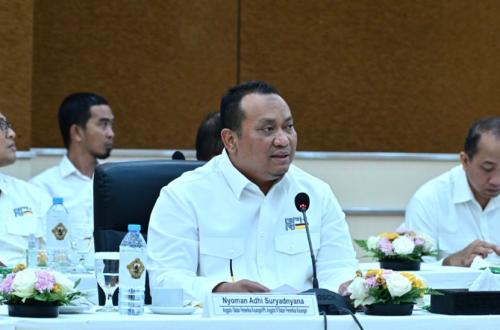
The Audit Board of Indonesia (BPK) considers strengthening governance based on Environmental, Social, and Governance (ESG) principles, along with the transformation towards Government 5.0, as a key foundation for achieving the Indonesia Emas 2045 vision. Both approaches are deemed capable of reinforcing the management of state resources while improving the quality of public-oriented and sustainable policy-making.
Acting BPK Member IV Nyoman Adhi Suryadnyana conveyed this during the submission of the Audit Results Report for the 2025 financial statements of the Ministry of Housing and Residential Areas (PKP), the Ministry of Forestry, the Ministry of Marine Affairs and Fisheries (KKP), and the Indonesian Quarantine Agency (Barantin) at the BPK head office in Jakarta on Tuesday.
The event was attended by Minister of Housing and Residential Areas Maruarar Sirait, Minister of Forestry Raja Juli Antoni, Minister of Marine Affairs and Fisheries Sakti Wahyu Trenggono, and Head of Barantin Abdul Kadir Karding.
Nyoman stated that financial statement audits serve as an instrument to ensure every rupiah of state money is managed accountably, transparently, and provides benefits to the public. “Therefore, the audit is not solely oriented towards issuing an opinion on the financial statements,” he said.
He added that audit results are also expected to contribute to the achievement of Indonesia Emas 2045 through strengthened state financial governance and sustainable development.
BPK believes ESG principles can be applied to the management of various resources within ministries and agencies, ranging from state finances, human resources, and assets to policy-making. “This management must be directed to provide benefits for the state and society while safeguarding the interests of future generations.”
Beyond ESG, Nyoman highlighted the importance of the transformation towards Government 5.0. This approach relies on the utilisation of artificial intelligence, data analysis, and cross-sector collaboration, placing society, the environment, and sustainability as the primary orientation.
According to BPK, the combination of Government 5.0 and the application of ESG principles can enhance the quality of governance and government policy-making.
However, Nyoman noted there are at least six challenges in realising Government 5.0. These include uneven digital transformation maturity, fragmentation of government data, a limited pool of artificial intelligence talent, governance integrity issues, human resource capacity that still needs improvement, as well as cybersecurity and collaboration problems.
Nyoman further explained that Government 5.0 requires a whole-of-government approach so that transformation does not proceed in silos within each ministry and agency.
On this occasion, BPK also delivered the audit results for the 2025 financial statements of four entities. The Ministry of Housing and Residential Areas, the Ministry of Forestry, the Ministry of Marine Affairs and Fisheries, and the Indonesian Quarantine Agency all received an Unqualified Opinion (WTP).
Nyoman reminded that a WTP opinion is not the ultimate goal of state financial management. The opinion should serve as a foundation to continuously address weaknesses, making governance more efficient, effective, and impactful on public welfare.
BPK also categorised the audit findings for the four entities into three main strategic issues. First, weaknesses in internal controls over the management of revenues, cash, expenditures, grants, official travel, allowances, and payment processes.
Second, weaknesses in asset administration, including inaccurate recording, unclear legal status of assets, suboptimal asset utilisation, and assets that are no longer in use but remain on the books.
Third, non-compliance with regulations concerning the procurement of goods and services, contract execution, grant management, work payments, and state revenue administration.
Based on these findings, BPK has issued recommendations to each entity. These recommendations are expected to drive system improvements, strengthen internal controls, enhance the quality of financial and asset management, and build sustainable compliance.
Nyoman expressed hope that synergy between BPK and ministries and agencies would continue to be strengthened, so that audit results serve not only as an instrument to maintain financial statement opinions but also to drive better governance and public services.