
BPJS Ketenagakerjaan Targets 20 Percent Informal Worker Coverage by End of 2026
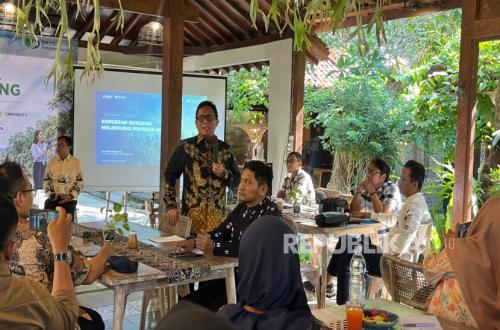
BPJS Ketenagakerjaan is targeting an increase in informal worker participation to 20 percent by the end of 2026. The target is being pursued from a participation rate that had only reached 17.44 percent as of July 2026.
President Director of BPJS Ketenagakerjaan Saiful Hidayat said there are currently 13.56 million informal workers who have become participants out of a total potential of around 77.8 million workers. According to him, this figure shows there is still considerable room to expand employment social security protection.
“We want to ensure they are protected, so hopefully the 17 percent figure can be achieved at around 20 percent this year. Because the challenge is indeed literacy,” Saiful said during a media gathering at Candi Tirto, Bantul, on Friday (28/8/2026).
Saiful did not deny that one of the main challenges in expanding informal worker participation is not merely the ability to pay contributions, but also the level of public literacy regarding the benefits of employment social security. For this reason, education about worker protection needs to be carried out massively and continuously.
To pursue the target, BPJS Ketenagakerjaan has prepared a 3R communication strategy, namely reframe, relevance, and resonance. This approach is intended to make information about social security easier to accept and for informal workers to feel its benefits.
At the reframe stage, BPJS Ketenagakerjaan wants to change workers’ perspective on contributions. Contributions should not be viewed as a burden or expense, but as a form of protection for workers and their families.
Saiful gave the example of online motorcycle taxi drivers who have irregular incomes. According to him, the contribution payment mechanism can be made more adaptable to income so that protection can still be obtained without adding to the worker’s burden.
“We are synergising with one application so that online motorcycle taxi workers no longer pay monthly contributions, but based on the money they earn, for example a deduction of Rp800, with the hope that it is not burdensome and they remain protected,” he said.
Saiful said informal workers have diverse characteristics. There are vulnerable workers who need support for contribution payments through local governments or corporate CSR. However, there are also informal workers who are economically capable of paying contributions independently.
For vulnerable workers, BPJS Ketenagakerjaan is encouraging collaboration with local governments through regional budgets and other funding sources. Amid limited fiscal conditions, Saiful said worker protection can also be promoted through the use of corporate CSR.
In addition, BPJS Ketenagakerjaan is also promoting the Sertakan programme, which invites certain parties, including civil servants, to help protect one or two vulnerable workers.
“For a civil servant, paying Rp16,800 for one person or Rp30,000 or say Rp50,000 a month is not too heavy and it can also be interpreted as alms. Because we have also received a fatwa from the MUI that protecting vulnerable workers can also be used as part of zakat and alms,” Saiful said.
The second strategy is relevance. BPJS Ketenagakerjaan will change its communication patterns to be closer to the daily experiences of informal workers, not just using regulatory language and programme terminology. Saiful gave the example of a fried food seller who faces the risk of being splashed with hot oil every day. This risk, according to him, can be an entry point to explain the benefits of Work Accident Insurance.
“So the message must match the point of view of our target, no longer using regulatory language and legal articles, but shifting to language of empathy and emotional closeness, protection, calm, and relatability,” he said.
Meanwhile, the third strategy is resonance, namely building public trust through real stories of participants who have experienced the benefits of protection when facing work risks. Saiful believes that the experiences of fellow workers will be more easily accepted by the public because they directly show that BPJS Ketenagakerjaan participation is not merely a programme, but protection that is truly needed when risks occur.
“If so far workers have been presented with programme theory and brochures, that pattern must be changed. Workers must directly understand what concrete benefits they get, so that independent awareness arises,” he said.
On the same occasion, Head of the BPJS Ketenagakerjaan Regional Office for Central Java and Yogyakarta Cahyaning Indriasari said expanding participation remains a major task. Universal coverage of Employment Social Security in Central Java currently reaches 29.98 percent, while Yogyakarta is at 32.10 percent.
According to Cahyaning, the potential number of unprotected workers is still quite large. In Central Java there is a potential of around 13.33 million workers, while in Yogyakarta it reaches around 1.27 million workers.
“These coverage figures show there is still considerable room to expand protection. Therefore, collaboration with various parties is important so that unprotected workers can immediately enter the social security ecosystem,” Cahyaning said.
In addition to expanding participation, BPJS Ketenagakerjaan is also running the Economic Empowerment and Independence Programme for Beneficiaries (PEKA). This programme is directed at beneficiaries of Death Insurance and Work Accident Insurance benefits to improve their economic capacity and build independence.
Since its launch on 4 July until 18 August 2026, the Peka programme has assisted 2,376 heirs in various regions.
Source: jawawa.id (https://jawawa.id/newsitem/bpjs-ketenagakerjaan-targets-20-percent-informal-worker-coverage-by-end-of-2026-1788184331)
Originally published by Republika (https://rejogja.republika.co.id/berita/tkmxj0291/bpjs-ketenagakerjaan-bidik-kepesertaan-pekerja-informal-tembus-20-persenhinggaakhir-2026), translated from Indonesian