
BPJS Ketenagakerjaan Disburses Rp49.3 Billion to Protect Vulnerable Workers in West Java
The threat of poverty does not always stem from job loss. For many families of vulnerable workers, misfortunes such as workplace accidents or the death of the primary breadwinner can be a far heavier blow. This is why social protection is a crucial instrument for safeguarding people’s livelihoods.
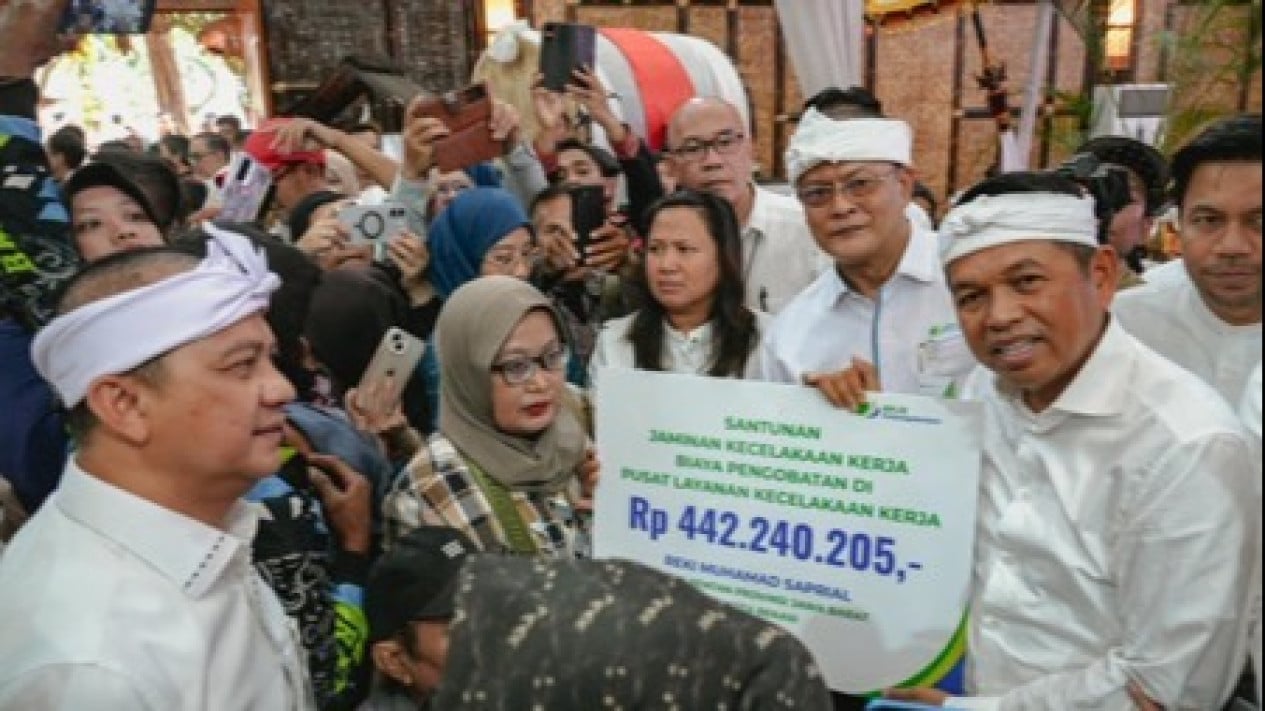
This commitment was reaffirmed by the West Java Provincial Government together with BPJS Ketenagakerjaan through the distribution of employment social security programme benefits totalling Rp49.3 billion to 1,515 participants and heirs. The assistance was provided to workers who experienced occupational risks and to families who lost a family member who was the economic backbone.
The benefit distribution took place during the West Java Programme Benefit Distribution Appreciation event at Bale Gede, Pakuan Building, Bandung, on Thursday, 18 June 2026. The event was attended directly by West Java Governor Dedi Mulyadi and BPJS Ketenagakerjaan Director of Human Capital and General Affairs Harjono Siswanto.
The benefits distributed came from the Work Accident Insurance (JKK) and Death Insurance (JKM) programmes. The recipients are workers who obtained protection through the support of the West Java Provincial Government, district and city governments, village governments, recipients of Tobacco Products Excise Revenue Sharing Funds (DBHCHT), and religious workers.
This programme is one of the efforts to ensure that vulnerable worker groups remain protected when facing unexpected risks.
According to Dedi Mulyadi, the benefits of the employment social security programme not only help individuals who suffer misfortune but also maintain the economic stability of the families left behind. He cited the example of a vulnerable worker from Bekasi who suffered a workplace accident. Through BPJS Ketenagakerjaan membership, the worker received JKK benefits along with medical expenses totalling up to Rp422 million. For Dedi, this kind of protection has a tremendous impact on the future of society.
‘If a poor person loses their job, it is hard. But if a poor person loses their breadwinner due to an accident or death, that can be the beginning of intergenerational poverty. I do not want any West Java resident to lose their future simply because they lacked protection when a risk occurred. The state must stand behind its people, especially those who work hard every day but live in vulnerability,’ Dedi asserted.