
BPJS Kesehatan Pati Educates Nursing Students on National Health Insurance Programme
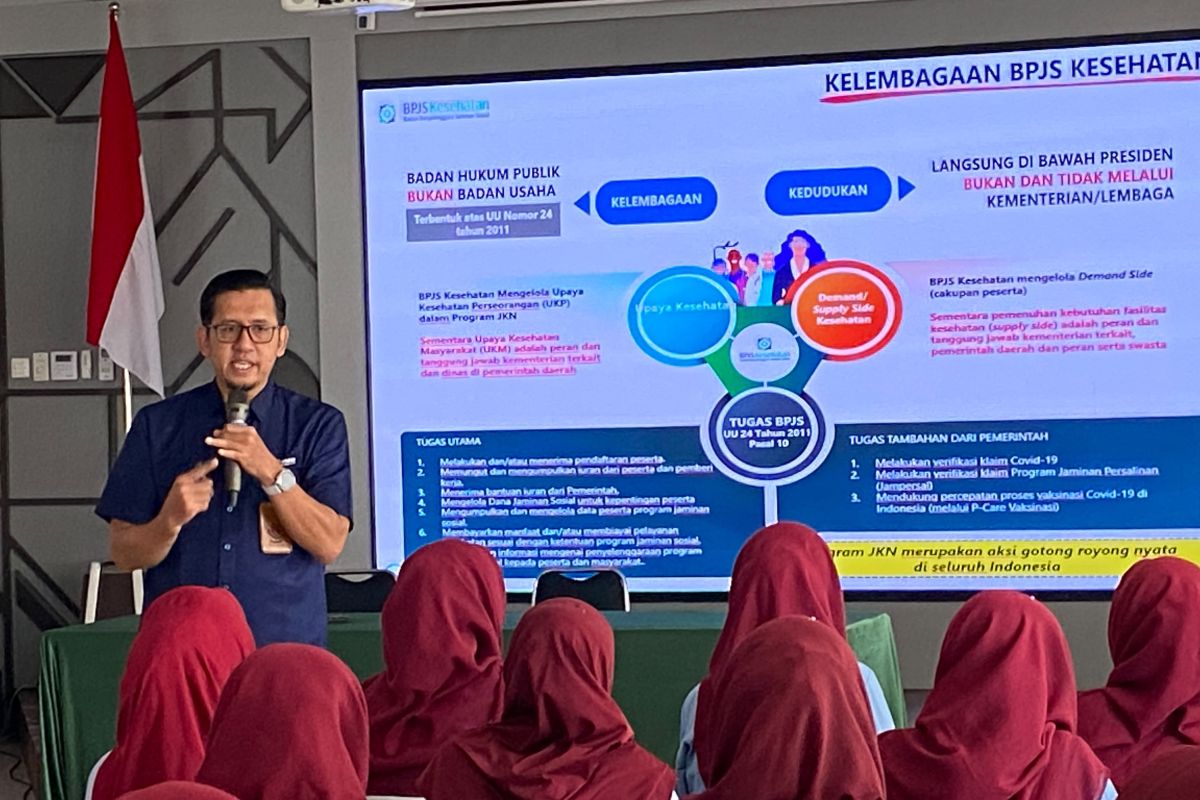
BPJS Kesehatan Pati branch is expanding education on the National Health Insurance (JKN) programme to the younger generation through a ‘BPJS Kesehatan Goes to Campus’ event targeting 50 students at the Ministry of Health’s Poltekkes Semarang Campus IV in Blora, Central Java. “The participants are 50 students from the Nursing Study Programme Semester IV who attended a special lecture on the JKN programme,” said Head of BPJS Kesehatan Pati Branch, Nuzuludin Hasan, contacted from Semarang on Friday. He explained that the presence of BPJS Kesehatan on campus is part of efforts to introduce the national health insurance system to prospective healthcare workers who will later play a direct role in providing services to the community. Nuzuludin stated that the JKN programme is the implementation of the National Social Security System mandated by the 1945 Constitution of the Republic of Indonesia and is run by BPJS Kesehatan as a Public Legal Entity directly responsible to the President. He also introduced the INISIATIF values, which serve as a guideline for all BPJS Kesehatan personnel in carrying out their duties and providing services to the community. “We are committed to implementing the INISIATIF values, which consist of Integrity, Collaboration, Excellent Service, and Innovation. These values form the foundation for maintaining service quality and the sustainability of the JKN programme,” said Nuzuludin. He explained that the three pillars are key to ensuring the programme remains sustainable while providing optimal healthcare benefits to all participants. “Through the principle of mutual cooperation, health risks are shared collectively so that the community can access the healthcare services they need. This is the main strength of the JKN programme as a national health protection system,” he explained. Nuzuludin also presented various achievements of the JKN programme, which by the end of 2025 had covered 282.7 million people, or 98.47 percent of Indonesia’s population. Additionally, he explained the continuous quality service transformations carried out by BPJS Kesehatan, ranging from the use of the national ID card (KTP) as a treatment identity, online queuing via the Mobile JKN application, to the development of various digital service channels that make access easier for participants. “As prospective healthcare workers, nursing students need to fully understand the JKN programme because they will later interact directly with participants in the healthcare service process. A good understanding will help them provide quality service while supporting the successful implementation of the JKN programme,” he added. Sutarmi, a representative from the campus, stated that this activity is an important momentum for students to understand the large-scale health insurance system in Indonesia and even the world. The material presented is closely related to the working world they will face after graduation. She assessed that the nursing profession is a crucial element in the integrated healthcare service delivery with the JKN programme. Therefore, understanding the mechanisms, benefits, and services within the JKN programme needs to be introduced during their studies so that students are adequately equipped. “Nurses will interact extensively with JKN participants and contribute directly to healthcare services. For this reason, I hope all students take this lecture seriously because the knowledge gained is not only beneficial for themselves and their families but also for the community they will serve in the future,” she said. Through the BPJS Kesehatan Goes to Campus activity, students can better understand the strategic role of the JKN programme in the national health system. Besides becoming competent healthcare professionals, students are also expected to become educational agents who help disseminate accurate information about the JKN programme to the public.