
BPJS Kesehatan and MUI Hold Tasbih JKN to Boost Public Understanding
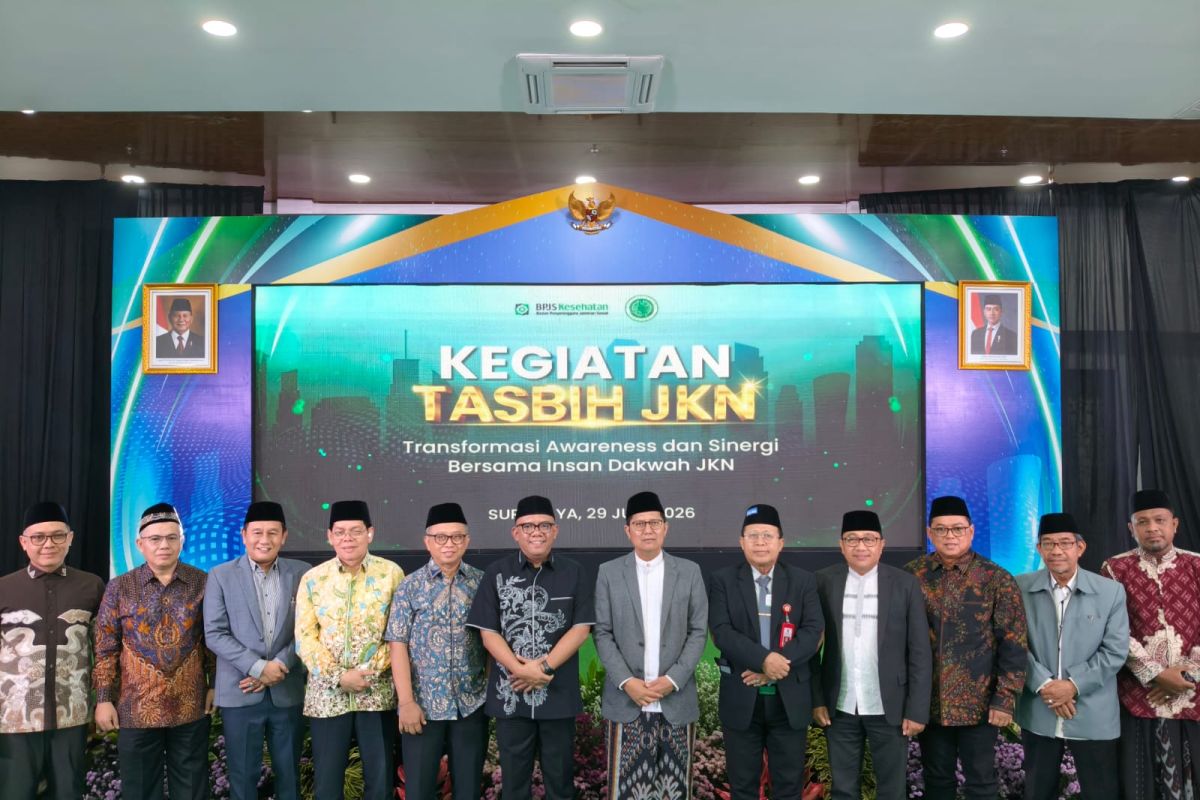
Surabaya (ANTARA) - The Social Security Administering Body for Health (BPJS Kesehatan) and the Indonesian Ulema Council (MUI) have held the Transformation of Awareness and Synergy with Da’wah Actors for National Health Insurance (Tasbih JKN) activity to improve public understanding of the JKN programme.
BPJS Kesehatan Membership Director Akmal Budi Yulianto, when confirmed in Surabaya on Monday, said the activity aims to enhance public understanding of the JKN programme through the strategic role of dai and daiyah as conveyors of correct information to the community.
“As of 31 May 2026, the number of JKN participants has reached 285.25 million people, or 98.94 per cent of Indonesia’s total population, with a participant activity rate of 82.78 per cent,” he said on the sidelines of the Tasbih JKN activity at the East Java MUI Building.
According to Akmal, challenges remain in the form of gaps in public understanding due to uneven access to information and the suboptimal use of digital services. Therefore, BPJS Kesehatan requires collaboration with various elements of society, including ulama, dai, and daiyah.
“Through Tasbih JKN, we want to build a joint movement so that da’wah actors become the JKN Front Guard in conveying correct information, building awareness of healthy living, and inviting the public to understand their rights and obligations as JKN participants,” he said.
Akmal said the JKN Programme is built on the principle of mutual cooperation, where healthy participants help those who are sick, while able participants help less fortunate members of society.
“We hope the public will become increasingly aware that JKN is not only health protection but also a form of social solidarity and regulatory compliance,” he said.
MUI Deputy Chairman and Chairman of the BPJS Kesehatan Sharia Supervisory Board, M. Cholil Nafis, affirmed that the JKN Programme is in line with Islamic Sharia values.
According to him, maintaining health is part of the objectives of Sharia (maqashid sharia) in preserving life (hifz an-nafs), while paying JKN contributions is a form of mutual assistance that holds worship value.
“We want to ensure that the JKN Programme complies with Islamic Sharia so that Muslims need to support this government programme which provides great benefits to the community,” he said.
He also highlighted that many religious social workers, such as mosque caretakers, ustaz, pesantren teachers, and religious organisation administrators, have not yet obtained health insurance protection.
Cholil Nafis revealed that MUI is preparing a fatwa encouraging zakat institutions and the National Amil Zakat Agency (Baznas) to help pay JKN contributions for vulnerable community groups who are not yet protected.
“Health is a basic right of every citizen and is one of the main indicators of a nation’s progress, alongside education and the economy,” he said.
Assistant III to the Regional Secretary of East Java Province for General Administration, Akhmad Jazuli, expressed full support for the implementation of Tasbih JKN.
According to him, the activity is able to raise public awareness that JKN membership is not merely an administrative obligation but also part of social worship reflecting the spirit of mutual assistance.
“The East Java Provincial Government fully supports the Tasbih JKN activity because it can strengthen public awareness that the JKN Programme is part of the values of worship and mutual cooperation,” he said.
Source: jawawa.id (https://jawawa.id/newsitem/bpjs-kesehatan-and-mui-hold-tasbih-jkn-to-boost-public-understanding-1782723259)
Originally published by Antara (Indonesian) (https://www.antaranews.com/berita/5627111/bpjs-kesehatan-mui-gelar-tasbih-jkn-tingkatkan-pemahaman-masyarakat), translated from Indonesian