
BPJS Health and Ministry of Immigration and Corrections Strengthen JKN Protection for Inmates
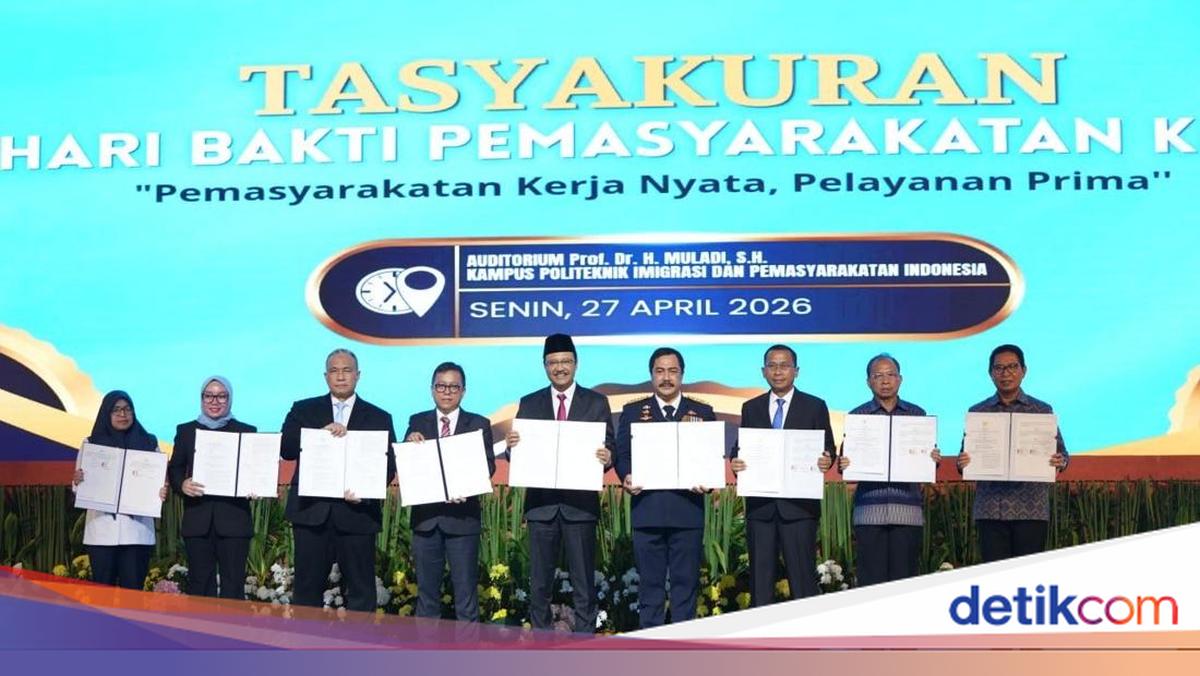
The government has reaffirmed the state’s commitment to guaranteeing participation in the National Health Insurance (JKN) programme for detainees and correctional residents through a Joint Decree (SKB) and Memorandum of Understanding (MoU) across ministries and agencies. The signing of the SKB and MoU coincided with the commemoration of Correctional Service Day 2026 at the IMIPAS Polytechnic Campus in Tangerang, Banten, on Monday (27/4).
The Joint Decree (SKB) on Strengthening the Provision of Health Services for Detainees and Correctional Residents within the Framework of National Health Insurance and Decentralisation was established and signed by the Minister of Immigration and Corrections, the Minister of Home Affairs, the Minister of Health, the Minister of Social Affairs, and the Director General of BPJS Health.
Meanwhile, the Memorandum of Understanding (MoU) on Synergy in Implementing the National Health Insurance Programme within the Ministry of Immigration and Corrections (Imipas) was signed by Minister of Imipas Agus Andrianto and BPJS Health Director General Prihati Pujowaskito.
Pujowaskito stated that inter-agency collaboration is crucial for maintaining order in JKN implementation from policy, participation, and data governance perspectives.
‘BPJS Health currently manages over 285 million participants, or nearly the entire Indonesian population. Achieving this requires cross-ministerial policy synergy to ensure implementation remains on target, administratively orderly, and sustainable, including ensuring accurate and up-to-date data for registered correctional residents as BPJS Health participants,’ said Pujo in his statement on Tuesday (28/4/2026).
Furthermore, Pujo explained that the SKB and MoU complement each other. The SKB provides legal certainty and role division across ministries and local governments, while the MoU serves as the basis for operational cooperation between Kemenimipas and BPJS Health.
This policy also aligns with the government’s efforts to conduct socio-economic data collection and verification for correctional residents’ participation in PBI-JK, carried out by the Ministry of Social Affairs (Kemensos) based on the National Single Social and Economic Data (DTSEN) with support from population data matching.
‘Data accuracy determines service accuracy as well as financial control. Therefore, synergy through this SKB and MoU provides a strong umbrella to encourage interoperable, secure, and accountable data exchange and utilisation across agencies,’ said Pujo.
Meanwhile, Agus emphasised that strengthening cross-sectoral synergy and collaboration is the key to driving correctional transformation. However, he reminded that collaboration would be meaningless without strong integrity at every level of implementation.
‘I encourage all ranks to focus on concrete actions in the field that impact correctional residents and the wider community. Unite efforts from central to implementation levels to realise productive, integrity-based, and modern corrections,’ he said.
Agus explained that corrections arise as a manifestation of the nation’s commitment to nurturing, providing hope, building human identity, and delivering justice to society. According to him, various changes have been made, including shifts in perspectives and the application of management systems that prioritise a humane approach.
‘We have made many changes, both in perspectives on inmates and in management systems that are now more humane-based. Today, I invite us all to deeply reflect on what has been achieved, what has not, and what we must do together as an integral part of national development,’ he said.
Furthermore, Agus mentioned that the new spirit of corrections is embodied through 15 programmes aligned with President of the Republic of Indonesia Prabowo Subianto’s Asta Cita vision and must be translated into concrete steps that touch society.
For information, the SKB regulates the strengthening of role and authority division across ministries and agencies, including Kemenimipas, the Ministry of Home Affairs, the Ministry of Health, the Ministry of Social Affairs, and BPJS Health, to ensure every detainee and correctional resident is registered as an active JKN participant, including as Premium Assistance Recipients (PBI) for those unable to afford it.
These arrangements cover participation certainty, provision of basic and referral health services in detention centres, prisons, and child correctional institutions, as well as funding sourced from the State Budget (APBN), Regional Budget (APBD), and other legitimate sources in accordance with applicable laws and regulations.
Additionally, the Memorandum of Understanding between Kemenimipas and BPJS Health functions as a strategic cooperation umbrella to optimise the implementation of each party’s tasks and functions. This MoU aims to enhance commitment, coordination, and effectiveness of cooperation in implementing the JKN programme within Kemenimipas.
Furthermore, the scope of the MoU includes optimising active JKN participation for civil servants and non-civil servant employees, support for JKN participation activation, policy support for JKN participation in public services, implementation of interoperability for data exchange and utilisation, support for health facility cooperation, and other forms of cooperation agreed upon by the parties.
Source: jawawa.id (https://jawawa.id/newsitem/bpjs-health-and-ministry-of-immigration-and-corrections-strengthen-jkn-protection-for-inmates-1777355517)
Originally published by detikcom (https://news.detik.com/berita/d-8464867/bpjs-kesehatan-dan-kemenimipas-perkuat-perlindungan-jkn-bagi-warga-binaan), translated from Indonesian