
BPGMN Plants Bamboo and Jelutung to Restore Peatlands
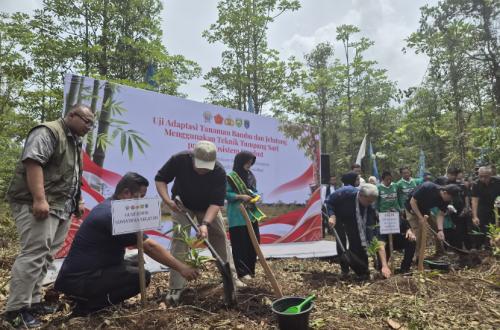
JAKARTA — Restoring peatland ecosystems requires not only fire prevention but also the development of economic activities that support the livelihoods of surrounding communities. Intercropping bamboo and jelutung is being trialled in Ogan Komering Ilir (OKI) regency, South Sumatra, as an approach to conserving peatlands while creating business opportunities for residents.
The planting trial was carried out on a demonstration plot in Kedaton, Kayuagung, OKI, on Friday (30 October 2026). Both plants were selected for their ecological and economic potential in peatland management.
Satyawan Pudyatmoko, head of the National Peatland and Mangrove Management Agency (BPGMN), said the area could serve as a model for restoring peatland ecosystems previously damaged by repeated fires. Fires were recorded there in 1997 or 1998, and again in 2006.
Following vegetation restoration, at least 30 tree species have grown in the area. Satyawan said the successful recovery of vegetation in OKI could provide lessons for other peatland regions.
“This is a very valuable learning experience for us. It turns out that peatland ecosystem restoration can be carried out very successfully, as demonstrated in OKI regency, South Sumatra. We will replicate this model in several places,” Satyawan said in a statement on Friday (30 October 2026).
Satyawan said peatland management in South Sumatra faced a major challenge, as about 10 per cent of Indonesia’s peatland is in the province. Fire prevention and restoration require the involvement of local governments, the Indonesian Military and National Police, as well as village communities.
He stressed the importance of ensuring that communities benefit economically from peatland management. This would allow economic activity to continue without compromising the ecosystem’s sustainability.
“One of the keys to keeping peatlands sustainable is ensuring they benefit communities. If peatlands are managed and economic activities are taking place, the ecosystem will be useful and the risk of fires can be reduced to a minimum,” Satyawan said.
Satyawan also referred to the local wisdom of peatland communities, including the raising of swamp buffalo, which was once a source of livelihood for residents. The decline of this activity, he said, had also changed how swamp areas were used.
Jelutung was chosen because it can grow in peatlands without requiring the ecosystem to be drained. It also has economic potential through latex production, although it takes a relatively long time before the trees can be tapped.
Bamboo, meanwhile, is being developed to combine ecological functions with the use of its harvest. Agi Diantoro, chairman of the Indonesian Green Economy Youth Community (KPEHI), said bamboo planting was expected to help maintain peat moisture and reduce the risk of forest and land fires.
“Bamboo is one nature-based solution to help prevent forest and land fires. A single clump of bamboo can store up to around 5,000 litres of water. Its roots also help maintain moisture in peat soil. This is one of the early mitigation measures we want to develop,” he said.
Alongside its ecological role, KPEHI is preparing to develop a bamboo-processing industry in collaboration with furniture businesses it supports. The harvest could be used as raw material for furniture, flooring and interior products.
Agi said the project would take a community-based economic approach, involving residents of villages bordering the peatland. Residents would receive guidance on managing the land and processing the harvest into products with economic value.
The plan has also been presented to BPGMN Deputy Head Major General Sriyanto as an approach to developing community livelihoods through ecosystem restoration.
Initially, planting is taking place on a one-hectare demonstration plot with around 300 bamboo seedlings. KPEHI aims to expand planting to 100 hectares in the next phase.
Agi said OKI was selected because it has extensive peatlands and faces the threat of forest and land fires. Bamboo cultivation is expected to provide long-term economic benefits, giving communities an incentive to help protect the area.
“Bamboo can be harvested after about three and a half years. So people will not only plant and protect the peatland, but will also be able to earn an income from it,” Agi said.