
BPDP’s Mandate Expanded Beyond Palm Oil to Include Cocoa and Coconut
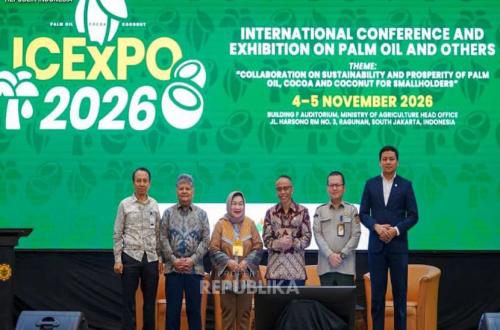
JAKARTA — The government has expanded the mandate of the Plantation Fund Management Agency (BPDP), which previously focused on palm oil, to include cocoa and coconut. The policy is intended to strengthen the national plantation sector and improve farmers’ welfare by supporting the development of commodities from upstream to downstream.
Deputy Coordinating Minister for Economic Affairs Dradjad Hari Wibowo said the expansion of BPDP’s mandate has a legal basis in Presidential Regulation No. 132 of 2024. He said the move forms part of the government’s effort to strengthen the foundations of national agribusiness so that farmers directly benefit from the management of plantation resources.
“The main message we want to convey is that national economic resilience must translate into farmers’ welfare,” Dradjad said at the International Conference and Expo on Palm Oil and Others (ICExPO) 2026 in Jakarta, quoted on Sunday (8 November 2026).
Under the expanded mandate, BPDP can support the development of cocoa and coconut through measures including plantation rejuvenation, or replanting, improving human resources, and providing facilities and infrastructure in the upstream sector. Support will also cover strengthening farmer institutions and providing technical assistance to improve plantation productivity and produce quality.
The government hopes the development of these three leading commodities will be integrated. Higher production at farm level needs to be accompanied by the development of processing industries so that palm oil, cocoa and coconut can generate higher-value products.
The effort is in line with the Agriculture Ministry’s push to accelerate modernisation of the plantation sector. Deputy Agriculture Minister Alim Setiawan Slamet warned that productivity across several plantation commodities remains under pressure because of suboptimal use of production inputs, ageing crops and the use of uncertified seeds.
For palm oil, national productivity, which was close to four tonnes per hectare in 2019, fell to 3.6 tonnes per hectare in 2025. Productivity on smallholder plantations remains at around two to three tonnes of crude palm oil (CPO) per hectare, well below the potential of four to six tonnes per hectare.
Alim called for the development of superior varieties, precision farming technology, mechanisation and the use of artificial intelligence to raise plantation productivity. Innovation is also needed to expand the processing of derivative products, he said, so that Indonesia’s leading commodities become more competitive.
“Technology and innovation must turn all these advantages into competitive advantages,” Alim said when opening ICExPO 2026 at the Agriculture Ministry’s headquarters in Jakarta on Wednesday (4 November 2026).
Developing downstream industries is one of the aims of strengthening the plantation sector. For coconut, for example, the government is promoting a wider range of products, including coconut oil, virgin coconut oil (VCO), coconut milk, coconut water, coir fibre, coco peat, activated charcoal and animal feed. Cocoa industry development, meanwhile, is being pursued through modernising post-harvest infrastructure, digitising supply chains and increasing exports of processed products.
Purnomo Yusgiantoro, chairman of the Lemhannas Alumni Family Association, also stressed the importance of developing plantation industries to strengthen national resilience. He said palm oil, cocoa and coconut play strategic roles in supporting food security, energy self-sufficiency and economic growth towards Golden Indonesia 2045.
Purnomo also advocated applying three principles to plantation development: Growth, Equity and Human Resource Development. Higher productivity and competitiveness should go hand in hand with a fairer distribution of economic benefits for smallholders and improvements in human resource quality.
Through BPDP’s expanded mandate, the government is seeking to increase support for cocoa and coconut without abandoning the development of the palm oil industry. Strengthening upstream activities, building farmers’ capacity and accelerating downstream processing are expected to increase the plantation industry’s contribution to the national economy while improving smallholders’ welfare.
Source: jawawa.id (https://jawawa.id/newsitem/bpdps-mandate-expanded-beyond-palm-oil-to-include-cocoa-and-coconut-1794124254)
Originally published by Republika (https://ekonomi.republika.co.id/berita/to689k522/mandat-bpdp-diperluas-tak-lagi-hanya-urus-sawit-tetapi-juga-kakao-dan-kelapa), translated from Indonesian