
BP2MI Urges Local Governments and Universities to Strengthen Migrant Worker Preparation
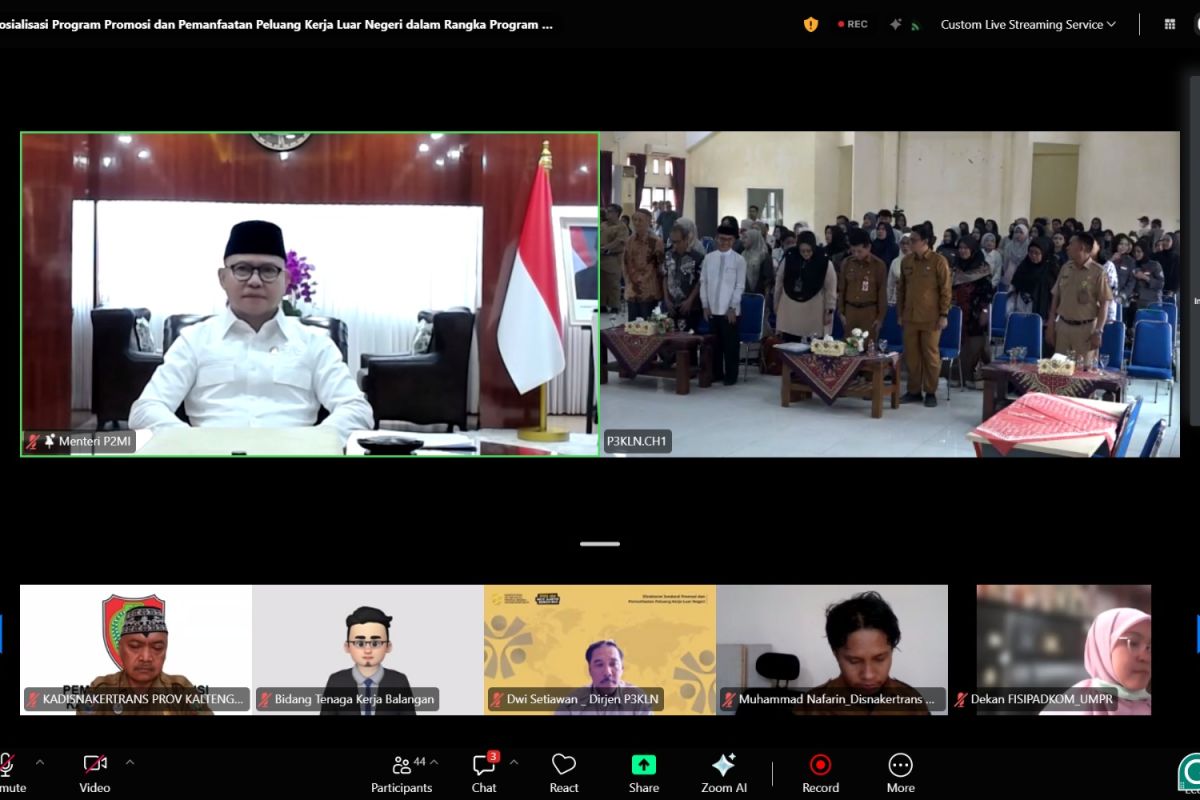
Jakarta (ANTARA) - The Minister for the Protection of Indonesian Migrant Workers (P2MI), Mukhtarudin, has urged local governments and universities in Central Kalimantan to strengthen human resource preparation to increase the placement of Indonesian migrant workers in overseas labour markets.
“This is a vital part of our efforts to expand access to information and overseas job opportunities that are safe, high-quality, and aligned with global labour market needs,” said Mukhtarudin.
He made these remarks during a socialisation session for the Overseas Job Opportunity Promotion and Utilisation Programme (P3KLN) held online on Tuesday, according to a press release from BP2MI.
The event was attended by the Regional Secretary of West Kotawaringin Regency, Rody Iskandar, representing the Regent of West Kotawaringin, the Rector of Antakusuma University (UNTAMA), members of the Regional Leadership Coordination Forum (Forkopimda) of Central Kalimantan Province, and the academic community from Central Kalimantan universities.
On this occasion, Mukhtarudin stated that overseas job opportunities are becoming increasingly strategic amidst Indonesia’s demographic condition, which possesses a large productive-age population, while several countries face the phenomenon of an ageing population.
According to him, the demographic bonus can become a strength if accompanied by an increase in human resource quality. Conversely, a large productive-age population without adequate competence has the potential to create social and economic issues.
“The age is productive, but if the human resources are not productive, it could lead to social, economic, and political problems,” he said.
Therefore, the central government, local governments, and universities must work together to prepare a productive generation possessing the knowledge, technical skills, and the proper attitude and mental fortitude required by the world of work.
Mukhtarudin emphasised the importance of Indonesian human resources possessing comparative, comprehensive, and competitive advantages to compete in the global labour market.
On the other hand, the phenomenon of an ageing population in various countries opens opportunities for Indonesia to meet the demand for productive labour. However, these opportunities cannot be optimally utilised without competence that meets international labour market standards.
“From the demand side, the need for overseas labour is very high. But this high demand must be accompanied by competency requirements, at the very least language proficiency, followed by certified technical skills,” he noted.
He acknowledged that a gap still exists between global labour market needs and the competence of education graduates in Indonesia, including both vocational high school (SMK) and university graduates.
To address this gap, the government is implementing an acceleration programme through ‘SMK Go Global’, which is part of the Asta Mandala SMK Go Global initiative.
The programme targets the preparation of 500,000 skilled prospective migrant workers by 2029, consisting of 300,000 vocational school graduates and 200,000 members of the general public.
This target will be achieved gradually, with 40,000 people in 2026, 140,000 in 2027, 180,000 in 2028, and 140,000 in 2029.
Mukhtarudin stated that the programme uses a demand-based approach, meaning labour preparation begins with mapping the needs of the labour markets in destination countries.
“We are reversing the way of thinking. The sector must exist first, the country must be identified, the demand must be present, and only then do we train. Once we know what kind of competence this demand requires, we provide the training,” he explained.
With this approach, the preparation process for prospective migrant workers does not stop at training but is directed so that participants possess the necessary competence before placement.
The programme covers various job sectors, including caregivers, welders, hospitality, nursing, manufacturing, and other sectors according to international market needs.
Mukhtar, also emphasised the importance of local government involvement in providing accurate information to the public regarding procedures for working abroad.
He reminded the public to choose official and procedural placement routes to ensure their rights and state protection while working overseas.
“The difficulty arises when working non-procedurally, unsafely, or without going through the Manpower Office or BP2MI. That is what is dangerous,” he said.
Conversely, the Minister for P2MI asserted that migrant workers who depart through official mechanisms will receive protection in accordance with applicable regulations.
“As long as they work procedurally, God willing, they will be safe and work with dignity in a foreign country,” he said.
Mukhtarudin hopes that the synergy between local governments, universities, the education sector, and the Ministry of P2MI can strengthen the ecosystem for preparing prospective migrant workers from the regions.
Through this collaboration, he hopes that human resource preparation in Central Kalimantan will become more directed, ensuring that international job opportunities are filled by competent and skilled Indonesian workers travelling through official channels.
Source: jawawa.id (https://jawawa.id/newsitem/bp2mi-urges-local-governments-and-universities-to-strengthen-migrant-worker-preparation-1790132527)
Originally published by Antara (Indonesian) (https://www.antaranews.com/berita/5753944/kp2mi-dorong-pemda-perguruan-tinggi-perkuat-penyiapan-pekerja-migran), translated from Indonesian