
Both Pursuing Ambitious Goals, South Korea Eyes Indonesia’s Renewable Energy Potential
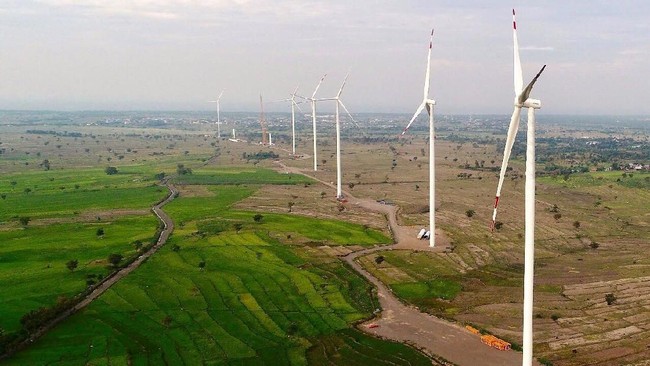
Jakarta, CNBC Indonesia – South Korea is seeking to strengthen clean-energy cooperation with Indonesia, as both countries pursue ambitions to accelerate the energy transition and develop their domestic industries.
Indonesia is targeting the construction of 100 gigawatt-peak (GWp) of solar power capacity. Achieving this will require more than building power plants: investment will also be needed in energy storage batteries, transmission networks and electricity technology.
In 2025, Indonesia’s installed electricity capacity stood at 107.5 GW. Renewable energy accounted for just 15.6 GW of that total, while solar capacity was only 1.49 GW, against estimated potential of around 3,294 GWp.
South Korea, meanwhile, is pursuing its Korean Green Transformation (K-GX) programme, which plans to mobilise 1,000 trillion won in investment by 2035, including more than 790 trillion won in climate financing. The programme covers the development of batteries, solar power, hydrogen, small modular nuclear reactors (SMRs) and carbon-capture technology.
South Korea is also targeting renewable energy capacity of 220 GW by 2040. However, that ambition faces several obstacles, particularly the readiness of the electricity grid and the pace of power plant construction.
Gahee Han, programme director of Electricity Solutions for Our Climate (SFOC), said South Korea needs to add around 14 GW of renewable energy capacity a year to meet its target of 100 GW of solar and wind power by 2030. In recent years, however, annual capacity additions have averaged only 3–4 GW.
“This means the pace of construction must increase more than threefold compared with normal conditions. This is a very significant challenge,” Gahee said at the Indonesian Next Generation Journalist Network on Korea workshop organised by the Foreign Policy Community of Indonesia (FPCI) and the Korea Foundation, according to a report on Thursday (5 November 2026).
South Korea’s electricity grid is also beginning to face constraints in accommodating new renewable power plants. Energy storage systems, meanwhile, lack market mechanisms that provide adequate compensation.
Nevertheless, South Korea’s technological and industrial capabilities present opportunities for cooperation with Indonesia, she said. A clean-energy memorandum of understanding signed by the two countries in April 2026 covers solar, wind, geothermal, hydrogen, nuclear energy, energy storage, smart grids and batteries.
The cooperation is also supported by a joint battery manufacturing facility in Karawang, which has been operating since 2024. Its first phase has a capacity of 10 gigawatt-hours (GWh).
Deon Arinaldo, a researcher at the Institute for Essential Services Reform (IESR), said collaboration could be expanded to include batteries for electricity storage, transmission technology, battery recycling and green hydrogen for the steel industry.
However, Deon said Indonesia needs to prepare clear, bankable projects if it is to turn investment opportunities into reality.
“The homework now lies with Indonesia,” Deon said, stressing that the main task is to prepare transparent project plans, secure locations and procurement frameworks that appeal to investors.
Deon estimates that utility-scale solar projects under the 100 GWp programme will require close to US$80 billion in investment. The figure could exceed US$100 billion if energy storage batteries and transmission networks are included.
Source: jawawa.id (https://jawawa.id/newsitem/both-pursuing-ambitious-goals-south-korea-eyes-indonesias-renewable-energy-potential-1793879453)
Originally published by CNBC Indonesia (https://www.cnbcindonesia.com/news/20261105150245-4-782661/sama-sama-berambisi-besar-korsel-lirik-potensi-energi-terbarukan-ri), translated from Indonesian