
Bosscha explains why the Venus occultation phenomenon appeared differently across regions
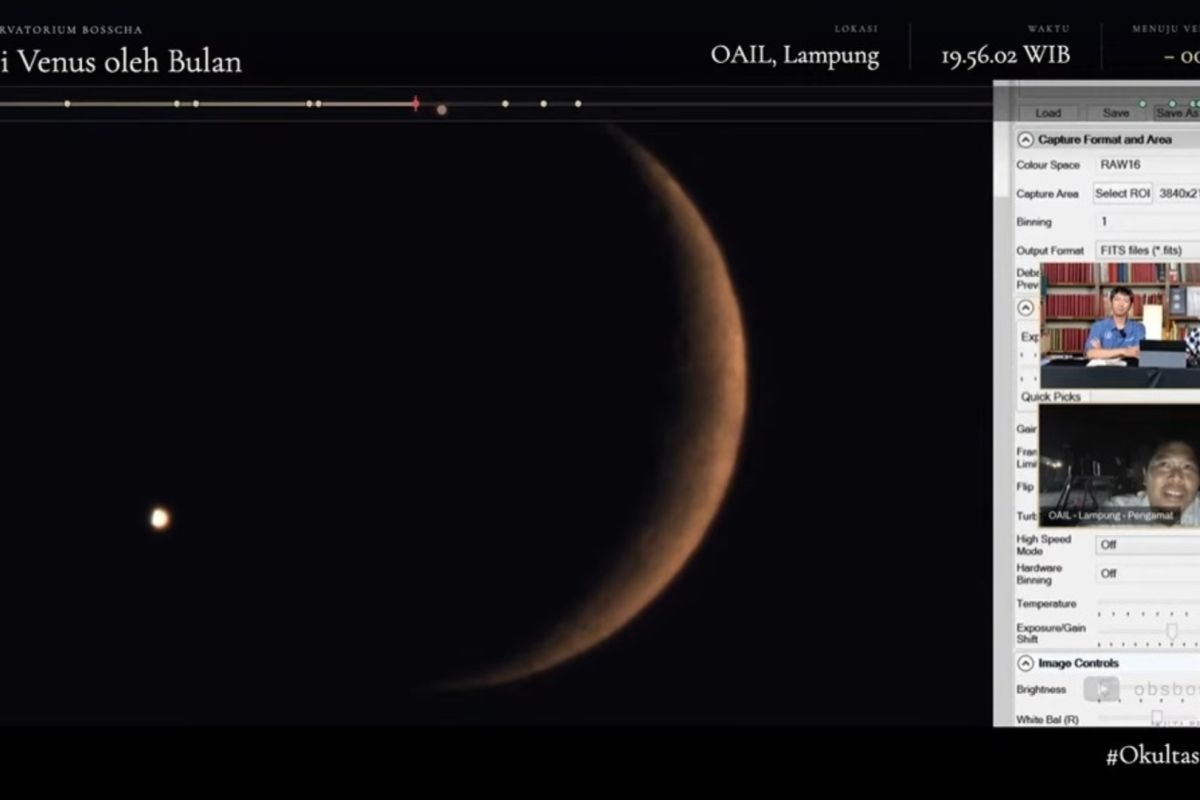
Bandung (ANTARA) - The Bosscha Observatory in Lembang has explained why the celestial phenomenon of the Moon occulting Venus on Monday night (14/9) displayed different visual appearances across each region of Indonesia, owing to geometric viewing angles and local weather factors.
Agus TP Jatmiko, a researcher at the Bosscha Observatory, revealed in Bandung, West Java, on Tuesday that these unique differences were also visible in the Venus Occultation Observation Livestream organised by the Bosscha Observatory of the Bandung Institute of Technology (ITB) from 7pm to 9pm Western Indonesia Time, involving a network of collaborators from Lampung, Bengkulu, Banten, Semarang, Lamongan, Yogyakarta, Medan, Padang, and as far as Bangkok.
He explained that the apparent position of Venus relative to the Moon differed because the Moon’s disc is far closer to Earth than the planet Venus.
“The Moon is positioned closer to Earth than Venus, which is why the apparent positions of the two celestial bodies can differ when observed from different locations,” he said.
In Semarang, however, the phenomenon appeared close to a grazing occultation, with Venus passing only very near the edge of the Moon’s disc, whilst in Yogyakarta and Lamongan it was visible merely as a conjunction, with Venus and the Moon simply appearing close together without a full occultation.
Beyond geographical location, Agus stressed that technical and natural factors were the main determinants of success in documenting the astronomical phenomenon.
“What matters most in observation is that the instruments are ready, the observers are ready, and finally, the weather is good,” he said.
Weather posed particular challenges for several observation teams. In Bangkok (WRWO Space), the Moon was visible for only one minute before being obscured by thick clouds.
In Medan (OIF UMSU), observations were obstructed by rain and drizzle, whilst the astronomy community team in Padang was hindered by thick fog at an altitude of 1,200 metres above sea level, despite having prepared a smart telescope.
This series of cross-regional observations by Bosscha ITB confirms that a single astronomical event can produce diverse visual experiences, whilst also serving as an educational demonstration of celestial geometry and the importance of collaborative observation from multiple geographical points.