
Boschbranden: When Sumatra Burned
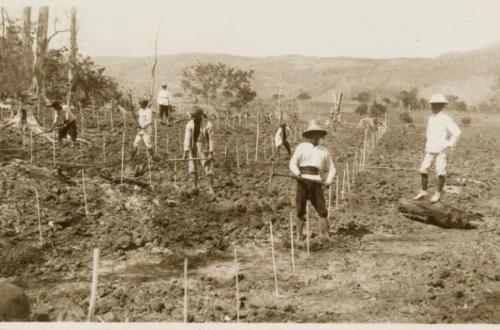
In May 1929, readers of De Sumatra Post came across a term that feels very familiar to Indonesian readers: boschbranden, or forest fires. The newspaper referred to the need for action to address forest fires. This brief mention is significant because it shows that fires in Sumatra’s landscape were not a new problem that emerged at the end of the twentieth century. They were already present as plantations, roads, railway lines, settlements and trade networks were accelerating changes to the island’s landscape.
However, fires in the colonial period cannot be understood solely as natural disasters. Fire lay at the intersection of land clearing, shifting cultivation, the expansion of commercial plantations, changes to protected forests and the government’s need to control territory.
In Sumatra, particularly along the east coast, the expansion of plantation capital from the second half of the nineteenth century created a productive zone very different from the landscape that had existed before. The archives of Deli Maatschappij describe the Sumatra’s Oostkust as a region that changed rapidly following the arrival of plantations and the consolidation of colonial power (Archief NV Deli Maatschappij, dochtermaatschappijen en gefuseerde bedrijven, ca. 1700).
The history of forest fires in Sumatra needs to be situated within the history of changes to space. Fires could originate from land clearing, negligence, drought, or spread from alang-alang grasslands and farmland. In colonial administration, the issue became one of public order, firefighting labour, asset protection and surveillance of the population. This perspective differed from modern environmental discourse. The colonial government often judged forests by their economic function, land use and state interests, rather than through the concept of ecological conservation.
In the early twentieth century, Sumatra was one of the most important economic regions in the Dutch East Indies. The island’s east coast developed into a plantation region for tobacco, rubber and various commercial crops. Land clearing in Sumatra’s Oostkust was an important part of the formation of the colonial empire, initially driven by Western private entrepreneurs. This development transformed forests into concession areas, plantations, transport routes and sources of raw materials (Ministerie van Koloniën: Toegangen Openbaar Verbaal, 1900).
This transformation did not necessarily mean that forests disappeared all at once. The colonial landscape was essentially a mosaic. Primary and secondary forests, plantations, fields, alang-alang grasslands, swamps, villages and estates existed side by side. In these conditions, fires could easily spread from one type of land cover to another during prolonged dry seasons. The more boundaries there were between forest and open land, the more places there were where human activity could trigger fires.
Colonial records often linked fires to the way local people cleared fields. This connection must be read critically. Shifting cultivation often used fire to clear biomass and return some nutrients to the soil. But the practice had local rules, seasonal rhythms and knowledge of the landscape that colonial officials did not understand. As the administration expanded state forest areas and concessions, a practice that had previously formed part of a cycle of disturbance in the forest came to be seen as a threat to Dutch colonial economic assets.
Across the Dutch East Indies, debates about boschbranden showed a similar tendency. The government considered Indigenous people obliged to help fight fires, while also worrying that paying them too much might be condemned as a waste of state funds.
In 1923, Koloniaal Weekblad recorded a debate about villages’ obligation to help extinguish fires, rewards for villages that remained fire-free, and concerns that a system of rewards might encourage deliberate arson. Although the report addressed forest management more broadly, its administrative logic helps explain how fires were framed as a problem of disciplining the population and protecting forests.
This framework is important for understanding Sumatra. On the one hand, officials needed local people to help when fires grew. On the other, local communities were readily treated as suspects. The colonial state rarely regarded itself as a principal source of increased fire risk. Yet plantation concessions, the construction of routes, logging and the reorganisation of space all expanded areas vulnerable to fire.
In colonial archives, Sumatra appears within an increasingly detailed administrative network. The Openbaar Verbaal index shows how the region was monitored through reports, official correspondence and decisions linking local government to the Netherlands (Ministerie van Koloniën: Toegangen Openbaar Verbaal, 1900). When forest fires threatened production, transport or public order, they entered this bureaucratic world.
Deli and the transformation of the east coast
Sumatra’s east coast is the clearest example of changes to the island’s landscape. In the mid-nineteenth century, the area had attracted little attention from the colonial government. That changed as plantations developed. The government subsequently expanded its administrative presence, while private companies acquired land and labour on a large scale (Archief NV Deli Maatschappij, dochtermaatschappijen en gefuseerde bedrijven, ca. 1700).
The growth of plantations created substantial demand for roads, warehouses, railways, workers’ barracks, processing buildings and ports. All this infrastructure required space. Forests were no longer simply landscapes beyond the centres of government; they also became reserves of land and timber, and frontiers for expansion. The archives of the Nederlandsche Handel-Maatschappij include material on the exploitation of jelutung forests in Borneo and Sumatra by forest-products companies, as well as objections from other trading companies. These records show that Sumatra’s forests were regarded as sources of commodities that could be incorporated into colonial capitalist networks (Archief Nederlandsche Handel-Maatschappij (NHM), 1784).
Fire as a threat to assets
In a plantation economy, fire did more than burn trees. It could cut transport routes, destroy warehouses, threaten plantations and disrupt the supply of labour and commodities. For this reason, colonial newspapers often connected forest fires with questions of security.
Two major forest fires were recorded in the late nineteenth century. A large fire swept through the tobacco-plantation centre on Sumatra’s east coast following an extreme drought and extensive tobacco land-clearing after the introduction of the Agrarisch Wet of 1870. The event was documented in Sumatrabode (1883) and the official Koloniaal Verslag 1884. In 1896, fires broke out again in Riau, Bengkalis and the Strait of Malacca.
The fires spread into Riau’s coastal peat-swamp region, fuelled by a strong El Niño event. Thick smoke from peatland fires in Bengkalis reached the Strait of Malacca and disrupted shipping navigation, as reported by Het Nieuws van den Dag voor Nederlandsch-Indië (1896).
In 1902, a prolonged dry season in Deli, Belawan and Bagan Siapi-api was compounded by the practice of burning the remains of timber from primary forest. De Locomotief (1902) and the handover report of Resident W.J. Rahder (1910) recorded that thick haze paralysed activity at Belawan port and threatened European plantation assets.
The 14 October 1902 edition of De Locomotief reported that thick smoke had covered the Strait of Malacca and Sumatra’s east coast for three consecutive weeks. Steamship navigation at the ports of Belawan and Bagan Siapi-api was severely disrupted, with visibility falling to less than two cables, or about 370 metres.
Fires ravaged plantation concessions and protected forests in the Deli region. The De Locomotief report cited above shows how, by the early twentieth century, fires had reached a scale that paralysed international shipping routes in the Strait of Malacca.
Seventeen years later, on 15 May 1929, De Sumatra Post referred to action against boschbranden. Although the news item does not give a full picture of the area burned, the use of the term shows that fires were already being treated as a problem requiring an organised response.
The bureaucratic record reinforces this impression. In Bagansiapiapi, for example, De Sumatra Post reported in 1928 and 1929 that a hoofdopziener, or chief inspector, from the forest service, Boschwezen, had been posted to the area. Bagansiapiapi lies in a coastal region of eastern Sumatra with swamp forests, industry and dense settlements. The presence of a forestry official shows that the colonial state regarded forest surveillance as part of territorial administration (De Sumatra Post, 10 May 1928; 8 April 1929).
It is important to distinguish urban fires from forest fires. Bagansiapiapi also suffered repeated fires in its settlements. Newspaper reports from 1932 and 1934 discussed these urban fires. They were not the same as forest fires, but they point to an important fact: fire was an everyday risk in a colonial landscape marked by flammable materials, dense settlements, industry and limited firefighting infrastructure. In coastal areas, meanwhile, the boundaries between forest and swamp, urban areas, farmland and other vegetation were not always clear, creating greater risks.
Dry seasons: alang-alang and secondary forest
One relevant ecological change during the Dutch colonial period was the spread of alang-alang grass on disturbed land. Colonial literature often described alang-alang as a sign of neglected land or previous clearing. The grass catches fire easily in dry seasons and can fuel repeated fires. After a fire, it grows back quickly. Over time, repeated fires can impede the regeneration of trees.
From the perspective of environmental history, this process shows that fires do not occur in isolation. Logging, plantation clearing, shifting cultivation, road construction and dry seasons interact. Colonialism increased the scale of spatial connectivity. Transport routes accelerated human mobility, while concessions changed land ownership and control. Fire risks in Sumatra often arose from the interaction of climate and social change, rather than from a single cause (Volkter, 1928).
Therefore, to describe colonial fires as the result of local people’s habit of burning land would be to repeat the bias of colonial sources. Archives need to be read against the grain. When a report blames the burning of fields, historians should ask: which forest was being protected, whose interests lay in the area, and how had land rights changed?
In the early twentieth century, the colonial administration relied on technical services. Forestry was no longer concerned only with timber extraction. Forests were linked to surveying, boundaries, monitoring, protection and relations with nearby communities. The posting of Boschwezen officials in Sumatra illustrates this institutional process. Fire consequently became one of the problems to be addressed through surveillance and the mobilisation of labour (Ministerie van Koloniën: Toegangen Openbaar Verbaal, 1900).
This management model had two sides. First, it introduced more systematic administration. Second, it strengthened colonial control over territory and the labour of local people. In debates about firefighting, communities were obliged to help. The colonial government also considered rewards for villages that remained free of fires. The logic was one of public order, not ecological participation.
In Sumatra, the state and companies helped create a new landscape organised around commodities. Forests were mapped, classified, exploited and converted into concessions. When fires broke out, the government sought to control them in the interests of security and production. This pattern shows that the history of fire is also a history of the political economy of the environment.
Old archives therefore remind us that the important question is not only who lit the fire. The 1929 report in De Sumatra Post may seem minor, but the word boschbranden opens a window onto a much larger history. Behind it lie the expansion of Deli’s plantations, the strengthening of the forestry bureaucracy, the transformation of forests into economic assets, and colonial debates over who should put out fires and who should be blamed (De Sumatra Post, 15 May 1929).
Source: jawawa.id (https://jawawa.id/newsitem/boschbranden-when-sumatra-burned-1791942669)
Originally published by Republika (https://analisis.republika.co.id/berita/tmvhbl393/boschbranden-ketika-sumatera-terbakar), translated from Indonesian