
Borobudur Temple Was Discovered via Information from Chinese Descendant, Here is the Figure
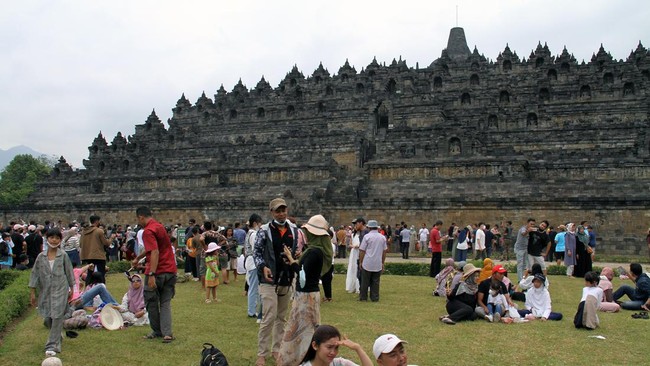
Borobudur, which currently serves as a major attraction for both local and international tourists, was abandoned for hundreds of years. After being ‘lost’ for a long period, the magnificent temple was rediscovered in the early 19th century. Interestingly, the rediscovery of this grand temple was not initiated by local Javanese people, but by a British official acting on initial information from a person of Chinese descent.
Borobudur began construction between 750-850 AD by the Shailendra Dynasty of the Old Mataram Kingdom. However, as eras changed, Borobudur fell into neglect. Many parts were buried under soil and covered by wild vegetation. Its condition was far from the intact state seen today, especially after being repeatedly affected by natural disasters.
This situation persisted for centuries without attracting attention, until the temple’s existence resurfaced thanks to initial information provided by Tan Jin Sing, a Chinese descendant who served as the Regent of Yogyakarta, to the Lieutenant Governor of Java, Thomas Stamford Raffles.
Around 1813, Tan Jin Sing met Raffles and shared information that his foreman in Bumisegoro Village had spotted a large temple. While the large temple had existed for a long time, local residents were indifferent to its presence, leaving the temple in a state of severe neglect.
Raffles, who had an interest in ancient temples, responded positively to the information and immediately requested Tan to visit the site. Tan proceeded to the location accompanied by local residents who frequently visited the area. The initial information regarding the large temple proved to be correct; Tan found the ancient monument covered in shrubs and buried under earth.
According to the local residents accompanying Tan, the name of the temple was Borobudur.
“Its age was estimated to be more than 100 years,” said Tan, as quoted from the account of his descendant, T.S. Werdoyo, in the book Tan Jin Sing: From Chinese Kapitan to Regent of Yogyakarta (1990).
This was the moment Borobudur’s existence was revealed. Raffles immediately ordered a relevant team to undertake a massive restoration. The restoration was also assisted by Dutch archaeologist Christian Cornelius, who possessed significant experience in restoring various temples across Java.
Research by Hanningan in Raffles and the British Invasion of Java (2015) notes that the team commissioned by Raffles—which included Tan Jin Sing, Cornelius, and approximately 200 local residents—immediately began renovating Borobudur. They cleared the wild grass and slowly excavated the accumulated earth.
After two weeks of work, the grandeur of the long-neglected Borobudur was finally revealed. Cornelius immediately wrote a detailed description of the temple to report back to Raffles in Batavia. From this point, the once-abandoned Borobudur became a subject of widespread interest as a significant ancient historical monument.
While Raffles, Tan Jin Sing, and Cornelius may not have been the very first people to literally stumble upon Borobudur, they were the key figures who brought Borobudur back into the spotlight, particularly for European experts and researchers, preventing it from remaining an unknown ruin.
After the British departed from Java in 1816, the Dutch colonial government also contributed to the efforts to uncover the mysteries of Borobudur. Following a long journey of excavation and restoration, the site can now be enjoyed and witnessed by the world.