
Boosting Farmer Productivity: Pupuk Indonesia's Strategy
PT Pupuk Indonesia (Persero) is continuously expanding its role as an agricultural solutions provider, or agro solution company, from previously only acting as a fertiliser producer.
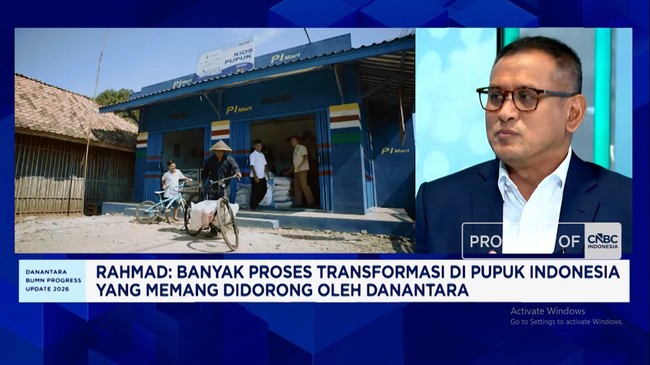
Pupuk Indonesia President Director Rahmad Pribadi explained that this is being done to ensure farmers not only receive fertiliser but are also able to improve their productivity and welfare. This transformation includes changes on the business side and in fertiliser industry governance.
“One of the things we are doing is developing precision farming. Precision farming is very important because fertiliser is like food for humans. If there is too little, it can be stunted; if there is too much, it can become sick,” he said on CNBC Indonesia’s Squawk Box on Monday (24/8/2026).
Therefore, Rahmad continued, fertiliser application must be appropriate and well targeted. Basically, each type of crop or land requires different fertiliser.
“Precision farming is ensuring the fertiliser is right for the crop and right for the location,” he added.
In addition, he said, Pupuk Indonesia must also transform into a more agile, efficient, and profitable company. In this way, Pupuk Indonesia is able to improve the quality of service to farmers.
Not to be left behind, Pupuk Indonesia is also continuing to strengthen the MAKMUR programme, which carries a closed-loop ecosystem concept. This programme integrates technology and agronomy assistance, market access, and financing for farmers.
Through this scheme, Pupuk Indonesia does not only sell fertiliser but provides support from the cultivation process until the harvest is absorbed by the market. In fact, Pupuk Indonesia also has other supporting products such as pesticides.
Furthermore, Pupuk Indonesia is also carrying out transformation in the digital field. Digitalisation has had an impact on company efficiency and fertiliser distribution. Digitalisation has also made the supply chain from procurement, production, to distribution able to be monitored in a more integrated and real-time manner.
This transformation ultimately had an impact on Pupuk Indonesia’s revenue, which increased by around 50% compared to the previous year, while net profit after tax increased by 253%. Not only that, Pupuk Indonesia’s net profit margin also rose from 6.1% to 14.3%.
Nevertheless, Pupuk Indonesia considers that the success of the transformation cannot be measured by financial performance alone. Certainty of fertiliser supply for farmers is also a benchmark for Pupuk Indonesia’s performance.
Rahmad said that subsidised fertiliser redemption up to July 2026 increased by around 1 million tonnes compared to the same period the previous year. In terms of capacity, Pupuk Indonesia has around 14.6–14.8 million tonnes per year and continues to revitalise its plants, including plans to build seven factories from Aceh to Bontang.
In the future, Pupuk Indonesia will expand its distribution network by adding outlets, including through the Merah Putih Village Corporation and the Merah Putih Village/Sub-district Cooperatives (KDKMP). Rahmad said that this network has the potential to strengthen fertiliser access to underdeveloped, frontier, and outermost (3T) regions that have so far been difficult for commercial outlets to reach.
Thus, Pupuk Indonesia is not only focused on increasing fertiliser production but also on ensuring fertiliser is on time, of the right quality, and reaches the right recipients, while simultaneously boosting farmer productivity and welfare.