
Boosting Energy Security: Pertamina Relies on This Strategy
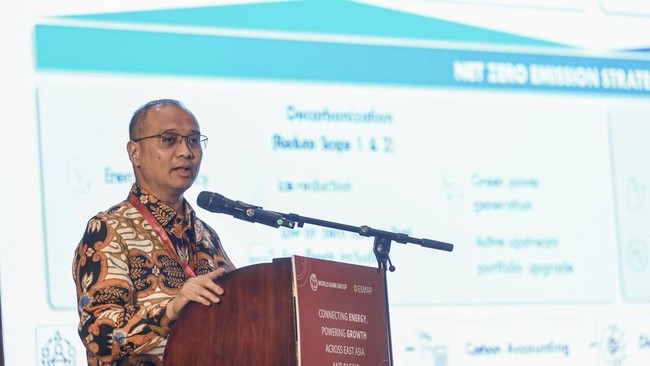
Jakarta, CNBC Indonesia - Pertamina continues to strengthen its commitment to supporting energy security and the energy transition through a dual growth strategy.
Firstly, Pertamina aims to maximise its legacy business by optimising value in the upstream sector, building refinery flexibility, transforming retail fuel businesses, and expanding infrastructure and services. Secondly, the company is focused on building low-carbon businesses.
This was revealed by Pertamina’s Director of Transformation and Business Sustainability, Agung Wicaksono, during a panel discussion themed “Decarbonisation: Global Technology Trends and Best Practices”. The session was part of the “World Bank Energy Knowledge and Learning Forum East Asia and Pacific”, a regional forum regarding sustainable energy transition in East Asia and the Pacific, initiated by the World Bank Group.
In his presentation titled “Accelerating Energy Transition Through Industrial Decarbonisation and Low Carbon Business”, Agung explained how the energy transition is being managed to achieve the Net Zero Emission (NZE) target by 2060. Agung stated that Pertamina’s current vision is to maintain national energy security and drive the energy transition through integrated decarbonisation programmes and the development of low-carbon businesses, aligning with President Prabowo Subianto’s Asta Cita mission.
In the context of Pertamina, Agung clarified that the energy transition in Indonesia must balance the challenges of the energy trilemma: energy security, affordability, and sustainability. “I believe Pertamina serves as an example, as the world faces significant geopolitical uncertainties due to conflicts in various parts of the globe, alongside uncertainties regarding climate change mitigation,” Agung said.
Pertamina’s decarbonisation initiatives and steps serve as a learning model for participants from various countries. “Pertamina is encouraging the use of geothermal energy as a clean energy source and the reduction of flaring. Pertamina is also developing new and renewable energy through low-carbon businesses, such as biodiesel, bioethanol, and plans for the development of CCS/CCUS (Carbon Capture and Storage/Carbon Capture Utilisation and Storage),” Agung explained.
Regarding decarbonisation, fossil-fuel-powered equipment is being replaced with electric-powered alternatives. This programme has resulted in energy efficiency savings of 1.52 MMtCO2e (Million Metric Tons of Carbon Dioxide), contributing 66.86% of Pertamina’s total emission reduction efforts. In the low-carbon business sector, innovation in biofuels is being pursued, with a predicted biofuel sales potential of 60 million KL by 2029, led by the Cilacap Bio Refinery project.
Pertamina is also working to maximise electricity potential with a capacity of 1.4 GW from geothermal energy through projects in Hululais and Lahendong. One strategic project under development is the Lahendong Geothermal Unit 7 and 8 Project, which has been included in the Green Book of the Ministry of National Development Planning/Bappenas to support energy transition and low-carbon development. Inclusion in the Green Book opens opportunities for financing from international financial institutions, including the World Bank, which can accelerate national geothermal capacity development and strengthen Indonesia’s clean energy mix.
Pertamina is also committed to reducing methane (CH4) emissions by 40% from 2021 baseline levels. In the upstream sector, there is a zero-flaring programme supported by leak detection and repair campaigns (LDAR). This programme has successfully reduced uncontrolled methane emissions by 30-39.7 per cent. This success is evident in the PEP Donggi Matindok field, where efforts are expected to reduce leaks by 68.4% by 2025. Similar results are seen in the Pertamina-Medco E&P Tomori joint operation, which aims to reduce CH4 emissions by approximately 30% by 2025, while PT Badak NGL has successfully reduced CH4 emissions by 38.7% by 2025.