
Boosting Economic Growth: Lampung Governor Promotes Commodity Downstreaming
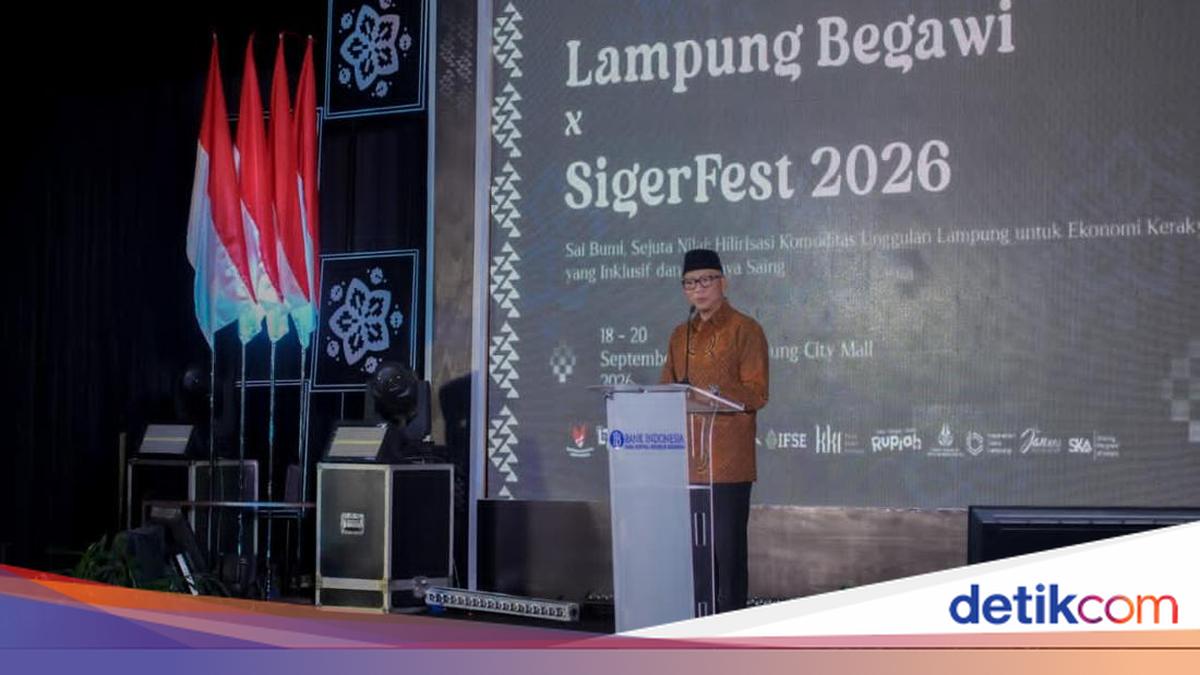
The Governor of Lampung, Rahmat Mirzani Djaument Djausal (Mirza), attended the opening of Lampung Begawi x Siger Fest 2026, an initiative by the Bank Indonesia Representative Office for Lampung Province, held at Lampung City Mall. Mirza expressed his appreciation for the strategic collaboration with Bank Indonesia (BI), which successfully integrates ideas, innovation, investment, and cross-sectoral collaboration.
“The idea behind Siger Fest is to bring together ideas, innovation, investment, and collaboration. This is extremely important for us,” Mirza stated in a written statement on Saturday (19/09/2026).
“We are aware that we have a target to grow by 8% in the future to achieve Indonesia Emas 2045,” he added.
Mirza presented Lampung’s comparative profile as a strategic food granary for Indonesia. Lampung’s paddy production has reached 3.5 million tonnes, with half distributed to supply food needs across various provinces.
In addition to a corn surplus that supports the poultry and egg industries in Jakarta and Java, Lampung supplies 7lar 70% of the national tapioca supply, placing Indonesia second globally. The province also exports 60% of the national coffee supply, is the largest pepper producer, and is the second-largest sugar producer.
However, Mirza revealed that for decades, this abundance of agricultural wealth has not been optimally felt by farmers due to the volatility of raw commodity prices.
A fundamental turning point occurred through commodity protection interventions during the era of President Prabowo Subianto, which successfully boosted farmer incomes and accelerated regional economic growth.
“For 15 years, Lampung’s economic growth was always below the national average. In 2026, we ranked second highest in Sumatra, following Riau, due to commodity prices,” said Mirza.
Rural economic vitality is also reflected in banking liquidity, with Third-Party Funds (DPK) growing by nearly 7% year-on-year. Looking ahead, Mirza emphasised that sustainable economic expansion cannot rely solely on trade policy interventions.
Industrial downstreaming, which currently only covers 30% of total local commodities, has been set as a top regional priority in line with the mandate of the National Medium-Term Development Plan (RPJMN).
“Today we are growing because of the President’s policies, which have forced prices up. But moving forward, to achieve 8%, we cannot rely on regulation alone,” said Mirza.
“There must be collaboration, creativity, innovation, and most importantly, in accordance with our RPJMN, we must implement downstreaming. We see that only 30% of our commodities in Lampung have been downstreamed,” he continued.
The downstreaming strategy is designed to be adaptive through two approaches: rural-scale downstreaming (local poultry feed industries, post-harvest handling of coffee and cocoa) and advanced downstreaming within manufacturing industrial zones.
This drive for added value runs alongside a surge in agricultural technology adoption following increased yields, where spending on agricultural machinery (alsintan) in Lampung rose by nearly 200% and the logistics truck fleet increased by 50%.
Potential for acceleration is further supported by the diversification of the renewable energy sector and a leap in the tourism sector, which recorded a surge in domestic tourists of up to 60% (from 17 million travellers in 2024 to 27 million visits in 2025). This is bolstered by a superior demographic ratio, where 71% of Lampung’s population belongs to the productive workforce.
Concluding his speech, Mirza invited central monetary authorities and the banking sector to oversee deregulation to resolve potential bottlenecks in investment licensing.
“I am certain that one of the foundations of Indonesia’s progress has only one requirement: when the regions become strong. The main foundation for future economic growth is when regional growth is strong,” he asserted.
“When Lampung grows, Lampung advances, the community’s economy prospers, our President’s ambitions will be achieved, and Indonesia will be far more prosperous in the future,” he added.
Meanwhile, the Deputy Governor of Bank Indonesia, Thomas AM Djiwandono, appreciated the solid economic growth achievement of Lampung Province, which reached 5.29% in the second quarter of 2026. This achievement placed Lampung as the province with the second-highest economic growth on Sumatra Island.
Thomas explained that the economic growth rate, supported by the processing industry, trade, and agriculture sectors, is the result of the hard work of regional leaders and all stakeholders.
Nevertheless, he warned that the main challenge ahead is how this growth can provide real added value for community welfare through downstreaming and the influx of investment.
“The challenge is not just how the economy grows, but how that growth generates increasingly wider added value for the community. Therefore, as the Governor stated, downstreaming and investment are incredibly important,” said Thomas.
Thomas explained that in line with the mandate of the Law on the Development and Strengthening of the Financial Sector (UU P2SK), BI is now not only focused on monetary stability and inflation but is also actively encouraging the growth of the real economic sector.
At the central level, synergy is being built in an integrated manner with the Ministry of Finance, the Financial Services Authority (OJK), and the Indonesia Investment Authority (BPI Danantara), which serves as an investment catalyst. BI is also prepared to mobilise its regional offices and overseas representatives to attract investor interest to Lampung’s various flagship potentials.
Regarding the empowerment of the grassroots economy, Thomas outlined three strategic approaches by BI to support Micro, Small, and Medium Enterprises (MSMEs): strengthening business partnerships, increasing managerial capacity and product quality, and expanding access to financing. Lampung’s flagship commodities, such as processed bananas, coffee, and traditional textiles (wastra), continue to be promoted to penetrate global supply chains.