
Boosting Cocoa Downstreaming, Government Revitalises Farmers' Plantations
The Indonesian government is currently pushing a cocoa downstreaming programme to boost value-added production. As one of the strategic commodities relied upon for exports, the government is also revitalising smallholder cocoa plantations through crop replanting.
As a global cocoa producer, Indonesia’s position has dropped drastically from 3rd in the world to 7th, with production currently at 200,000 tonnes. This decline is caused by many plants experiencing decreased productivity due to old age. Domestic cocoa productivity averages only 700-800 kg/ha, whereas in other countries, it can reach much higher levels.
The Director of Plantation Seedlings at the Ministry of Agriculture, Ebi Rulianti, stated that the government has established a cocoa downstreaming programme for the 2025-2027 period. The programme targets 247,260 hectares of farmers’ cocoa land to ensure the supply of raw materials for downstream industries. There are two main programmes: the rejuvenation of smallholder cocoa and the expansion of cocoa land.
In 2025, as the initiation phase, the expansion of cocoa plantation areas by approximately 200 ha and rejuvenation of 4,066 ha has been implemented. 2026 will serve as the massive acceleration phase, with the government targeting an expansion of around 71,722 ha and rejuvenation of 102,488 ha. Meanwhile, 2027 will be the stabilisation phase with a target of 59,974 ha, consisting of 19,700 ha of expansion and 40,274 ha of rejuvenation.
“Within this downstreaming programme, the government is providing assistance of 1,000 seedlings per hectare as well as labour wage assistance,” he said, as quoted from a press release received on Thursday (10/9).
In an effort to accelerate the downstreaming programme, Ebi noted that the government is currently revising the Minister of Agriculture’s Decree No. 2-25/Kpts/Kb.020/5/2017 regarding Guidelines for the Production, Certification, Distribution, and Supervision of Cocoa Plant Seeds.
The government, he continued, has also designated production plantations to serve as rootstock plantations and producers of scions. Furthermore, there is an effort to reactivate Seed Source Plantations (KSB) that have been inactive.
“We are also encouraging stakeholders to apply for the designation of KSB and production plantations, and to accelerate the issuance of Decrees,” he explained.
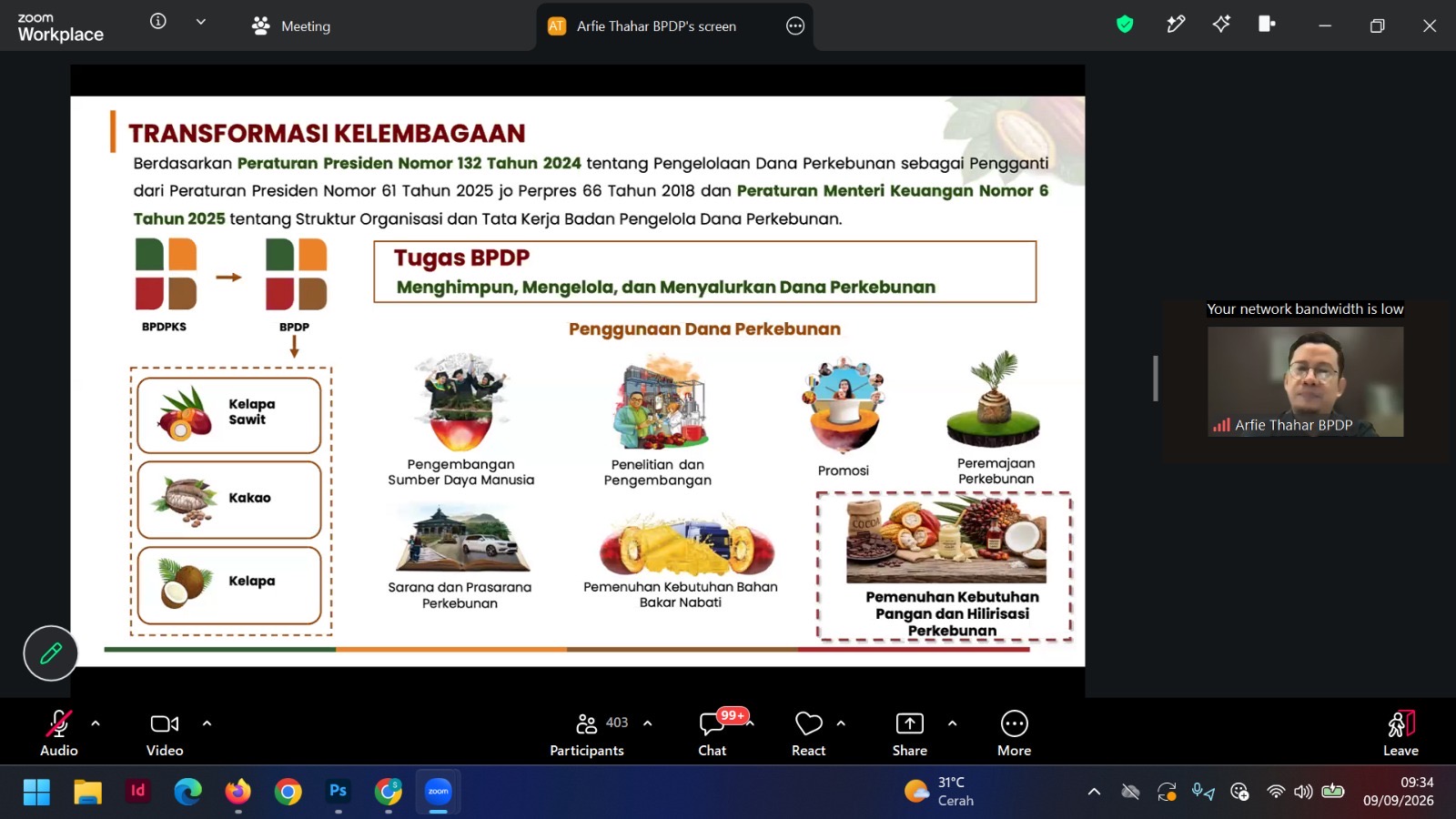
Meanwhile, the Acting Head of the Fund Management Agency for Plantation Products (BPDP) for Food and Downstreaming Fund Distribution Division, Arfie Thahar, stated that there are two BPDP programmes supporting the cocoa plantation downstreaming programme. In the upstream sector, BPDP is working with the Ministry of Agriculture and following up on technical recommendations from the Director General of Plantations.
“We are providing a budget for plantation rejuvenation programmes, the provision of infrastructure, and the development of plantation human resources, through both education and training,” he said.
Regarding the downstream sector and strengthening market access, Arfie revealed that BPDP accepts proposals directly from business actors. This includes activities for plantation research to produce product and technology innovations ready for the commercial stage, as well as policy recommendations.
“We are ready to provide funding support to increase the added value of cocoa products and their derivatives,” he explained.
For the food and downstreaming programme, BPDP opens opportunities through a selection process. This pathway is conducted at specified times through official announcements via a ‘Call For Proposal’ for Downstreaming Programmes. Proposals can be submitted by business entities, including cooperatives and MSMEs, professional associations in the plantation sector, and research institutions or universities.
Another pathway is through competitions, aimed at smaller-scale downstreaming programmes for the general public. Funding for these programmes will be awarded to competition winners following an assessment by a team.
Meanwhile, the Chairperson of the Indonesian Cocoa Association - Cacao Sustainability Partnership (Askindo CSP), Jefrey Haribow, emphasised that his organisation fully supports the government’s downstreaming efforts, particularly the efforts to improve the upstream sector, namely smallholder cocoa plantations.
In fact, Askindo has been integrated with CSP since 14 August 2026 to strengthen support for Indonesian cocoa from upstream to downstream, especially as Indonesia’s position as a global cocoa producer continues to decline.
In 2010, Indonesia ranked 3rd as a global cocoa producer. However, by 2025, it only holds 7th place, with Indonesian cocoa bean production reaching 200,000 tonnes in the 2024/2025 season. This occurs despite a 2-3% annual increase in global demand for cocoa and chocolate.
Although there are approximately 1.4 million hectares of cocoa land in Indonesia, according to Jefrey, this area continues to decrease. This condition impacts the domestic cocoa industry. Out of 11 cocoa processing industries with a capacity of 700,000 tonnes, utilisation is only at 51 percent.
Therefore, Jefrey emphasised that Askindo CSP strongly supports the acceleration of high-quality seed availability to improve cocoa plantations, 99 per cent of which are owned by farmers.
“We also hope the government strengthens the quality and quantity of extension workers and facilitators focusing on cocoa,” he added.
Given the challenges currently faced by farmers, the Chairperson of the Indonesian Cocoa Farmers Association (APKI), Arif Zamroni, hopes that the government will strengthen assistance to cocoa farmers, empower production quality and human resources, and provide policy advocacy that favours farmers.
“Government support should not only be in the plantations, but from the plantation to policy. For this, cross-sectoral synergy and collaboration are essential,” he concluded.