
Boost Training for Sports Qualifying for the 2026 Asian Games
The allocation scheme for the 202<0xC2>5 National Training Centre (Pelatnas) funds is currently a subject of intense debate. The football sector continues to dominate the budget, while several sports disciplines that serve as Indonesia’s primary sources of gold medals are forced to operate with very limited funds.
Based on recent data, the total allocation for the 2025 Pelatnas reaches Rp407.72 billion. From this amount, the Football Association of Indonesia (PSSI) has been allocated Rp199.78 billion. This figure represents 49% of the total national budget for athlete development, meaning almost half of the state funds are absorbed by a single sport.
This inequality is stark when compared to the budgets received by the five sports disciplines that contribute the most gold medals in international multi-sport events. Despite regularly bringing honour to the nation, the allocations they receive are well below Rp40 billion. Conversely, while the Indonesian National Football Team has failed to qualify for the 2026 Asian Games—an event that should serve as a benchmark for development success—sports such as archery, which contributed 6 golds at the 2025 SEA Games, and athletics, with 9 golds, are forced to work with minimalist budgets.
Hamdi Putra from the Civil Voice Forum (FORSIBER) emphasised the need for a total evaluation of budget rationality within the Ministry of Youth and Sports (Kemenpora). According to him, the national sports budget should not merely serve as a ‘popularity subsidy’ for certain disciplines.
“Disciplines that produce gold are instead treated as mere supplements. Evaluation does not mean opposing football, but the current scheme risks being unfair and inefficient,” Hamdi stated in Jakarta on Friday (12/6). FORSIBER is urging the implementation of four new indicators in budget preparation: medal track record, future medal potential, technical requirements, and accountability.
Amidst the controversy surrounding the PSSI budget, preparations for the 2026 Asian Games are generally facing financial constraints. Minister of Youth and Sports Erick Thohir noted that the Pelatnas funds for the event are only available at Rp81 billion, a sharp decline compared to the 2022 edition, which reached Rp389.81 billion.
Erick Thohir mentioned that the budget currently available in his ministry to support the Indonesian contingent to the 2026 Asian Games stands at Rp61 billion.
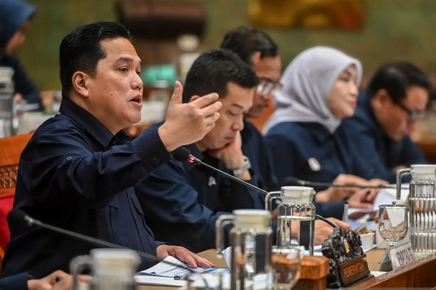
“With the sincere cooperation of all deputies present, I appreciate that we have continued to scan the budget until we finally secured Rp61 billion,” said Erick Thohir during a working meeting with Commission X of the Indonesian House of Representatives (DPR RI) in Jakarta on Tuesday (2/6/2026).
Erick admitted that the budget requirements for the national training centres of various sports disciplines are still not ideal. Currently, the funds available to support athlete training programmes ahead of the Asian Games are only around Rp81 billion. “This is a significant decrease,” he said.
The General Chair of the Indonesian Wushu Association (PBWI), Airlangga Hartarto, is targeting gold medals for the 2026 Nagoya Asian Games and focusing on athlete regeneration towards the Olympics.
Former wushu queen Lindswell Kwok has officially been appointed to coach the national wushu team for the taichi category for the 2026 Asian Games, emphasising the importance of mental toughness and communication.
Airlangga Hartarto was officially inaugurated as the General Chair of the Indonesian Wushu Association (PB WI) for the 2026-2030 term and immediately directed the focus towards development.
The Indonesian Volleyball Federation (PBVSI) has submitted a long list of players for the 2026 Asian Games, but confirmation of their departure awaits direction from the Indonesian National Olympic Committee (NOC) regarding the budget.
He acknowledged that winning many gold medals at Asia’s largest multi-sport event is no easy feat.