
Book Launch of 'Militer Pemikir, Pemikir Militer' Revives Discussion on TNI Reform
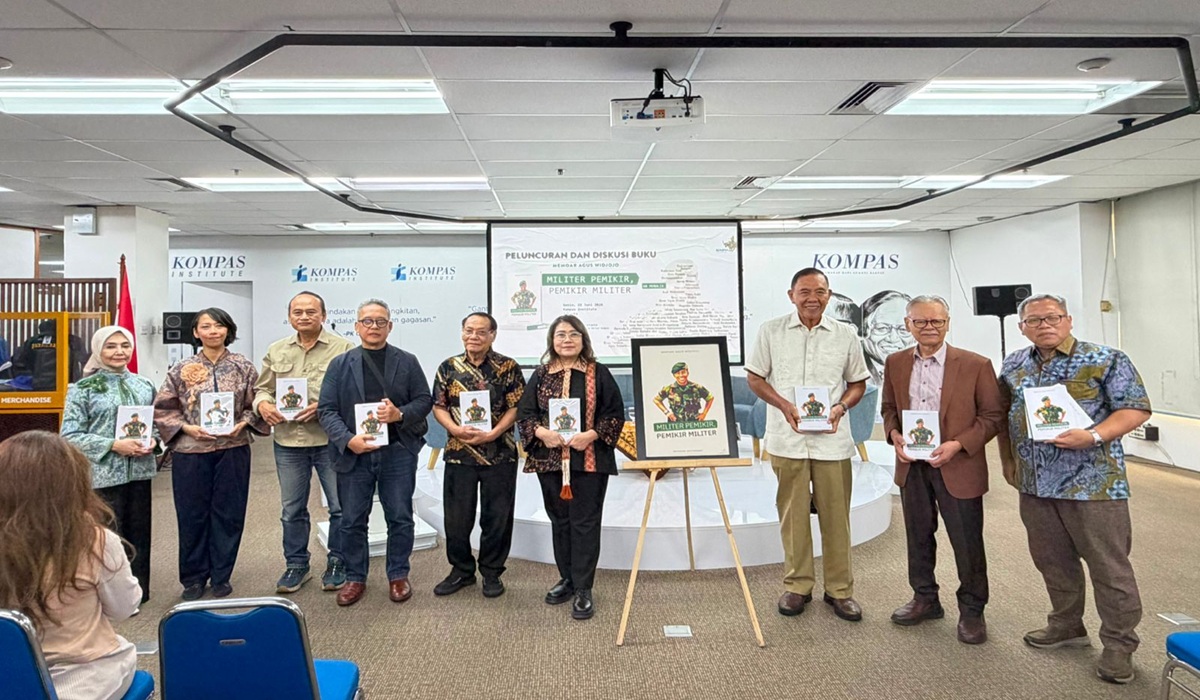
An important record regarding the journey of military reform in Indonesia has been officially immortalised in a book titled ‘Militer Pemikir, Pemikir Militer’ (Military Thinker, Military Thinker). The book, which documents the life and thoughts of retired Lieutenant General Agus Widjojo, was launched in Jakarta on Monday (22/06/2026).
The launch event served as a gathering for various national figures, academics, and retired TNI officers. They attended not merely to celebrate the publication of a work, but to re-examine Agus Widjojo’s strategic contributions to organising civil-military relations in the country following the 1998 era.
Agus Widjojo is known as one of the primary architects behind the internal reform of the TNI. The book compiles various perspectives on Agus’s consistency in fighting for military professionalism based on democratic and constitutional values.
The former head of the KPK, Erry Riyana Hardjapame lauded Agus, emphasising that for him, the military’s subordination to civilian authority was not a form of defeat. “True professionalism only grows when the military stands in its constitutional position. For him, that is not a defeat, but maturity,” Erry stated.
Agus’s ideas encompass fundamental steps that have now become pillars of Indonesian democracy. However, the first year of President Prabowo Subianto and Vice President Gibran Rakabuming Raka’s administration shows defence policy directions that require serious attention. Issues such as active-duty soldiers in non-defence institutions, the extension of retirement ages for high-ranking officers, and the formation of six new Regional Military Commands (Kodam) indicate a potential regression in the military reform agenda. Furthermore, the discreet revision of Law No. 34 of 2004 concerning the Indonesian National Armed Forces (UU TNI) is seen as contrary to the TNI reform agenda.
Beyond democratic aspects, the book also highlights Agus Widjojo’s courage in critiquing the internal military structure. Marcus Mietzner, an academic from the Australian National University, described Agus as a visionary officer who dared to question the relevance of the territorial command system in the modern era. “Mr Agus believed that while that structure may have been necessary in the past, it can no longer be considered functional in the 21st century,” said Marcus. He added that Agus’s thoughts are highly relevant for evaluating evolving defence policies.
A strong message also came from the former Commander of the TNI, General (Ret.) Endriartono Sutarto. He remembered Agus Widjojo as a figure who strictly maintained the independence of the military institution to prevent it from being dragged into the vortex of practical politics. Endriartono quoted an important message from Agus: “Never, no matter who they are… let a president arbitrarily dismantle the TNI merely for their own interest in gaining and maintaining power.”
The launch of ‘Militer Pemikir, Pemikir Militer’ is expected to serve as a primary reference for the younger generation, academics, and policymakers in understanding the long history of defence reform in Indonesia and the importance of maintaining civilian supremacy for a stronger democratic future.